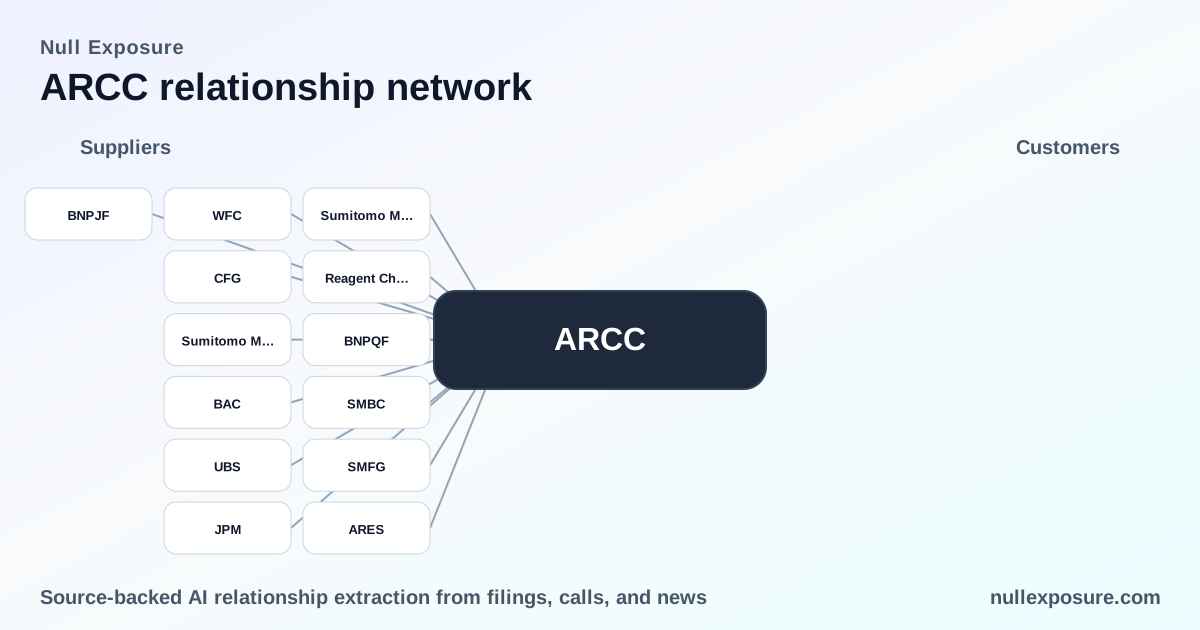
Ares Capital (ARCC) — who its customers are, how the exposures behave, and what investors should watch
Ares Capital Corporation (ARCC) operates as a publicly traded business development company that underwrites and holds customized debt and equity positions in middle‑market companies, generating income through interest, fees and selective equity upside while managing mark‑to‑market risk across its portfolio. The firm leverages Ares Management’s platform to originate first‑lien and mezzanine loans, syndicate credit, and rotate assets through structured vehicles, monetizing both recurring yield and capital appreciation from realized exits.
Discover the broader relationship coverage and analytics at https://nullexposure.com/.
What the customer map tells us about ARCC’s business model
ARCC’s customer relationships reflect a capital‑provider posture to North American middle‑market companies, with long weighted average contract terms and active rotation of assets into structured vehicles. Company disclosures show a weighted average term for new investment commitments of roughly 71 months, indicating long‑duration underwriting commitments that translate into steady interest income but also longer revaluation horizons. ARCC’s portfolio construction signals a deliberate tilt toward the U.S. mid‑market, with origination and servicing practices structured to support loan longevity rather than short‑term turnover.
Constraints and segment signals at the company level reinforce that ARCC:
- Targets mid‑market borrowers (first‑lien senior secured loans predominant), concentrating origination activity in North America per SDLP and related disclosures.
- Operates with long‑term contractual exposure, which raises reinvestment and liquidity considerations but supports predictable cash flows.
- Maintains meaningful sector exposure to software and services (~23.8% noted) alongside manufacturing, hardware, distribution and other service verticals, creating sector concentration risk balanced by cross‑industry diversification.
These characteristics drive ARCC’s operating model: a commitment to durable credit relationships, a reliance on asset rotation (sales to affiliated CLOs and other buyers), and active valuation management across cyclical performance. For full platform context and relationship mapping, visit https://nullexposure.com/.
Relationship rundown — what every named counterparty contributes to the picture
Below I cover every identified customer relationship from available reporting, with a concise, source‑linked takeaway for each.
-
Ivy Hill
ARCC recorded repayments excluding sales to Ivy Hill and referenced portfolio sales connected to that counterparty, indicating Ivy Hill functions as a buyer of loan assets in ARCC’s portfolio rotation strategy. (Source: Q1 2026 earnings call transcript reported by InsiderMonkey, FY2026 — https://www.insidermonkey.com/blog/ares-capital-corporation-nasdaqarcc-q1-2026-earnings-call-transcript-1749860/) -
SLQT (SelectQuote)
ARCC appears as a syndicated lender on a senior secured credit facility for SelectQuote alongside UMB Bank and others, confirming ARCC’s role in direct lending and participation in bilateral and syndicated credit deals. (Source: TradingView news item, March 10, 2026 — https://www.tradingview.com/news/tradingview:592fdaba11de0:0-selectquote-signs-senior-secured-credit-facility-with-plc-agent-and-umb-bank/) -
CoreLogic Inc. (CLGX)
ARCC took markdowns on exposures to CoreLogic as part of broader software sector revaluations, reflecting valuation pressure on specific software and data providers within its credit book. (Source: WHTC coverage, April 28, 2026 — https://whtc.com/2026/04/28/ares-capital-corps-software-valuations-steady-despite-concerns/) -
Cornerstone OnDemand (CSOD)
ARCC’s combined debt and equity exposure to Cornerstone and Sunshine Software was marked at $261.9 million as of March 31, 2026—approximately 26% below cost, with the largest discount on a $137.5 million second‑lien loan marked at $103.1 million, highlighting concentrated downside in select software credits. (Source: WHTC, April 28, 2026 — https://whtc.com/2026/04/28/ares-capital-corps-software-valuations-steady-despite-concerns/) -
Sunshine Software Holdings
Sunshine is grouped with Cornerstone in ARCC’s disclosure and subject to the same mark‑down treatment; ARCC holds both debt and equity interests that have been materially revalued in Q1 2026 reporting. (Source: WHTC, April 28, 2026 — https://whtc.com/2026/04/28/ares-capital-corps-software-valuations-steady-despite-concerns/) -
FEH Group LLC
ARCC recorded mark‑ups on exposures to FEH Group, indicating select credits within healthcare and services are outperforming underwriting expectations, which can offset software‑sector markdowns in net portfolio valuation. (Source: WHTC, April 28, 2026 — https://whtc.com/2026/04/28/ares-capital-corps-software-valuations-steady-despite-concerns/) -
Global Medical Response Inc
Exposures to Global Medical Response were marked up alongside FEH Group, signaling positive revaluations in emergency services/healthcare exposures within ARCC’s loan book. (Source: WHTC, April 28, 2026 — https://whtc.com/2026/04/28/ares-capital-corps-software-valuations-steady-despite-concerns/) -
Symplr Software Inc
Symplr is cited among software names that were marked down, reinforcing sector concentration and sensitivity to software valuations for the portfolio. (Source: WHTC, April 28, 2026 — https://whtc.com/2026/04/28/ares-capital-corps-software-valuations-steady-despite-concerns/) -
DigiCert Inc.
DigiCert is also listed among the markdowns, further illustrating distributed valuation risk across software and services vendors within ARCC’s holdings. (Source: WHTC, April 28, 2026 — https://whtc.com/2026/04/28/ares-capital-corps-software-valuations-steady-despite-concerns/)
How to read these relationships as an investor
- Concentration and cyclicality: The sizeable software weighting (reported at ~23.8%) creates a clear performance lever—software markdowns materially depress NAV but positive revaluations in healthcare and services can offset some volatility.
- Liquidity management through asset sales: Recurrent references to sales and repayments (including sales to entities such as Ivy Hill and structured CLO transfers) demonstrate ARCC’s active use of asset rotation to manage liquidity and capital deployment.
- Long‑term underwriting stance: A weighted average commitment term near 71 months means earnings are supported by longer cash flows but value recognition is slower, increasing exposure to multi‑year credit cycles.
Bottom line for operators and researchers
ARCC is a yield‑driven, long‑duration lender that actively manages credit exposures via sales and structured vehicles; software sector volatility will be the near‑term NAV swing factor while healthcare and services credits provide offsetting upside. For a complete relationship map and ongoing updates, go to https://nullexposure.com/.
If you want a focused relationship brief or rolling updates on ARCC counterparties, visit our homepage for subscription options: https://nullexposure.com/.