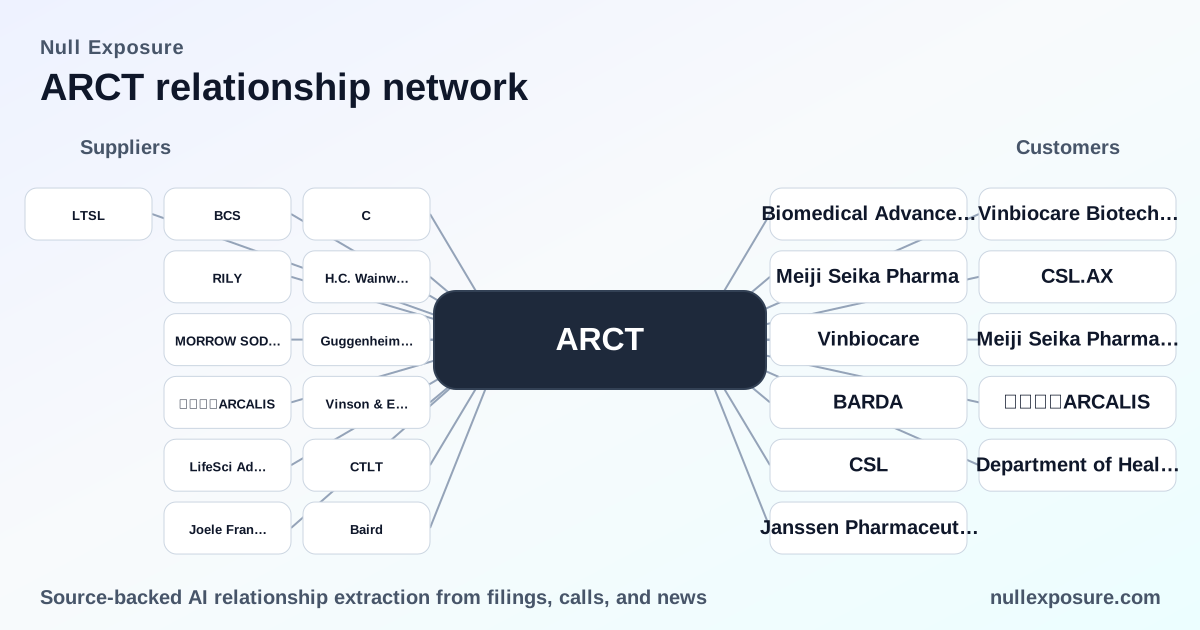
Arcturus Therapeutics (ARCT): Customer Relationships Drive Revenue Concentration and Strategic Optionality
Arcturus operates a platform-first RNA therapeutics business that monetizes primarily via exclusive licensing agreements, large collaboration deals and government cost-reimbursement contracts. Revenue is concentrated in a single partnership that licenses Arcturus’ STARR® self‑amplifying mRNA platform and LUNAR® lipid delivery, supplemented by government R&D awards and regional manufacturing/distribution alliances that convert platform IP into local product sales and royalties. For investors, the key structural point is high customer concentration coupled with diversified commercial routes (license, supply, government funding, and local licensees/distributors) — a mix that drives outsized near‑term cashflow volatility but preserves optionality if partners execute commercialization.
For a concise overview of the data behind this analysis, visit https://nullexposure.com/.
How Arcturus makes money: licensing, supply and government contracts
Arcturus grants partners exclusive global licenses to its mRNA technologies while continuing to supply mRNA drug substance, share manufacturing know‑how, and recognize revenue across multiple performance obligations. The company also secures government cost‑reimbursement awards to fund platform development and early trials, and it signs regional manufacturing or distribution license agreements that produce royalties or local sales. The interplay of these revenue streams explains why Arcturus’ reported revenue is highly lumpy and partner‑dependent.
Key operating model signals
- Contracting posture: licensing-led. The company recognizes a discrete vaccine license at a point in time and recognizes other collaboration obligations over time under multi‑obligation agreements. This is consistent with Arcturus’ commercial model of licensing core platform IP while retaining services/supply revenue streams.
- Concentration: critical single partner exposure. One partner accounts for the overwhelming share of revenue historically, producing material revenue dependency.
- Counterparty mix includes government funding. Cost‑reimbursement contracts from US federal agencies fund platform development and de‑risk R&D spend.
- Geographic commercial footprint: APAC and EMEA expansion priority with global licenses embedded in partner contracts.
- Maturity: transitioning from development to commercialization. Sales started in Japan in October 2024, signaling active commercial stage for at least one product line.
Explore full relationship detail and provenance at https://nullexposure.com/.
Customer relationships — line‑by‑line read for investors
Below are plain‑English summaries of every customer relationship captured in the source results, with the primary documentary source cited for each.
-
CSL / CSL Seqirus / CSL.AX
Arcturus’ collaboration with CSL Seqirus is the company’s dominant commercial relationship and includes an exclusive global license to Arcturus’ mRNA platform alongside supply and process transfer obligations; CSL accounted for 91% of total revenue in FY2024 and remains central to R&D and early commercialization. This relationship was described in Arcturus’ FY2024 Form 10‑K and reinforced in company press releases and earnings commentary in 2025. (See Arcturus 2024 Form 10‑K; Q2 2025 earnings call; FY2025 press release.) -
Biomedical Advanced Research and Development Authority (BARDA) / HHS ASPR
BARDA funds a pandemic avian influenza self‑amplifying mRNA vaccine program under a cost‑reimbursement contract worth up to $63.2 million, and BARDA represented a large portion of accounts receivable at year‑end. The BARDA award is a federal cost‑reimbursement contract supporting Phase 1 development beginning in December 2024. (See Arcturus 2024 Form 10‑K; globalbiodefense reporting FY2022.) -
Vinbiocare / VinBioCare / Vinbiocare Biotechnology Joint Stock Company
Arcturus licensed mRNA drug substance manufacturing and granted exclusive local manufacturing rights for Vietnam to Vinbiocare, with the partner paying for drug substance and owing royalties on vaccines produced at the local facility; the arrangement is framed as an exclusive regional manufacturing license. (See BiospectrumAsia and Techsauce reports, FY2021 announcements.) -
Meiji Seika Pharma / Meiji Seika Pharma Co., Ltd.
Meiji Seika Pharma is CSL’s exclusive distributor in Japan and has filed NDAs with the PMDA for Arcturus/CSL’s lyophilized two‑dose vaccine presentation and seasonal variant updates; commercial distribution in Japan began in October 2024. (See Q2 2025 earnings commentary and PR Newswire press release FY2024–FY2025.) -
Janssen Pharmaceuticals, Inc. (Johnson & Johnson)
Arcturus entered a research collaboration and worldwide license agreement with Janssen to discover and develop RNA medicines, reflecting historical business development activity to extend the platform across therapeutic areas. (See company press release announcing the strategic collaboration, FY2017.) -
株式会社ARCALIS (Arcalis)
Arcalis licensed Arcturus’ mRNA manufacturing technology to stand up a Japan‑based CDMO focused on mRNA drug substance and product manufacturing for Arcturus’ research and commercial pipeline, with a target to begin cGMP manufacturing supply. (See JETRO reporting FY2022.) -
Department of Health and Human Services, Office of the Assistant Secretary for Preparedness and Response (ASPR)
Federal funding for the BARDA contract is provided under an HHS ASPR vehicle; the project is explicitly supported with federal funds under the BARDA contract number, anchoring the government funding pathway. (See globalbiodefense coverage of FY2022 contract award.)
What the relationships imply for risk and upside
- Concentration risk is acute and material. CSL accounted for 91% of FY2024 revenue; that dependency creates revenue volatility as CSL transitions assets (for example, KOSTAIVE) from development to commercialization and supply cadence changes. Arcturus’ filings and earnings commentary both document this concentration and related arbitration/write‑down events tied to the CSL relationship. (Source: FY2024 Form 10‑K; Q4 2025 earnings summaries.)
- Government partnerships improve funding visibility for platform R&D. BARDA’s cost‑reimbursement award reduces net R&D cash burden and anchors the pandemic influenza program, representing a significant accounts receivable concentration in year‑end reporting. (Source: FY2024 Form 10‑K; BARDA award announcements.)
- Regional licensees and CDMOs convert IP into localized commercial pathways. Agreements in Japan and Vietnam (Meiji Seika, Vinbiocare, Arcalis) create non‑dilutive revenue through royalties and local sales while also diversifying commercial channels across APAC and EMEA. (See press releases and news coverage 2021–2025.)
- Contract structure is license‑centric with multiple performance obligations. The CSL collaboration explicitly separates a point‑in‑time vaccine license from time‑based services and supply obligations, which drives how revenue is recognized and amplifies the sensitivity of reported revenue to milestone timing. (See FY2024 Form 10‑K disclosures on the CSL Collaboration Agreement.)
Bottom line for investors
- Arcturus is a platform company monetizing through a small number of large, structured partnerships: licensing to global partners, government cost‑reimbursement, and regional manufacturing/distribution licensees. That structure delivers both concentrated near‑term revenue and long‑term optionality if commercialization scales across partner channels.
- Primary risks are partner concentration and commercial execution by licensees/partners; primary mitigants are government funding and geographically diversified license agreements that produce royalties and local sales.
For ongoing tracking of Arcturus’ partner exposure and relationship evidence, visit https://nullexposure.com/ — the relationship map and source references are maintained there for investor due diligence.
Bold takeaway: CSL is the single largest revenue driver; BARDA provides strategic R&D funding; regional licensees (Meiji, Vinbiocare, Arcalis) convert IP into local commercial routes.