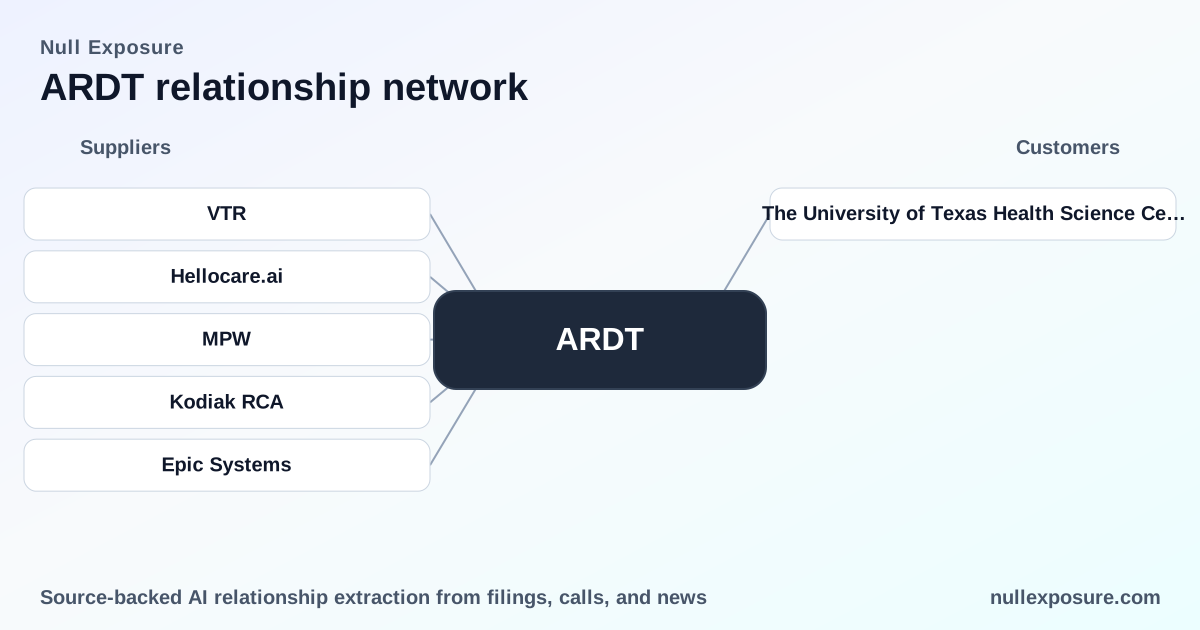
Ardent Health Partners (ARDT) — Customer Relationships and What They Mean for Investors
Ardent Health Partners operates and monetizes an integrated healthcare services business by managing and operating acute-care hospitals, outpatient facilities, and physician practices, generating revenue primarily from patient care reimbursements, managed-care contracts, and management fees where Ardent operates clinical services on behalf of third parties. The company’s value rests on scale in regional markets, fee-for-service and managed-care reimbursement mix, and the ability to win and retain clinical management contracts that convert local assets into recurring service revenue. For a deeper look at relationship-level exposures tied to Ardent’s customer posture, visit the Null Exposure landing page for ARDT: https://nullexposure.com/.
Quick investor thesis: what to watch
Ardent is a services-centric healthcare operator with meaningful exposure to government payors and geographic concentration in Texas and Oklahoma. Key drivers for investors are reimbursement mix, local contracting posture for managed operations, and the concentration of revenue by state; management contracts like the one with UT Health North Campus Tyler convert operational expertise into revenue without balance-sheet consolidation. If you focus on downside protection, monitor Medicare/Medicaid mix and single-market exposures that can swing volume and margins.
The single reported customer relationship: UT Health North Campus Tyler
Ardent reported that it manages the clinical operations of UT Health North Campus Tyler, a hospital owned by The University of Texas Health Science Center at Tyler (UTHSCT). Because Ardent only manages clinical operations, the hospital’s financial results are not consolidated into Ardent’s financial statements, reflecting a service-provider contract rather than ownership. This disclosure is documented in an 8‑K filing reported via StockTitan (referenced March 9, 2026): https://www.stocktitan.net/sec-filings/ARDT/8-k-ardent-health-inc-reports-material-event-62f3c22ccffd.html.
- Ardent’s role is operational: it provides managed clinical operations at UT Health North Campus Tyler rather than holding an ownership stake, and the related hospital results are not consolidated under Ardent’s financials (8‑K, FY2026). https://www.stocktitan.net/sec-filings/ARDT/8-k-ardent-health-inc-reports-material-event-62f3c22ccffd.html
Why this kind of relationship matters to valuation
Management contracts such as the UT Health North Campus Tyler engagement are strategically valuable but structurally distinct from owned hospitals. They deliver recurring, service-style cash flows with lower capital intensity and reduced balance-sheet leverage for Ardent, while producing limited equity upside from asset appreciation. For investors, these contracts enhance revenue diversification and margin scalability but do not directly expand consolidated asset base or debt capacity.
For a practical view of portfolio-level exposures and relationship mechanics, see our platform: https://nullexposure.com/.
Company-level operating model signals investors should price in
The relationship data plus company disclosures produce a clear set of operating-model constraints and implications:
-
Contracting posture — service provider orientation. Ardent repeatedly frames itself as a provider of healthcare services and clinical management across its network of hospitals and sites of care. The company manages clinical operations for third-party-owned facilities, indicating a recurring-services contracting posture rather than an acquirer-of-assets model. This reduces capital deployment per new market entry but shifts the risk profile toward contract renewal and operational performance.
-
Counterparty mix — government and individuals drive cash flows. For 2024, approximately 39.2% of revenue was tied to Medicare and ~10.3% to state Medicaid programs, signaling high exposure to public payor reimbursement policies and rate-setting. Simultaneously, Ardent treats large volumes of individual patients—serving about 1.2 million unique patients and ~5.8 million visits in 2024—creating exposure to collection risk from uninsured or underinsured patients. Both the public payor concentration and material self-pay component are structural levers for margins.
-
Geographic concentration — regional risk is real. Ardent’s facilities are heavily concentrated in Texas and Oklahoma, with those two states representing 60.3% of consolidated net revenue in 2024. All long-lived assets and revenue are U.S.-based across several mid-sized urban markets, concentrating regulatory, competitive and reimbursement risk regionally.
-
Role and criticality — healthcare services where IT and operations matter. The company emphasizes information technology and integrated sites of care as critical components of operations and revenue delivery. That elevates operational continuity and contract performance as determinants of revenue stability.
-
Materiality signals — most discrete items are non-material to consolidated results. The company has stated that some settlements and adjustments will not have a material impact on consolidated results, which indicates a disciplined materiality threshold in public disclosures and suggests most third-party operational arrangements are structured to avoid balance-sheet surprises.
-
Business maturity and segmentation — single reportable segment focused on services. Ardent reports one segment: healthcare services. The business is mature in its approach to scaling via managed operations, hospital ownership and affiliated providers, and the company is positioned to monetize operational scale through reimbursement optimization and managed-care contracting.
Risk and upside considerations tied to customer relationships
-
Risk — reimbursement sensitivity. With nearly half of revenue tied to private payors and almost 40% from Medicare, changes in federal or state reimbursement rates materially affect margins. The managed operations model reduces capital intensity but does not insulate top-line from payor rate changes.
-
Risk — geographic concentration. A regulatory change, a regional downturn, or an adverse competitive development in Texas and Oklahoma would disproportionately affect Ardent given the 60.3% revenue concentration.
-
Upside — scalable service revenue. Managed clinical operations agreements like the UT Health North Campus Tyler engagement provide higher-margin, lower-capex expansion alternatives relative to hospital acquisitions; they can be accretive to operating margins if Ardent converts operational improvements into reimbursement efficiency.
-
Operational gating items. Contract renewals, IT continuity, and patient-collection performance are operational levers that directly influence cash conversion from managed relationships.
Bottom line for investors
Ardent’s customer relationships are predominantly service contracts that convert operational expertise into recurring revenue without consolidating third-party assets. The UT Health North Campus Tyler arrangement is a prototypical example: operational control with no balance-sheet consolidation. Investors should value Ardent as an operator whose cash flow stability depends on reimbursement environments, regional concentration, and contract renewal dynamics rather than asset-led appreciation alone.
For a concise, relationship-level breakdown and to monitor updates, visit Null Exposure’s ARDT page: https://nullexposure.com/.
Key takeaways:
- Service-provider model reduces capital intensity but raises contract-renewal and performance risk.
- High public payor exposure (Medicare/Medicaid) and Texas/Oklahoma concentration are primary tail risks.
- Managed operations like UT Health North Campus Tyler expand recurring service revenue while leaving consolidated assets unchanged.