Ardelyx (ARDX) — who pays the bills and why investors should care
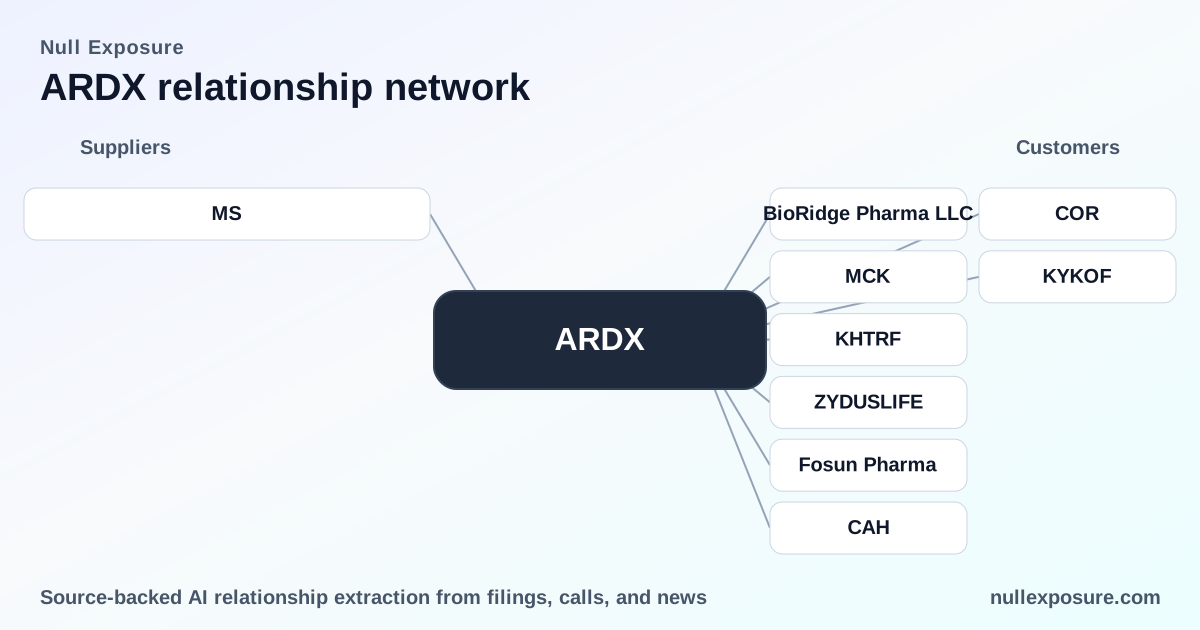
Ardelyx is a commercial-stage biopharma that monetizes tenapanor through U.S. product sales and international licensing, selling primarily to wholesalers, GPOs and specialty pharmacies while collecting royalties and milestone income from regional partners. The company’s revenue mix is driven by two core products — IBSRELA® for IBS‑C and XPHOZAH® for hyperphosphatemia — and a set of named commercial customers and international licensees that determine near‑term cash flow stability and upside from geographic rollouts. For a concise view of Ardelyx’s relationship map and implications, visit https://nullexposure.com/.
How Ardelyx makes money and how customers fit into the model
Ardelyx’s business model is straightforward: develop a differentiated small molecule (tenapanor), launch domestically, and extend global revenue through licensing and distribution partners. Product sales in the U.S. represent the primary cash engine, while international partners commercialize branded versions (PHOZEVEL®, IBSRELA® or regionally marketed names) and provide non‑dilutive funding via royalties, milestones and supply revenues. Ardelyx sells finished product to wholesalers and specialty pharmacies; title transfers on delivery, making those counterparties the immediate revenue-recognizing customers in the income statement (FY2024 disclosures). This commercial posture creates predictable short‑cycle working capital dynamics but concentrates near‑term risk around a handful of large buyers and partner milestones.
Customer and partner roll call — what’s on record
Below are every counterpart referenced in the source material for Ardelyx’s customer relationships, with plain‑English summaries and sources.
BioRidge Pharma LLC
BioRidge Pharma LLC is listed in Ardelyx’s FY2024 customer concentration disclosures, flagged under customer concentration and revenue‑from‑contract lines in the 10‑K. According to Ardelyx’s FY2024 Form 10‑K, BioRidge appears in the company’s customer concentration section (FY2024 10‑K).
McKesson Corporation (MCK)
McKesson is named as a customer under Ardelyx’s FY2024 customer concentration and revenue disclosures, indicating McKesson receives product shipments that generate recognized revenue. Ardelyx’s FY2024 10‑K explicitly lists McKesson Corporation in the customer concentration/revenue‑from‑contract disclosures (FY2024 10‑K).
Cardinal Health (CAH)
Cardinal Health is similarly captured in Ardelyx’s FY2024 disclosures on customer concentration and revenue from contracts with customers, positioning Cardinal as a material commercial counterparty. The FY2024 Form 10‑K names Cardinal Health in the customer concentration section (FY2024 10‑K).
Cencora (COR)
Cencora is recorded in the same FY2024 customer concentration disclosures, confirming it as one of the principal purchasers/receivers of Ardelyx product under standard commercial terms. Ardelyx’s FY2024 10‑K includes Cencora in its revenue/customer concentration disclosures (FY2024 10‑K).
Fosun Pharma
Fosun Pharma is the international partner associated with tenapanor’s regulatory progress in China; press releases and news items note that a New Drug Application for tenapanor for hyperphosphatemia has been approved in China in collaboration with Fosun. A GlobeNewswire release (Mar 9, 2026) and subsequent news coverage (May 2026) report the China approval and Fosun’s role in commercializing tenapanor in that market (GlobeNewswire Mar 9, 2026; QuiverQuant May 2, 2026).
Knight Therapeutics (KHTRF / 04K.FRK)
Knight Therapeutics is documented as the Canadian commercial partner that currently commercializes IBSRELA in Canada, serving as Ardelyx’s distribution/licensing vehicle for that territory. Multiple news releases and investor notices reference Knight Therapeutics as the Canadian commercializer of IBSRELA (GlobeNewswire Feb 24, 2026; QuiverQuant May 2, 2026; StockTitan Mar 2026).
Kyowa Kirin (KYKOF / KY4.FRK)
Kyowa Kirin is Ardelyx’s Japanese commercialization partner for tenapanor (marketed as PHOZEVEL®), a relationship that provides both near‑term revenue and strategic proof of international uptake. Various news and analyst writeups confirm Kyowa Kirin commercializes PHOZEVEL in Japan and that the partnership contributes milestone and royalty streams (SimplyWall.st analysis Mar 2026; GlobeNewswire and StockTitan March–May 2026).
Zydus Lifesciences (ZYDUSLIFE)
Zydus Lifesciences is reported in market press as evaluating an acquisition of a majority stake in Ardelyx, with deal values discussed in the $2.2–$2.5 billion range in press coverage. LiveMint reported on March 9, 2026 that Zydus was evaluating a majority‑stake acquisition of Ardelyx (LiveMint Mar 9, 2026).
What the documented constraints tell investors about operating risk
The company‑level constraint signals drawn from Ardelyx’s disclosures provide a compact picture of operating characteristics that matter to investors:
- Geographic concentration is high and U.S.‑centric. Ardelyx reported the bulk of revenues in the United States and detailed U.S. sales of IBSRELA and XPHOZAH in its FY2024 disclosures; this creates currency and market‑access sensitivity tied to U.S. reimbursement and prescribing trends.
- Customer concentration is material. The 10‑K highlights customers and collaboration partners that individually account for more than 10% of revenues, elevating counterparty risk from a few large wholesalers and distributors.
- Ardelyx is an active seller of core products. Product sales are recurring and growing — IBSRELA and XPHOZAH together drove substantial product sales in 2024 — which means near‑term cash flow is closely linked to commercial execution and partner performance.
- Counterparty mix includes both individual patients and government programs. Disclosures note patient assistance and participation in U.S. federal and state pricing programs, so revenue and margin dynamics are shaped by payer rules, copay assistance programs and government pricing obligations.
- Commercial relationships are mature and revenue‑generating. The company reports continuous sales growth since launch for its core products and first full‑year commercialization results for XPHOZAH, indicating a transition from R&D volatility toward operating predictability.
None of the constraints explicitly names a single customer except through the general customer concentration language in the 10‑K; therefore these points function as company‑level signals rather than relationship‑specific attributions.
Investment implications — what matters next
- Revenue stability depends on a small set of large wholesalers and channel partners. Investors should watch order patterns from McKesson, Cardinal Health and Cencora and any disclosure of top‑customer percentages in quarterly filings.
- International tails matter for upside. Approvals and commercialization with Fosun (China), Kyowa Kirin (Japan) and Knight (Canada) generate non‑dilutive revenue and optionality through royalties and milestones; regulatory wins translate quickly to cash flow in the Ardelyx model.
- M&A chatter is a valuation catalyst. LiveMint’s reporting on Zydus’s interest indicates strategic value recognition; a transaction would crystallize international synergies and de‑risk the revenue concentration profile.
For a deeper mapping of Ardelyx’s counterparties and how each relationship changes the revenue risk profile, visit https://nullexposure.com/.
Bottom line
Ardelyx is a commercial biopharma with two revenue‑generating products distributed through a concentrated set of U.S. wholesalers and international licensing partners. That structure yields reliable near‑term cash flows while leaving upside tied to partner execution and regulatory expansion outside the U.S. Investors should focus on quarter‑to‑quarter sales trends for IBSRELA and XPHOZAH, partnership milestone timing, and any changes in the identity or revenue share of the company’s top customers.