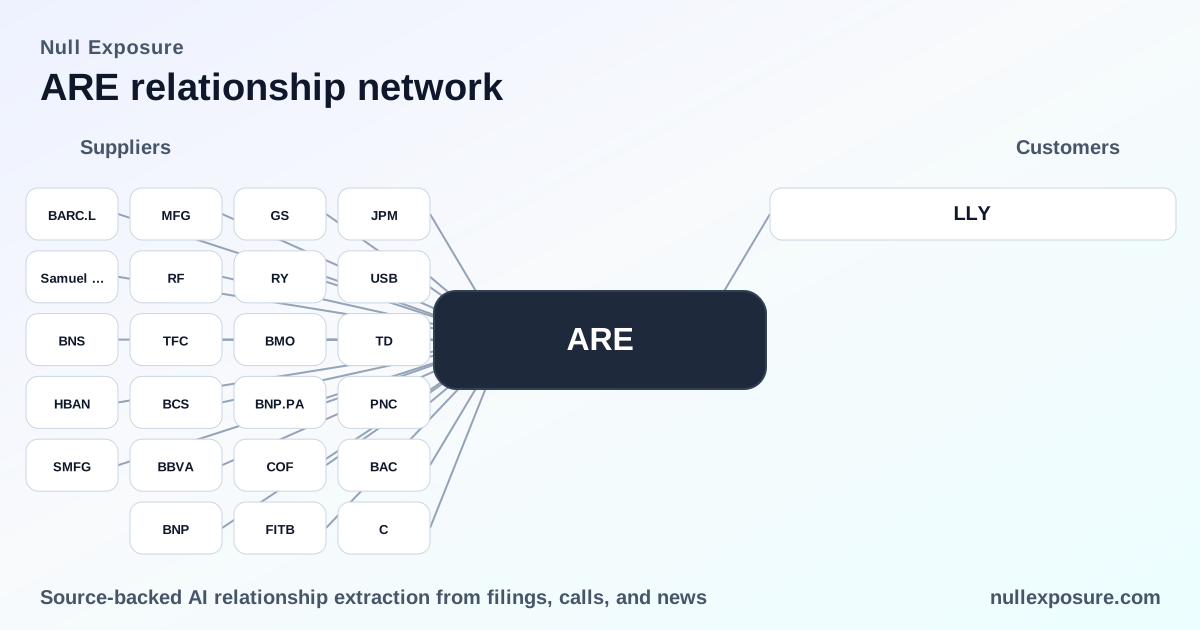
Alexandria Real Estate Equities (ARE): Customer Relationships that Drive Value and Risk
Alexandria Real Estate Equities is a specialized REIT that develops, owns, and operates life‑science and technology campuses and leases advanced laboratory and office space to multinational pharma, biotech, research institutions, and large technology firms. The company monetizes primarily through rental income and tenant reimbursements under long‑term, mostly triple‑net leases, supplemented by development and joint‑venture activities that accelerate rent roll and asset appreciation. For investors, the question is not whether Alexandria operates in an attractive niche — it does — but how concentrated, long‑dated, and strategically critical its customer roster is to cash flow and valuation. Learn more at https://nullexposure.com/.
High‑level thesis: predictable cash flows from sticky, large tenants
Alexandria’s business model trades lower tenant turnover for capital intensity: long lease terms, high occupancy in North America, and a revenue mix skewed toward investment‑grade and publicly traded large caps deliver predictability in rental revenue but create exposure to cluster‑specific dynamics in life‑science real estate and single‑tenant concentration. Company filings and recent public statements show the firm is actively building megacampuses that lock in long leases and tenant ecosystems that increase stickiness and re‑letting difficulty for competitors.
The portfolio constraints that matter to investors
- Contracting posture — long‑term orientation. Company disclosures show weighted average remaining lease terms of 9.7 years for the top 20 tenants and 7.5 years across all tenants, with many single‑tenant buildings signed for 5–15 years and multi‑tenant initial terms of 3–9 years (company filings as of Dec. 31, 2025). This underpins stable near‑term cash flow and lowers churn risk.
- Concentration to large corporates. Investment‑grade and publicly traded large‑cap tenants represented 53% of annual rental revenue in effect as of Dec. 31, 2025, signaling both high credit quality and meaningful revenue concentration.
- Geographic concentration in North America. All properties operate in North America (predominantly the U.S.) with operating occupancy of 90.9% as of year‑end 2025, meaning the company’s demand exposure is regionally concentrated and correlated to North American life‑science cycles.
- Materiality and scale. The large cap tenant concentration is a material revenue driver; disposals flagged as immaterial show management differentiates between asset‑level transactions and strategic shifts.
- Relationship staging and renewal behavior. About 82% of leasing activity in the prior twelve months was generated from existing tenants, indicating a high renewal component that supports steady rent growth and re‑letting economics.
- Service and infrastructure orientation. Alexandria positions itself as an infrastructure provider of high‑spec lab facilities and campus services — an operating model that increases tenant switching costs and the capital intensity required to replicate product market fit.
These constraints shape investing assumptions: discount rates, lease‑up timelines, and re‑letting risk should reflect a portfolio of long‑dated, high‑cap tenant cash flows concentrated in North America.
Relationship roll‑call: what public mentions tell investors
Below are the customer relationships surfaced by public sources; each entry includes a plain‑English summary and the cited source.
Eli Lilly (LLY)
Alexandria will lease a 334,000‑square‑foot, 12‑story building at 15 Necco Street to Eli Lilly for a new genetic medicine institute, reflecting Alexandria’s role as landlord to major pharma R&D expansions in Boston. According to GenEng News (March 9, 2026), Lilly plans to base the institute in the Alexandria‑owned building and lease substantial lab space.
Amazon (AMZN)
Management noted during the Q1 2026 earnings call that Amazon accounts for a significant portion of rent at one campus — together with another tenant they represent roughly 25% of the site’s rent roll — and that Amazon’s footprint is research‑oriented, not distribution. This comment appears in an earnings transcript republished by InsiderMonkey (May 2026), underlining Amazon’s status as a strategic, research‑focused tenant rather than a logistics operator.
Bristol‑Myers Squibb (BMY)
Alexandria is delivering Bristol‑Myers’ West Coast research headquarters hub on a campus, demonstrating the company’s tenancy relationships with large, multinational pharmaceutical companies that locate major R&D functions within Alexandria projects. This was mentioned on Alexandria’s Q1 2026 earnings call transcript (InsiderMonkey, May 2026).
Leidos (LDOS)
Management referenced new multi‑story office space built for Leidos, which uses the premises for advanced screening technology manufacturing and related R&D work, indicating that Alexandria’s tenant base extends into defense‑adjacent and technology service companies. The remark is included in the Q1 2026 earnings call transcript (InsiderMonkey, May 2026).
Novartis (NVS)
Alexandria has a ground‑breaking underway with Novartis in an early‑stage biotech cluster, showing continued demand from global pharma for bespoke laboratory campuses and pipeline incubation space. This was cited on the Q1 2026 earnings transcript reproduced by InsiderMonkey (May 2026).
Stantec (STN) / Aecon & Pomerleau mention
A GlobeNewswire release (March 4, 2026) reported that Stantec was selected to deliver engineering and design services for Canada’s Arctic Over‑the‑Horizon Radar project and that Aecon and Pomerleau will provide construction services as a joint venture; the entry in the relationship set references that release. While this item is in the results list, its connection to Alexandria is indirect and should be treated as a media mention captured in the relationship feed (GlobeNewswire, March 4, 2026).
Investment implications and risk map
- Credit quality vs. concentration risk. The 53% exposure to investment‑grade/public large‑cap tenants reduces default risk but increases sensitivity to a handful of corporate occupiers and sector cycles — particularly pharma and biotech capital spending. Pricing and valuation should reflect this duality.
- Lease term structure supports near‑term cash flow stability. Long WALEs (weighted average lease expiries) provide cash flow visibility and support dividend coverage assumptions, but also lock capital into specialized assets that require scale to re‑lease.
- Geographic and sector clustering. Strong North American clustering and megacampus strategy drive premium rents and ecosystem effects, but amplify local market downturns and life‑science funding cycles.
- Operational complexity elevates capex risk. Alexandria’s positioning as an infrastructure provider (high‑spec lab services) increases tenant stickiness and rent per square foot, while raising replacement and redevelopment costs if vacancies rise.
Bottom line for investors
Alexandria’s customer relationships are anchored by long, credit‑backed leases with large life‑science and technology firms, which deliver predictable rental revenue but create concentrated exposure to a defined set of corporate and regional risks. The portfolio’s high occupancy and renewal rates are positive structural signals, while the specialized nature of lab infrastructure requires careful modeling of capex and re‑letting assumptions.
For a deeper read on tenant concentration and how it feeds asset valuation and risk, visit https://nullexposure.com/ for analytic frameworks and comparative REIT coverage.
Bold takeaway: ARE’s cash flows are durable through long leases and high‑quality tenants, but valuation must price concentration and specialized asset risk explicitly.