American Rebel (AREBW) — customer relationships and what they mean for investors
American Rebel Holdings operates as a designer, manufacturer and marketer of branded safes, personal security products and related soft goods, deriving revenue primarily from direct-to-consumer e-commerce and a growing network of specialty dealers and distributors; monetization comes from product sales of safes and accessories, supplemented by ancillary beverage sales and periodic financing arrangements. Revenue is modest (about $1.2M trailing twelve months) and the company runs at a loss, so customer and counterparty dynamics are material to near-term liquidity and execution. For a concise company overview and broader coverage, see https://nullexposure.com/.
What investors need to know up front
American Rebel’s operating footprint mixes manufacturing, dealer/reseller channels and online retail. That mix creates short-term, transactional customer relationships with a small-company cost structure, and exposes the firm to dealer- and litigation-driven volatility. The 2024 Form 10-K highlights both dealer/distributor dependence and the use of alternative financing structures to bridge working capital gaps. Given the firm’s negative EBITDA and negative book value, these customer and financing relationships warrant close monitoring.
Direct relationship profiles — the concrete counterparties
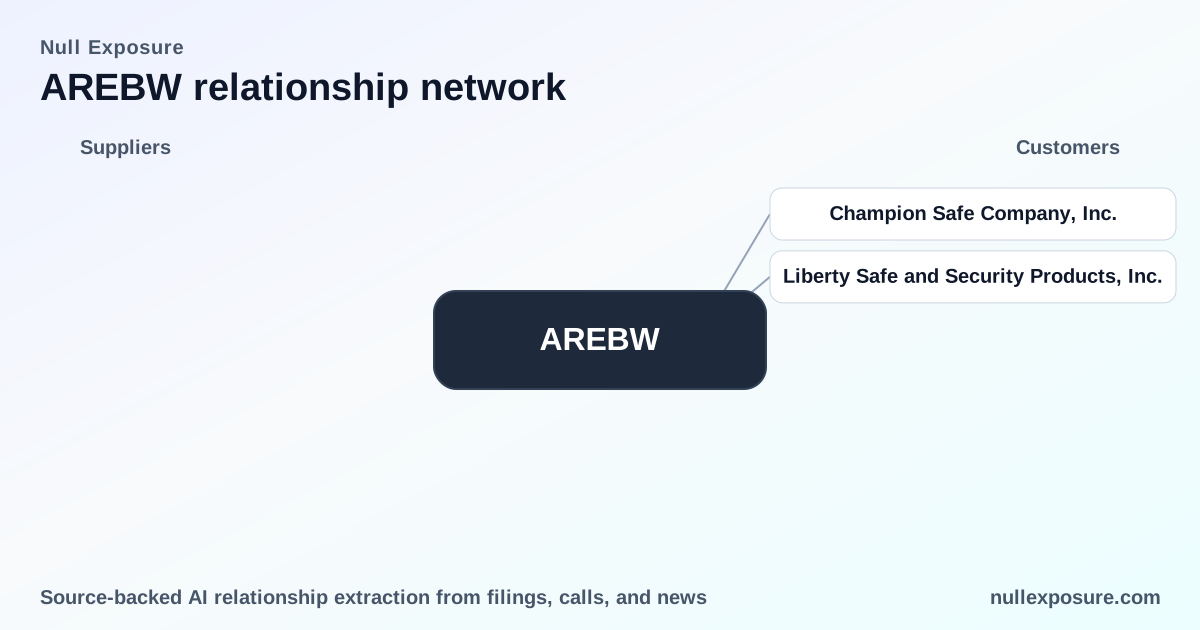
Champion Safe Company, Inc.
Champion is one of the Company’s wholly‑owned subsidiaries and a central commercial arm for manufacturing and distribution of the safe product line. American Rebel disclosed a Factoring Agreement in FY2024 under which the subsidiary sold a specified percentage of future receipts equal to $357,500 to an accredited investor for $250,000 (net of origination and fees of $12,500), reflecting use of receivables monetization to fund operations. This filing is documented in the company’s FY2024 Form 10‑K. (Source: FY2024 Form 10‑K filing.)
Liberty Safe and Security Products, Inc.
Liberty Safe filed a complaint in U.S. District Court (D. Utah) on July 23, 2024, alleging issues connected to the marketing and sale of American Rebel’s and Champion Safe Company’s line of safe products; the dispute is active and disclosed by American Rebel in its FY2024 Form 10‑K. The litigation introduces reputational and remediation risk to a business that sells through specialty dealers and online channels. (Source: FY2024 Form 10‑K filing.)
How the relationships map to the operating model and constraints
The company disclosures and relationship excerpts reveal a set of structural characteristics that shape revenue durability and risk:
-
Contracting posture — short-term, transactional sales. The company explicitly states customers issue purchase orders as needed rather than long-term firm commitments, which produces volatile demand recognition and working-capital pressure. This short-term posture drives reliance on financing tools (for example, the Champion factoring agreement). (Company-level signal from FY2024 10‑K.)
-
Counterparty mix — individuals, small businesses and regulated channels. Sales target individual consumers via e-commerce and safe specialty retailers and independent gun stores; in some states sales require state-licensed distributors or state-owned agencies. This mix increases complexity in go-to-market execution and creates multi-channel credit and compliance exposures. (Company-level signal from FY2024 10‑K.)
-
Channel roles — manufacturer, distributor and reseller activity. Through its acquisition of Champion, the company acquired manufacturing facilities and leases, while selling through dealers and distributors and via online retail; Champion functions as a manufacturer and operating arm. These overlapping roles raise operating leverage and inventory risk at the same time the company maintains distribution relationships that are important to reach retail end customers. (Constraint excerpt naming Champion and company-level excerpts in FY2024 10‑K.)
-
Relationship stage and concentration — active but shallow. The Champion entities are active operational channels; customer relationships are primarily transactional rather than built on long-term supply contracts, which implies concentration risk can crystallize quickly if a key dealer or state channel shifts shelf space or distribution partners change terms. (Company-level signals from FY2024 10‑K.)
-
Segment focus and criticality — core product dependency. The firm manages as a single operating segment of patriotic goods comprised of safes, soft goods and beer, making the safe product line the core revenue driver and central to customer relationships. Any disruption to safe product distribution or reputation (for example, litigation) will have outsized impact on revenues. (Company-level signal from FY2024 10‑K.)
Investment implications — what drives upside and risk
American Rebel’s customer landscape creates a narrow set of levers for investors:
-
Upside drivers: successful stabilization of dealer relationships, expansion of online conversion and retention, and improved working capital access at lower cost than current factoring/revenue interest arrangements. If the company converts short-term buyers into repeat customers or secures more favorable distribution agreements, revenue leverage will be significant given current scale.
-
Principal risks: litigation outcomes (Liberty Safe suit), continued dependence on receivables monetization (Champion factoring transaction), and channel concentration across specialty retailers and a limited multistate footprint. Given negative EBITDA and limited institutional ownership, operational missteps or adverse legal rulings will strain liquidity and shareholder value.
Practical monitoring checklist for investors
- Track litigation updates and reserve disclosures tied to the Liberty Safe complaint as disclosed in the FY2024 10‑K.
- Monitor future financing activity and terms similar to the Champion factoring agreement for signs of tightening liquidity or more dilutive funding.
- Watch dealer/distributor commentary in earnings or MD&A about state-level distribution access and national retail placements.
- Observe sequential revenue and gross margin trends to confirm whether the merchant/retailer network is scaling profitably beyond one-off promotional channels.
For more context on the company, filings and related analysis, visit https://nullexposure.com/.
Final take
American Rebel’s commercial model combines manufacturing capacity (via Champion), reseller and distributor reach, and direct online sales—a valuable if capital‑intensive mix for a small company. The FY2024 disclosures make clear that the firm relies on short-term customer orders and alternative financing to fund operations, and that an active legal dispute with a peer distributor represents a non-trivial operational risk. Investors should treat customer relationship health and financing terms as leading indicators of near-term solvency and performance.