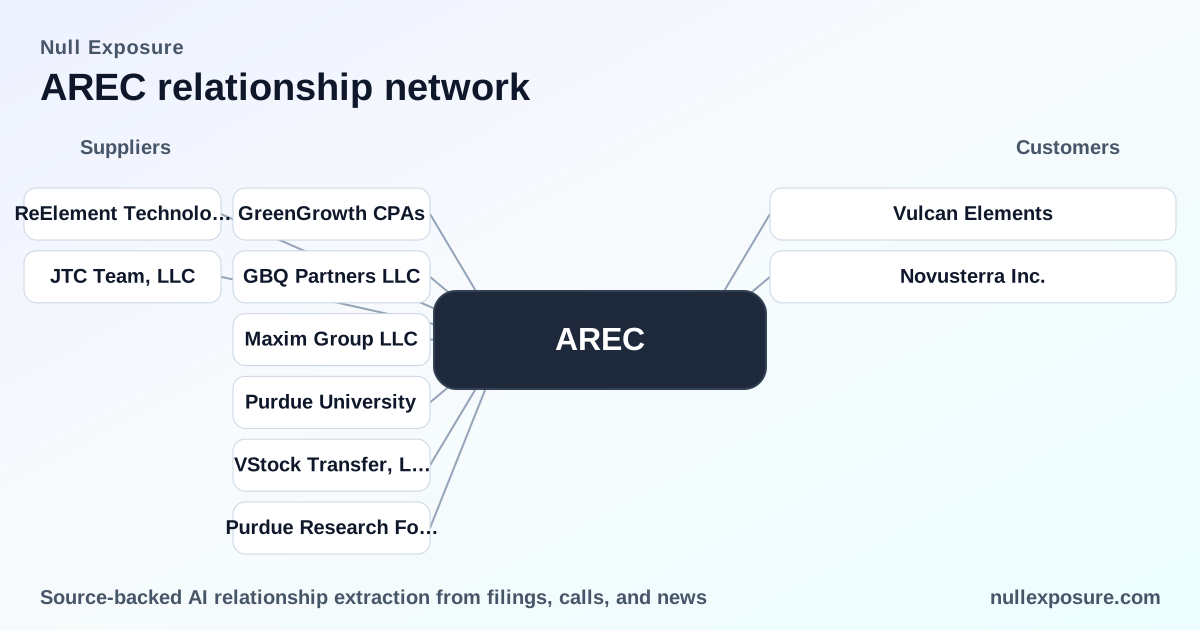
American Resources Corp (AREC): customer map and commercial implications for investors
American Resources Corp extracts and processes metallurgical coal, recovered metals and is scaling rare-earth purification through its ReElement platform; it monetizes via short-term coal sales, processing fees, asset sales and offtake arrangements for critical minerals. The business is transitioning from a coal-centric seller to a vertically integrated minerals operator, with commercial relationships that drive both near-term cash flow and strategic optionality in rare earths. Learn more about the firm’s commercial footprint at https://nullexposure.com/.
How the company makes money and what that means for investors
American Resources’ revenue mix is straightforward: sales of mined coal (main driver through 2024), sales of recovered metals, and service fees from processing. Contracts are described as short-term (10–30 day payment terms) for coal, which creates rapid cash conversion but limits forward revenue visibility. The company sells both domestically and internationally, while operations are concentrated in eastern Kentucky, western West Virginia and southern Indiana — a combination that produces a North American operating base with global customer reach through east-coast export blending.
Key operating characteristics investors should treat as company-level signals:
- Concentration risk is material: two customers accounted for roughly 74% and 26% of 2024 coal revenues, indicating heavy reliance on a small number of counterparties.
- Contracting posture is short-term: predictable cash receipts but minimal long-term offtake protection for commodity price exposure.
- Dual commercial role: American Resources functions as both a seller (coal and metals) and a service provider (processing and storage fees), which diversifies revenue types but ties margin to utilization of processing plants.
- Strategic pivot into manufacturing-like activities: ReElement’s purification/refining work and the graphene/carbon technology activity indicate movement toward higher-margin, manufacturing-linked products.
Customer and partner relationships you should know
The following items reproduce every relationship mention found in coverage. Each entry is a concise, plain-English summary with a source reference.
Vulcan Elements (FY2025)
American Resources initiated a rare-earth supply deal with privately held Vulcan Elements in August, selling high-purity rare-earth element oxides with Vulcan paying over US$100 per kilogram for the material. According to Mugglehead coverage (first seen March 9, 2026), this is a supply arrangement tied to the company’s rare-earth extraction efforts.
Novusterra Inc. — sub-license collaboration (FY2021)
American Resources announced a collaboration with Novusterra to provide a customer for its carbon fines and to create local jobs, reflecting a commercial pathway for byproduct monetization via graphene/ carbon technology projects. This was reported on StockTitan (first seen March 9, 2026).
Novusterra Inc. — patent sale for equity (FY2022)
American Resources agreed to sell exclusive patent rights in carbon nanostructure and graphene technology to Novusterra in exchange for $16 million of Novusterra stock, converting IP exposure into an equity stake and potential upside. Yahoo Finance reported this transaction (first seen March 9, 2026).
SKYE / Arecor Therapeutics mention (FY2026)
A press release from SKYE referenced an agreement with Arecor Therapeutics plc (AIM: AREC) to develop a higher-concentration formulation; this mention concerns Arecor (ticker AREC on AIM) and not American Resources Corp (NASDAQ: AREC), representing a ticker collision in the news feed rather than a commercial relationship for American Resources. The SKYE release was reported on The Globe and Mail (first seen March 10, 2026).
ReElement Technologies (FY2025)
ReElement Technologies — a portfolio company of American Resources — will deploy processing capacity across American Resources’ controlled deposits to produce mixed rare-earth concentrates that feed ReElement’s refining platform, aligning asset control with downstream purification capability. Investing.com reported on this operational rollout (first seen May 2, 2026).
POSCO International America Corp — offtake (FY2025)
ReElement signed a rare-earth offtake agreement with POSCO International America Corp to collaborate on refining, providing a strategic commercial outlet for refined rare-earth products and validating ReElement’s place in the supply chain. Investing.com and a market recap reported POSCO’s involvement (first seen May 2, 2026), with Yahoo Finance also highlighting the POSCO offtake in operational developments (first seen May 2, 2026).
What the relationships imply for trajectory and risk
- Strategic uplift from ReElement and POSCO: The POSCO offtake and ReElement capacity expansion convert extraction capability into marketable refined product, upgrading American Resources’ revenue exposure from commodity coal to higher-value critical minerals. This is a material strategic shift that changes the company’s risk/return profile.
- Commercial validation and pricing leverage with Vulcan Elements: A supply contract at >US$100/kg for rare-earth oxides signals commercial demand and pricing discipline for the firm’s purification output.
- Non-core monetization via Novusterra: The IP sale and sub-license transactions convert specialty technology exposure into equity and customer flow, supporting byproduct monetization without requiring full internal commercialization.
- Ticker/noise risk in public reporting: The SKYE/Arecor (AIM: AREC) mention illustrates how ticker collisions can generate misleading coverage; investors should cross-check entity identity when scanning press flow.
Explore a concise, investor-focused dossier on American Resources’ counterparties and market signals at https://nullexposure.com/ — a practical next step for due diligence.
Bottom line: investable signals and where to watch
American Resources carries high concentration in coal revenue and short contract terms, balanced by a deliberate push into rare-earth extraction and refining that offers substantial upside if ReElement and its offtake arrangements scale. Key metrics for ongoing monitoring: production ramp at ReElement facilities, offtake fulfillment with POSCO and Vulcan Elements, utilization and fee revenue from processing plants, and the P&L impact of Novusterra-related transactions. For investors, the story is transitionary: current cash flows hinge on coal sales and short-term contracts, but commercial partnerships in rare earths are the principal lever for re-rating.
If you want consolidated counterparty intelligence and timely relationship updates on AREC’s partners, visit https://nullexposure.com/ for structured coverage and market-context analysis.