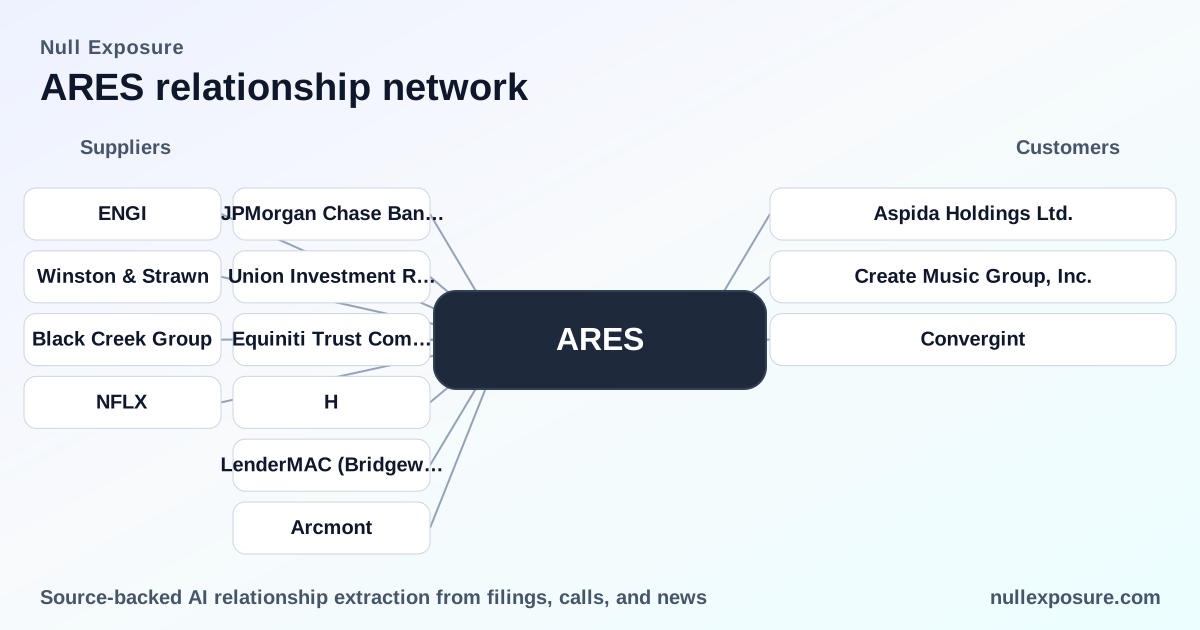
Ares Management (ARES) — Customer Relationships That Power an Enduring fee engine
Ares Management is a global alternative asset manager that monetizes a diversified platform of credit, private equity, real estate and insurance strategies through management fees, incentive fees and carried interest tied to long-dated/perpetual vehicles and actively managed credit and fund sponsors. Investors should value Ares as a fee-originating services business whose economics are driven by scale of assets under management, the stickiness of perpetual capital, and the firm’s role as an external manager to listed and private vehicles.
Explore more research at NullExposure.
How Ares’ customer model actually works — the operating constraints that matter
Ares’ commercial model is predominantly a services relationship: subsidiaries charge management fees and performance-linked compensation for advising funds and externally managed vehicles. The company reports that 95% of management fees are earned from perpetual capital vehicles or long-dated funds, which creates a predictable, annuity-like fee base and supports capital deployment and co-investment activity across its platform. At the same time, Ares maintains a set of short-term advisory contracts — including separately managed accounts and certain advisory agreements that are terminable on 30–60 days’ notice — so contract tenure is a mix of durable and cancellable revenues.
Geography and client mix are material to risk and growth. Ares is a global manager with a North America-dominant revenue profile but meaningful EMEA and APAC channels, servicing institutional investors (pensions, insurance, sovereign wealth funds), retail investors via public vehicles, and middle-market corporate borrowers. The firm’s typical deal sizes and capital commitments sit in the $100m+ spend band, supporting large-ticket lending and equity investments; at the same time Ares services mid-market borrowers across its direct lending franchise.
Ares is first-and-foremost an active service provider: investment advisory, underwriting and portfolio monitoring are core deliverables and generate management and incentive fees. Most relationships are active and ongoing; some funds are in harvesting or winding-down phases, but the platform is organized to recycle capital and scale new strategies. Notably, the firm discloses that management fees from one externally managed vehicle — ARCC — represent a significant percentage of its management fees, so a few large external relationships have outsized revenue importance.
If you want the raw relationship intelligence for diligence, NullExposure aggregates headlines and filings that surface how these customer relationships are utilized across deals and financing — see the site for deeper dossiers.
Visit NullExposure for the full view.
Relationship roll-call — what Ares does for and with its customers
Below are concise, source-backed descriptions of every customer relationship surfaced in the recent collection of public reporting and transcripts.
OAK-P-B (Oaktree preferred B)
Ares provided private credit financing syndicated with Barings to support Oaktree Capital Management’s acquisition of Perpetual Ltd.’s wealth unit, positioning Ares as a co-lender on a sponsor-led acquisition in March 2026, according to PE-Insights reporting that cites Bloomberg (March 2026).
OAK-P-A (Oaktree preferred A)
Independent reporting echoed the same arrangement: Ares participated in private-credit financing to back Oaktree’s acquisition of Perpetual’s wealth management business, noted by Alternative Credit Investor (October 2025 / reported March 2026).
PAA (Plains All American Pipeline)
Plains All American acquired a remaining 45% stake in Epic Crude from Ares private equity portfolio companies for roughly $1.5 billion, indicating Ares’ private equity ownership was monetized into a strategic sale to an industry buyer (reported by SimplyWall.St and transaction notices, May 2026).
PAGP (Plains GP Holdings)
Plains’ corporate disclosure noted the effective closing of the Epic acquisition from a portfolio company of Ares private equity funds for approximately $1.33 billion (inclusive of debt), confirming the same divestment from Ares-backed assets (GlobeNewswire, Q3 2025 results).
BALY (Bally’s Corporation)
Bally’s secured a $1.1–$1.25 billion term loan facility underwritten by Ares Management credit funds alongside King Street and TPG Credit, demonstrating Ares’ role as a senior lender in large leveraged financing for a gaming operator (Yogonet and The Gaming Boardroom, Feb 2026).
ACRE (Ares Commercial Real Estate Corporation)
ACRE is externally managed by an affiliate of Ares Management; public filings and earnings transcripts describe ACRE leveraging Ares’ origination, co-investment and balance-sheet facilities to access loans and co-invest alongside other Ares vehicles, underscoring a tight manager-managed client relationship (MarketBeat, MarketScreener and Q4 2025 earnings transcripts, FY2026 reporting).
Aspida Holdings Ltd. / Aspida
Ares’ insurance solutions business managed investments for Aspida, which raised $2.3 billion for its life insurance and annuity subsidiary and contributed meaningful inflows to Ares’ insurance AUM, per AI-CIO and Ares’ own earnings commentary on insurance flows (Jan 2026 and FY2026 earnings).
WHF (WhiteHorse Finance)
WhiteHorse Finance’s investment strategy leverages Ares’ underwriting, portfolio monitoring and credit-management capabilities, with public filings and market alerts noting the team’s use of Ares’ platform as a central credit-management partner (MarketBeat, Dec 2025–Feb 2026).
Create Music Group, Inc.
Create Music Group disclosed $450 million in funding from Ares alongside other strategic investors, signaling Ares’ participation in growth-stage media/rights financing and minority equity placements (MarketScreener and Oppenheimer report, Mar 2026).
Federal Express Corporation (FedEx)
Ares acquired a Class A industrial distribution facility in the Dallas-Fort Worth market that is fully leased to FedEx under a long-term triple-net lease, reflecting Ares’ direct real estate investment in stabilized, tenant-backed industrial assets (Qatar Tribune / Arcapita exit notice, FY2025).
Convergint
Ares closed an $850 million single-asset continuation vehicle for Convergint, led by Leonard Green & Partners, illustrating Ares’ role in structuring continuation vehicles and single-asset realizations for sponsor-backed portfolio companies (StockTitan and SEC filing notices, March 2026).
FIP (FTAI Infrastructure / FIP)
FTAI Infrastructure secured a $1.315 billion secured term loan arranged with Alter Domus as administrative agent and funds managed by Kennedy Lewis, Ares and Caspian Capital as lenders, showing Ares’ participation in structured, syndicated lending to infrastructure issuers (TradingView summary of loan terms, Feb 2026).
ARCC (Ares Capital Corporation)
Ares Capital is externally managed by Ares Management; filings and coverage highlight ARCC’s reliance on the Ares platform for deal flow and investment evaluation and that management fees from ARCC are a significant component of Ares’ fee revenue (TradingView and MarketBeat coverage of ARCC’s external management, FY2026).
DVA (DaVita or related)
In a Q4 2025 earnings call transcript, Ares’ private equity funds participated alongside a minority investor to acquire Elara Caring, with Ares contributing the majority investment, indicating platform-level private equity dealmaking and minority co-invest support (DVA Q4 2025 earnings call transcript).
Key takeaways for investors
- Fee durability is high because a disproportionate share of management fees are generated by perpetual and long-dated vehicles, creating recurring revenue visibility.
- Concentration risk exists: a handful of externally-managed vehicles such as ARCC contribute meaningfully to management-fee revenue.
- Ares is both lender and sponsor: the firm underwrites credit facilities, structures continuation vehicles, and sells or monetizes private equity portfolio stakes — giving it diversified origination channels but also exposure to capital markets and buyer appetite.
- Global footprint with North America emphasis: investor mix and revenue generation tilt to North America, while EMEA and APAC present diversification and operating complexity.
For a practitioner-level readout of transaction-level exposures and to map these customer relationships into an investment risk model, NullExposure maintains the aggregated reporting and relationship dossiers that informed this note.
Visit NullExposure for deeper transaction and relationship intelligence.