Argo Group: an underwriting franchise that monetizes through specialty underwriting, investment returns and selective asset sales
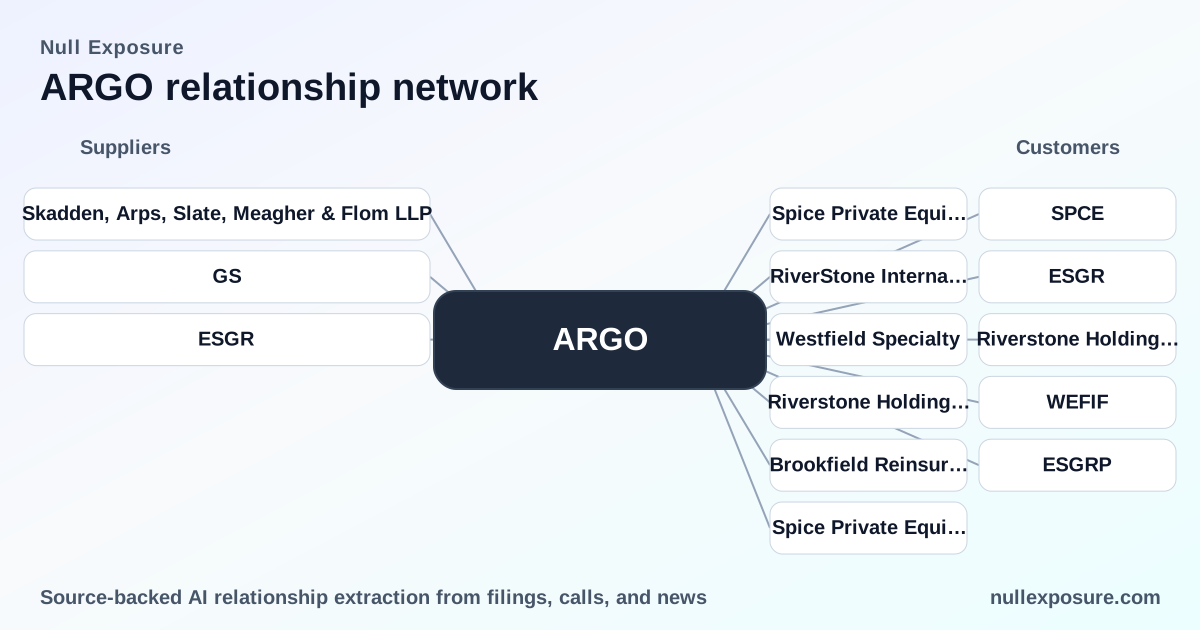
Argo Group underwrites specialty property & casualty risks and monetizes through a combination of underwriting income, investment returns and disciplined capital recycling — selling non-core international operations and transferring legacy liabilities to reduce capital drag. The company’s relationship map shows a consistent pattern: targeted divestitures to private equity and run‑off specialists, legacy loss portfolio transfers, and a strategic all‑cash acquisition that crystallized value for shareholders. For a concise look at Argo’s customer and counterparty activity, visit https://nullexposure.com/.
Divestitures and legacy transfers have become core to Argo’s operating posture
Argo’s transactions over the last several years reveal a deliberate contracting posture: reduce exposure to smaller, overseas operations, accelerate release of legacy liabilities, and conserve capital for core specialty underwriting. Those moves create several business-model signals relevant to investors and operators:
- Concentration: The company is narrowing geographic exposure by exiting Brazil and Malta and exiting the Lloyd’s platform, signaling a tilt back to higher-return U.S. specialty lines.
- Contracting posture: Argo is an active seller of non-core businesses and of legacy portfolios rather than a long-term holder of smaller international units.
- Criticality & maturity: Use of loss portfolio transfers and run‑off buyers (Enstar, Riverstone) indicates legacy-book maturity and a choice to accelerate reserve resolution rather than retain longer-term tail risk.
- Counterparty mix: Buyers are specialized investors and insurers (private equity, run‑off consolidators, and traditional reinsurers), which limits execution risk but also compresses sale proceeds versus strategic alternatives.
These themes are visible across the relationships documented below.
Relationship-by-relationship: the buyers and counterparties that reshaped Argo
RiverStone / Riverstone Holdings Limited / RiverStone International
Argo sold its Malta operations — ArgoGlobal Holdings (Malta) Ltd. — to Riverstone, a consolidator focused on legacy and run‑off insurance books, as announced in December 2021 (FY2021). The transaction reinforces Argo’s strategy of offloading legacy and smaller international units to specialist acquirers (Bermuda Reinsurance Magazine; Insurance Journal; Bernews, Dec 2021).
Westfield Specialty / Westfield (WEFIF)
Argo agreed and later completed the sale of its Argo Underwriting Agency Limited and Lloyd’s Syndicate 1200 to Westfield Specialty for approximately $125 million, exiting its Lloyd’s presence and simplifying distribution (Royal Gazette; Reinsurance News, FY2022–FY2023). Multiple reports record the transaction and its completion, documenting the company’s strategic withdrawal from that international syndicate model.
Spice Private Equity Ltd (SPCE)
Argo sold its Brazilian operation, Argo Seguros Brasil S.A., to Spice Private Equity for a purchase price reported at 160 million Brazilian reais (announced FY2021). The disposal eliminated a small, volatile geographic exposure and generated immediate cash proceeds (Royal Gazette; Bernews, Oct 2021).
Enstar Group Limited / Enstar (ESGR / ESGRP)
Argo executed a loss portfolio transfer (LPT) with a wholly owned subsidiary of Enstar; Argo recorded $34.2 million of pre‑tax realised losses tied to assets that will move upon close of that LPT (Royal Gazette; Bermuda Reinsurance Magazine, FY2022). The transaction is consistent with a deliberate program to accelerate legacy resolution and remove reserving volatility.
Brookfield Reinsurance Ltd. / Brookfield Reinsurance (BNT)
Argo entered into a definitive merger agreement to be acquired by Brookfield Reinsurance in an all‑cash transaction valued at roughly $1.1 billion (announced FY2023). The deal price represented a measured premium to the pre‑announcement trading level and crystallized strategic value for Argo shareholders (Express News; Bernews, FY2023).
Note on name and symbol variants: the results include multiple document-level mentions under slight name or ticker variants (for example Westfield / WEFIF, Spice Private Equity Ltd / SPCE, Enstar / ESGR or ESGRP, Brookfield Reinsurance / BNT, RiverStone / Riverstone Holdings Limited). The summaries above consolidate those variants under the principal counterparty to avoid duplication while preserving the original source context.
What investors should take from these counterparty relationships
- Capital reallocation over organic expansion: Argo is reallocating capital away from smaller international platforms and toward its core U.S. specialty underwriting, evidenced by the Brazil and Malta sales and the Lloyd’s divestiture to Westfield.
- Legacy run‑off is being outsourced: Use of LPTs and sales to run‑off specialists transfers long‑tail reserve risk off Argo’s balance sheet, improving near‑term capital flexibility but also recognizing realised losses (the Enstar‑related $34.2 million impairment is a concrete example).
- Counterparty selection reduces execution risk: Buyers are experienced operators in their niches — private equity for regional assets, run‑off specialists for legacy books, and a strategic reinsurance acquirer for enterprise sale — which controls transaction completion risk and provides credible valuation benchmarks for similar assets.
- Single-event crystallization: The Brookfield acquisition converts the entire corporate strategy into a liquidity event for shareholders and marks a cycle endpoint for the asset‑sale program.
Investment implications and risk checklist
- Valuation dynamics: Sales of non‑core assets provide near‑term cash but are also a signal that remaining portfolio returns must justify the narrower operating footprint.
- Reserve volatility: LPTs reduce reserve uncertainty going forward but create near-term earnings impacts and require careful monitoring of recovery on transferred assets.
- Execution risk: Counterparties are specialists, lowering closing risks; however, future disposals would depend on market appetite for legacy and regional insurance assets.
For further research and ongoing tracking of Argo’s counterparties and transaction history, see https://nullexposure.com/.
Conclusion: Argo’s customer/counterparty map over the recent multi‑year period reads like an intentional corporate unwind of peripheral operations and an acceleration of legacy resolution, culminating in a strategic sale that monetized the company’s remaining franchise value. Investors should price Argo not only as an underwriting platform but as a business actively managing and monetizing non‑core assets and legacy liabilities.