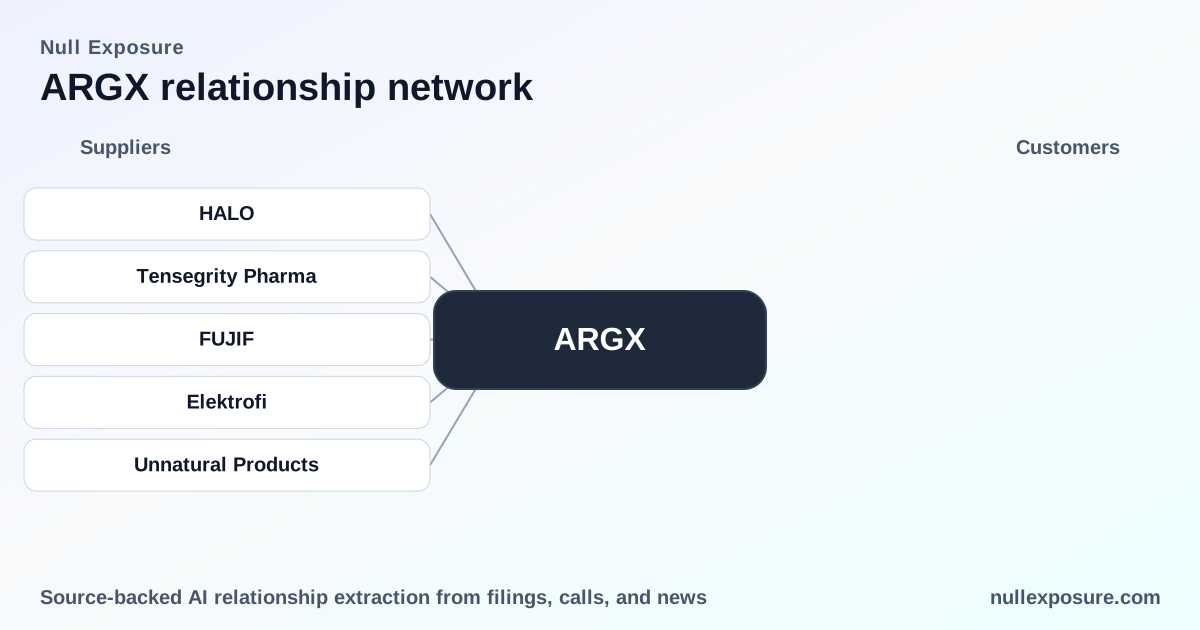
argenx (ARGX) — commercial partnerships that scale regional reach
argenx operates as a commercial-stage immunology company that monetizes through product sales, exclusives licenses and regional commercialization partnerships for its antibody-based therapies. The balance sheet and operating metrics show a company with meaningful revenue and profitability — Revenue TTM $4.236B and a 30.5% profit margin — that leverages third‑party partners to accelerate market access in geographies where local expertise and reimbursement relationships are critical. For investors evaluating customer and partner exposure, the key framework is simple: product concentration plus targeted licensing defines both upside and geopolitical/regulatory dependency. For full coverage of partner relationships and implications, visit https://nullexposure.com/.
What the commercial footprint looks like in one sentence
argenx sells into global markets directly where it has infrastructure and outsources regional market entry through exclusive licenses and commercialization partners to secure faster reimbursement and distribution in locally complex markets.
The single customer relationship on record — what it is and why it matters
- Zai Lab (ZLAB): Zai Lab holds an exclusive license from argenx to develop and commercialize efgartigimod in Greater China, reflecting argenx’s strategy to transfer regional commercialization responsibility and regulatory navigation to a local partner with established market access capabilities. According to a BioSpace press release covering updates to China’s national reimbursement list, Zai Lab’s license arrangement with argenx was explicitly referenced in March 2026. (BioSpace, March 10, 2026)
How that relationship fits argenx’s operating model
argenx’s commercial model combines in-house commercialization and selective regional licensing to accelerate uptake in territories that present regulatory and reimbursement complexity. The Zai Lab agreement is a clear manifestation of that posture: argenx retains global intellectual property and clinical development control while ceding regional market execution to a partner with local reimbursement experience. A company with material revenue and positive operating margins can use this approach to scale a flagship asset beyond core markets without building full local infrastructure.
Business-model constraints and company-level signals investors need to know
- Contracting posture: argenx uses exclusive, territory-limited licensing as a deliberate tool to expand reach while managing capital intensity; the Zai Lab Greater China license is a concrete example of that posture.
- Concentration: revenue and strategic value concentrate around a small number of late‑stage assets; this concentrates execution risk even as those assets deliver high-margin sales (Revenue TTM $4.236B; Profit Margin 30.5%).
- Criticality of partners: partners in large, complex markets are operationally critical — their commercial and reimbursement performance directly impacts argenx’s regional revenue realization. The Zai Lab license underscores this dynamic for Greater China.
- Maturity: argenx has transitioned from pure clinical-stage company into a commercial-profit generating enterprise based on reported financials through FY2025 (positive EBITDA and operating margin), which changes the risk profile from development binary outcomes to execution and market access management.
What investors should watch next
- Reimbursement and pricing decisions in partner-governed territories will be the primary near-term revenue drivers outside argenx’s direct markets; monitor public announcements from Zai Lab and Chinese reimbursement listings for updates tied to efgartigimod. (BioSpace press release, March 2026)
- Partner performance metrics (launch timelines, formulary placements, distribution breadth) will convert into revenue growth or shortfalls; operational KPIs from partners are as material as internal guidance when a major geography is licensed exclusively.
- Any expansion of regional license scope, or transfers of commercial rights for additional products, will materially affect revenue concentration and risk diversification.
Relationship-by-relationship round-up
Zai Lab (ZLAB) — Zai Lab carries an exclusive Greater China license from argenx to develop and commercialize efgartigimod, positioning Zai Lab as argenx’s primary commercial agent in that market and making its reimbursement outcomes directly material to argenx’s Greater China revenue. Source: BioSpace press release on China reimbursement updates, March 10, 2026.
Risk and reward — calibrated for investors
- Reward: Exclusive regional licenses accelerate penetration into high-potential markets without the capital burden of local infrastructure, preserving margin and cash for R&D and global launches. argenx’s current financials support this approach.
- Risk: Exclusive licensing concentrates execution risk in partner hands; a single partner’s underperformance in a major market like Greater China will materially affect revenue growth expectations. Additionally, geopolitical and regulatory changes in partner markets amplify this dependency.
Practical investor takeaways
- Monitor partner announcements and local reimbursement cycles as primary leading indicators for international revenue growth. The Zai Lab licensing update is the immediate example to track for Greater China outcomes.
- Treat partner KPIs as quasi-customer data: for companies like argenx that rely on exclusive regional partners, partner operational performance is a de facto customer relationship metric.
- For a focused view of partner exposure and to track new relationship disclosures as they hit the market, review centralized coverage at https://nullexposure.com/.
Conclusion: argenx’s commercialization strategy balances in-house sales where it can scale quickly with exclusive regional partnerships where local expertise reduces time-to-market and execution risk. The Zai Lab license for Greater China is the live case study — it demonstrates both the operational leverage and the counterparty dependence inherent in this model. For investors, the actionable signal is simple: watch partner-driven reimbursement and launch milestones as closely as company guidance.