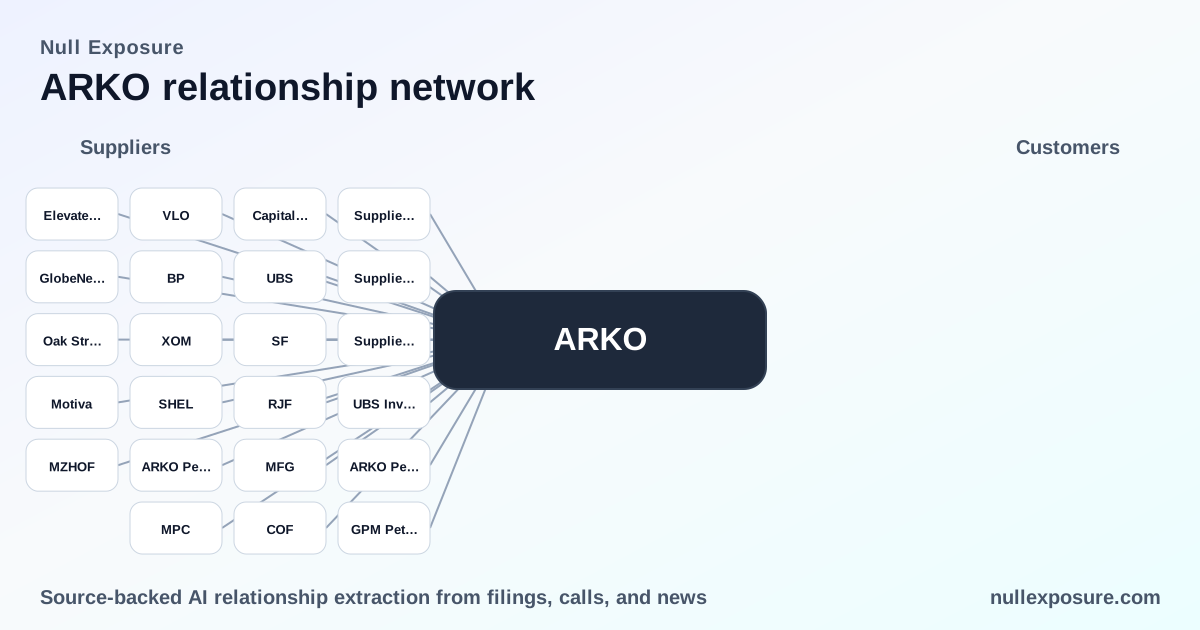
ARKO Corp: Customer relationships, contracting posture, and what investors should know
Arko Corp operates a large U.S.-centric convenience-store and fuel distribution platform that monetizes through fuel margins, merchandise sales, and ancillary services (car washes, fleet card fees). The company's economics combine volume-driven, usage-priced fuel supply to dealers and company-operated retail sites with recurring fees in fleet and cardlock channels; investors should view ARKO as a high-throughput, low-margin retail fuel operator with ancillary profitability from merchandise and services. For a concise view of ARKO’s relationship exposures and contracting signals, visit https://nullexposure.com/.
Quick investment thesis up front
ARKO scales via high store counts and integrated fuel supply arrangements: fuel is both product and margin engine, sold under a mix of long-term supply contracts and spot/wholesale arrangements, while retail merchandise and services provide higher-margin leverage. The company’s customer base is broad and no single external customer represented more than 10% of revenues as of year-end 2024, making counterparties individually immaterial but collectively critical to volume and liquidity.
One explicit counterparty on record: APC
- APC — ARKO Petroleum entered a Third Amended and Restated Fuel Distribution Agreement effective February 13, 2026; the amendment consolidates and governs internal fuel supply arrangements and is structured as at-will. This confirms ARKO’s continued use of formalized fuel-distribution contracts to centralize supply across related entities. (Source: TradingView news report summarizing ARKO Petroleum IPO and related agreements, March 2026 — https://www.tradingview.com/news/tradingview:d3d3014b41f0a:0-arko-petroleum-closes-ipo-secures-84-million-pnc-revolver-and-15-year-intercompany-notes/)
How the relationships translate into operating constraints and business characteristics
ARKO’s disclosed contract language and segment notes reveal a set of clear, company-level operational features that shape revenue predictability, counterparty risk, and margin mechanics:
- Contracting posture — a mix of long-term anchor supply with usage pricing. The company reports fuel supply agreements with initial terms commonly around 10 years and a volume-weighted average remaining term of approximately 4.5 years as of December 31, 2024, indicating multi-year supply commitments underpinning a large portion of throughput. (Company filings and MD&A as of Dec. 31, 2024.)
- Pricing mechanics — primarily usage-based and fixed-margin constructs. For certain internal supply arrangements, ARKO supplies fuel at cost plus a fixed margin (example: 5 cents per gallon in some segments), signaling that volume growth directly scales revenue with predictable per-unit incremental gross margin. (Company filing disclosures as of FY2024.)
- Spot and wholesale activity coexist with contracted supply. The wholesale channel supplies fuel on either consignment or cost-plus terms and includes bulk and spot purchasers, which introduces price volatility and working-capital sensitivity into the model alongside long-term contracted volume. (Company filings.)
- Counterparty composition — retail individuals, commercial accounts, and municipal fleets. ARKO reports roughly 2.3 million loyalty members and operates cardlock locations serving commercial and municipal entities, revealing diverse customer types that smooth concentration risk even as local demand fluctuations remain material. (Company disclosures, 2024.)
- Concentration and materiality — broad but not concentrated. No single external customer exceeded 10% of revenues, a structural plus for credit exposures; risk is aggregate rather than counterparty-specific. (Company filing, FY2024.)
- Criticality and role: ARKO functions primarily as a seller of fuel and fuel-related services. The company supplies fuel to thousands of dealer locations (1,922 reported as of Dec. 31, 2024), operates proprietary and third-party cardlock sites, and charges fixed fees in fleet channels — all of which make ARKO a critical supplier within its immediate dealer network. (Company filings.)
- Maturity and lifecycle signals — active relationship management with conversions underway. ARKO actively converts company-operated retail stores to dealer models (153 converted in the reported year, with plans for additional conversions), a dynamic that reduces operating capital intensity for certain locations and shifts contract counterparty profiles. (Company filings, 2024.)
Operational implications for suppliers, partners, and investors
- Liquidity and commodity risk exposure are central. The simultaneous presence of long-term supply contracts and spot wholesale activity creates a need for disciplined hedging and working-capital management; margin compression or fuel cost spikes will transmit rapidly into P&L without offsetting retail price flexibility.
- Scale reduces single-counterparty credit risk but raises operational concentration. While no external customer is individually material, loss of regional volume or disruptions at scale (transportation, terminal capacity) would have outsized short-term impacts given the company's U.S.-focused footprint. All reportable revenues and most assets are U.S.-based. (Company filings.)
- Contract structure supports predictable per-gallon economics. Usage-based and fixed-margin constructs (e.g., per-gallon fees) make earnings more directly tied to volume trends — a positive for investors tracking throughput metrics but a vulnerability in prolonged demand downturns.
- For deeper monitoring of relationship-level signals and to see how ARKO’s counterparty map evolves, see https://nullexposure.com/ for consolidated coverage.
Relationship-by-relationship checklist (complete coverage)
- APC: ARKO Petroleum enters a Third Amended and Restated Fuel Distribution Agreement effective February 13, 2026; the amendment is at-will and designed to consolidate internal fuel supply arrangements, reinforcing ARKO’s reliance on formal distribution contracts to manage internal flows and dealer supply. (TradingView news summary, March 2026 — https://www.tradingview.com/news/tradingview:d3d3014b41f0a:0-arko-petroleum-closes-ipo-secures-84-million-pnc-revolver-and-15-year-intercompany-notes/)
Key takeaways for investors
- ARKO’s model is volume-first with contract architecture that blends long-term stability and spot flexibility. That structure produces reasonably predictable per-gallon economics but requires active commodity and working-capital management.
- Counterparty risk is diffuse but operationally concentrated in the U.S. No single external customer breaches 10% revenue, yet the domestic-only footprint concentrates macro and regulatory exposure.
- Watch throughput trends and dealer conversions. Metrics such as gallons sold, dealer count, and pace of store conversions materially drive near-term earnings variability given low fuel unit margins and higher-margin but smaller merchandise/service contributions.
For consolidated monitoring of ARKO’s counterparty dynamics and to track future relationship amendments, visit https://nullexposure.com/ for ongoing updates and signal-driven summaries.