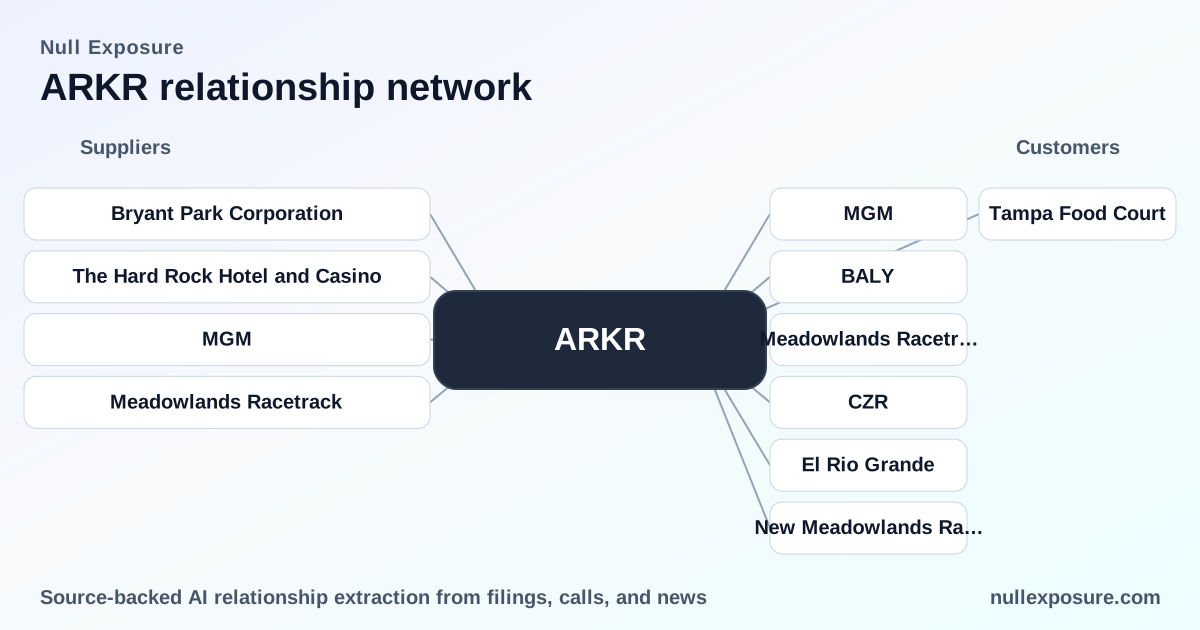
Ark Restaurants (ARKR): Customer Relationships that Drive — and Constrain — Growth
Ark Restaurants operates, manages and franchises full-service and fast-casual food-and-beverage concepts primarily inside hospitality and entertainment venues, monetizing through retail food and beverage sales, managed catering and exclusive venue concessions. The company’s revenue mix is concentrated on a portfolio of branded restaurants and venue-specific contracts—some of which carry material revenue weight and optional upside tied to casino and racetrack developments. For a quick overview of Ark’s market positioning, visit https://nullexposure.com/.
How Ark makes money and why customer relationships matter
Ark is a single-segment operator: it recognizes revenue when food, beverage and related services are delivered to guests, and its operating model is structured around contracts with landlords and venue operators to run restaurants, room service, banquets and food courts. That posture creates a profile of contractual dependency (leases and concession agreements), geographic concentration and customer-type exposure that drive both near-term cash flow and medium-term optionality from venue development rights.
Commercial footprint: the relationships driving the business
Below I list every customer/partner reference identified in Ark’s recent reporting and press coverage, with a concise plain-English summary and source for each mention.
BALY
Ark operates a restaurant inside the Tropicana complex in Atlantic City, an arrangement that connects Ark’s operations to Bally’s (BALY)-owned venue traffic and casino economics. According to a StockTitan recap of Ark’s FY2025 results published March 9, 2026, Ark specifically highlighted the Atlantic City Tropicana location as part of its venue portfolio. (StockTitan, March 9, 2026 — https://www.stocktitan.net/news/ARKR/ark-restaurants-announces-financial-results-for-the-fourth-quarter-u1c0mzs6xdi7.html)
MGM
Ark runs multiple food-and-beverage operations tied to MGM resorts in Las Vegas, including restaurants, room service and banquets that leverage resort volumes. The company disclosed in its FY2025 reporting that Las Vegas activities include operations inside MGM-owned properties, as cited in a StockTitan report on March 9, 2026. (StockTitan, March 9, 2026 — https://www.stocktitan.net/news/ARKR/ark-restaurants-announces-financial-results-for-the-fourth-quarter-u1c0mzs6xdi7.html)
Tropicana Hotel and Casino
The Tropicana in Atlantic City is an active venue where Ark operates at least one restaurant, exposing Ark to gaming-driven foot traffic and lease/concession economics tied to that property. Ark referenced the Tropicana location in its FY2025 summary as captured by StockTitan on March 9, 2026. (StockTitan, March 9, 2026 — https://www.stocktitan.net/news/ARKR/ark-restaurants-announces-financial-results-for-the-fourth-quarter-u1c0mzs6xdi7.html)
New York-New York Hotel & Casino Resort
Ark cites four restaurants and multiple F&B roles at New York-New York in Las Vegas, indicating multi-unit exposure within a single resort and reliance on resort guest volumes. This detail was included in Ark’s FY2025 disclosures summarized on March 9, 2026. (StockTitan, March 9, 2026 — https://www.stocktitan.net/news/ARKR/ark-restaurants-announces-financial-results-for-the-fourth-quarter-u1c0mzs6xdi7.html)
Meadowlands Racetrack
Ark holds a minority investment and exclusive food-and-beverage rights tied to the Meadowlands Racetrack—an asset that creates optionality if regulatory or development outcomes enable a casino or expanded venue. TradingView’s March 9, 2026 item highlighted this optionality as a potential growth catalyst. (TradingView / Zacks, March 9, 2026 — https://www.tradingview.com/news/zacks:967108227094b:0-rave-vs-arkr-which-restaurant-turnaround-stock-is-more-compelling/)
New Meadowlands Racetrack (transcript mention)
Management reiterated on the Q1 FY2026 call that Ark’s position in New Meadowlands Racetrack includes exclusive F&B rights and an ownership stake in the LLC, framing the relationship as strategic optionality tied to regulatory progress. This was transcribed in an Investing.com earnings summary for Ark’s Q1 2026 call on May 2, 2026. (Investing.com transcript, May 2, 2026 — https://in.investing.com/news/transcripts/earnings-call-transcript-ark-restaurants-q1-2026-shows-stable-performance-93CH-5232597)
Planet Hollywood Resort and Casino
Ark operates a restaurant within Planet Hollywood in Las Vegas, linking a portion of Ark’s Las Vegas revenue to Caesars’ (CZR) Planet Hollywood guest flows. The Planet Hollywood connection was cited in Ark’s FY2025 discussion captured by StockTitan on March 9, 2026. (StockTitan, March 9, 2026 — https://www.stocktitan.net/news/ARKR/ark-restaurants-announces-financial-results-for-the-fourth-quarter-u1c0mzs6xdi7.html)
El Rio Grande
Ark’s reporting separates revenues tied to El Rio Grande from same-store sales metrics, indicating carve-outs for certain venues when calculating organic performance. The mention was captured on Intellectia’s Ark news feed addressing FY2026 commentary on same-store sales. (Intellectia, March 9, 2026 — https://intellectia.ai/en/stock/ARKR/news)
New Meadowlands Racetrack (strategic optionality in press)
Multiple outlets reiterate that Ark’s minority stake and exclusive operating rights at New Meadowlands Racetrack are long-term optionality if regulatory approvals materialize, positioning this asset as a potential non-capex route to incremental revenues. The Globe and Mail’s March 9, 2026 coverage reiterated this thesis when comparing dining stocks. (The Globe and Mail, March 9, 2026 — https://www.theglobeandmail.com/investing/markets/stocks/ARKR/pressreleases/37254849/bdl-vs-arkr-which-dining-stock-is-the-better-buy-now/)
Tampa Food Court (lease termination)
Ark terminated the Tampa Food Court lease and recognized a one-time termination payment of $5.5 million and a net gain of $5.2 million, an event that materially affected reported results for the period. This was reported by TradingView on March 9, 2026. (TradingView / Zacks, March 9, 2026 — https://www.tradingview.com/news/zacks:73971b117094b:0-arkr-stock-slips-despite-q4-earnings-improvement-amid-challenges/)
Tampa Food Court (same-store sales disclosure)
Ark’s same-store sales calculations exclude revenues related to El Rio Grande and the Tampa Food Court, confirming these venues are treated as outliers when assessing comparable performance. Intellectia captured this same-store sales disclosure in its March 9, 2026 Ark coverage. (Intellectia, March 9, 2026 — https://intellectia.ai/en/stock/ARKR/news)
New Meadowlands Racetrack (additional press note)
Finviz echoed the view that Ark’s minority interest and exclusive rights at New Meadowlands Racetrack offer optional upside without direct development exposure, repeated across financial press on March 9, 2026. (Finviz, March 9, 2026 — https://finviz.com/news/288740/bdl-vs-arkr-which-dining-stock-is-the-better-buy-now)
Operating constraints and what they signal for investors
- Geographic concentration: Ark operates exclusively in the United States, which focuses regulatory, labor and demand risk domestically rather than diversifying across markets. (Company FY2025 disclosures)
- Customer/venue concentration and materiality: The Bryant Park Grill & Café and The Porch at Bryant Park together generated roughly $25.5M–$31.1M of revenue in FY2025/FY2024, representing roughly 15–17% of total revenue—a material concentration that increases exposure to lease renewals and litigation outcomes tied to those locations. (FY2025 filing disclosures)
- Contracting posture: Ark is primarily a seller/operator of services and food-and-beverage; revenue recognition is transaction-based and depends on continuous performance under venue contracts and leases. (FY2025 filing language on revenue recognition)
- Relationship stage and maturity: Most venue relationships are active and operational, while the New Meadowlands Racetrack stake is a strategic minority investment providing optional upside if regulatory conditions change.
- Spend and scale signal: The company has mid-sized revenue concentrations in the $10M–$100M band for key locations, indicating meaningful but not overwhelming single-site economic weight.
- Counterparty type: The company’s revenue model is guest-driven (individual customers) combined with contractual relationships with large venue operators.
Investment implications — what matters for valuation
- Upside driver: The New Meadowlands Racetrack stake is the clearest optionality—exclusive F&B rights without full development risk—and is priced by investors as contingent value pending regulatory outcomes. (Multiple press sources, March–May 2026)
- Risk drivers: Lease and concession renewal risk at high-revenue locations (notably Bryant Park) is a material downside given their share of revenue; termination events (Tampa Food Court) create one-time gains but reduce recurring revenue. (FY2025 filing; TradingView)
- Operational leverage: Ark’s single-segment service model concentrates operational focus and simplifies margin recovery if traffic normalizes, but it also amplifies venue-specific demand shocks.
If you evaluate operational counterparties or construct scenario models for Ark, prioritize lease renewal timelines, casino/racetrack regulatory pathways and same-store sales excluding outlier locations. For a deeper look at relationship-level exposure and how it maps to contract expiry and revenue volatility, visit https://nullexposure.com/.
Bold takeaway: Ark’s near-term performance is driven by a handful of venue contracts that produce material revenue, while its long-term upside is tied to contingent rights at Meadowlands—an optionality that trades on regulatory progress rather than core restaurant growth.