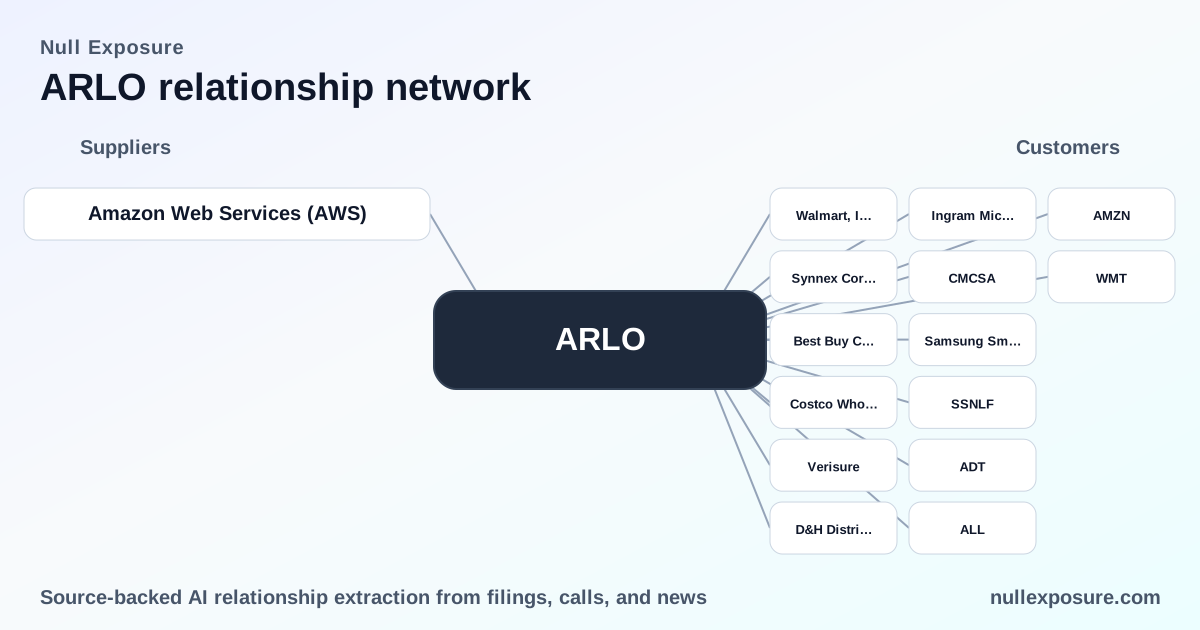
Arlo Technologies (ARLO): Customer Map, Concentration Risk, and Partnership Levers
Arlo sells smart security devices and increasingly monetizes through recurring subscription services (Arlo Secure, Arlo Total Security, Arlo Safe) while distributing hardware through retail, wholesale distributors and security solution partners. The company’s revenue engine is a hybrid of one‑time device sales and fast‑growing recurring services, and that hybrid structure both amplifies margin upside and concentrates risk where large channel partners dominate volume. For a compact view of commercial counterparties and evidence links, visit https://nullexposure.com/.
Executive takeaway: how Arlo makes money and where the concentration sits
Arlo’s financial model is two‑pronged: hardware sales drive volume and acquisition, while subscription services produce ratable recurring revenue and higher lifetime value. The 2024 Form 10‑K discloses that Arlo generated significant revenue through traditional and online retailers, wholesale distributors and security solution providers; critically, Verisure accounted for 43.2% of revenue in FY2024, a single‑counterparty concentration that defines near‑term commercial risk. At the same time, Arlo is executing strategic platform partnerships (Comcast, Samsung SmartThings, ADT) intended to accelerate subscription growth by tapping large installed bases rather than relying solely on retail sell‑through.
Key risk/reward lens: hardware sales scale quickly but are lumpy and spot‑priced; subscription growth smooths revenue and lifts EV/Revenue multiples, but the company remains exposed to counterparty concentration and channel dynamics.
What the operating model signals tell investors
The company disclosures and extracted constraints produce several company‑level operating signals worth flagging for due diligence:
- Contracting posture: Arlo operates on both subscription (ratable revenue recognition for billed‑in‑advance services) and spot product sales (revenue recognized on shipment), reflecting a dual go‑to‑market that balances recurring income and one‑time cash. This is a company‑level characteristic disclosed in the 2024 10‑K.
- Commercial concentration: Critical concentration exists at the company level, with one partner representing a material portion of sales—this elevates counterparty risk and bargaining leverage considerations.
- Channel mix and roles: Arlo sells direct to consumers, to retailers and through wholesale distributors; the company acts as seller, distributor supplier and service provider to security solution firms and carriers.
- Geographic footprint and scale: Arlo reports global operations (Americas, EMEA, APAC) with ~10.8 million registered accounts and 4.6 million paid subscribers as of year‑end 2024, indicating mature cross‑border distribution and subscription scale.
- Spending/backlog signal: A backlog of $33.5 million at year‑end 2024 points to near‑term performance obligations in the $10m–$100m spend band, typical for device shipment cycles.
If you want an ongoing feed on these relationship signals, see https://nullexposure.com/ for more.
Documented customer and partner relationships (evidence‑backed)
Below I cover each counterparty mentioned in the source material with a one‑to‑two sentence plain‑English note and the source cited in narrative form.
Verisure
Verisure accounted for 43.2% of Arlo’s revenue in FY2024, making it a material and critical channel for device and service revenue. According to Arlo’s FY2024 Form 10‑K, sales to Verisure and affiliates represented that percentage of revenue.
Walmart, Inc.
Walmart is named by Arlo as a core retail channel; management noted they nearly doubled shelf share at Walmart as part of retail expansion efforts. The retailer is cited in Arlo’s 2024 10‑K and in Q4/2025 remarks reported on the company’s earnings call transcript.
Best Buy Co., Inc.
Best Buy is identified in Arlo’s 10‑K as a significant traditional retailer through which a substantial portion of products flow to end customers, supporting broad consumer distribution.
Costco Wholesale Corporation
Costco is similarly listed in the company’s 2024 10‑K as a principal retail partner, representing another large‑format channel for bulk sell‑through and membership‑driven volume.
D&H Distributing Company
D&H is cited as one of Arlo’s wholesale distributors that supply retailers and resellers; Arlo sells directly to these distribution partners as disclosed in the 10‑K.
Ingram Micro, Inc.
Ingram Micro appears in the 10‑K as a wholesale distributor for Arlo’s hardware, reflecting enterprise and channel distribution scale rather than direct retail placement.
Synnex Corporation
Synnex is listed among wholesale distributors in Arlo’s 2024 disclosures, completing the named distributor set that supports multi‑channel retail fulfillment.
Amazon / AMZN
Arlo sells products through Amazon’s platform and management credits the Amazon channel with driving additional paid subscriptions via digital customer acquisition, per the 10‑K and Q4/2025 earnings commentary.
Comcast (CMCSA)
Arlo announced a strategic partnership with Comcast to provide connected home security solutions to millions of Xfinity Internet households, a distribution and subscription acceleration channel reported in TradingView summaries and earnings call transcripts (Q4/2025).
Samsung SmartThings
Arlo entered an agreement to integrate Arlo’s Smart Security Platform into the SmartThings app for U.S. users, broadening Arlo’s platform reach; this partnership was announced via PR Newswire and covered in sector press in early 2026.
Samsung / SSNLF
Beyond SmartThings integration, Arlo will power an emergency response service across Samsung devices in the U.S., a capability referenced on the Q4/2025 earnings transcript and in subsequent coverage mentioning SSNLF.
ADT
ADT is a strategic partner where technical integration was reportedly completed by late 2025, with management stating the ADT integration “is going very well” on the Q4/2025 earnings call as reflected in published call transcripts.
Allstate
Allstate is referenced in industry commentary as a strategic partner that could deepen engagement across insurance and monitoring use cases, cited in market coverage discussing Arlo’s privacy‑oriented positioning.
Strategic implications for investors
- Upside: Platform partnerships with Comcast, Samsung and ADT provide scalable channels to convert device buyers into paid subscribers, improving ARR and gross margin profile. Evidence from Q4/2025 commentary and early 2026 press shows these deals are live and positioned to accelerate services growth.
- Downside: Single‑partner concentration (Verisure at 43.2% in FY2024) is a structural risk until subscription diversification materially reduces dependence on large solution providers.
- Operational posture: The hybrid model requires Arlo to manage retail shelf economics, distributor relationships and SaaS operations simultaneously—operational complexity that rewards execution but penalizes channel disruption.
Final note
Arlo sits at the intersection of consumer hardware and recurring security services; the company’s valuation upside depends on converting distribution reach into durable subscription ARR while managing counterparty concentration risk. For continued monitoring of Arlo’s partner signals and revenue concentration metrics, visit https://nullexposure.com/.