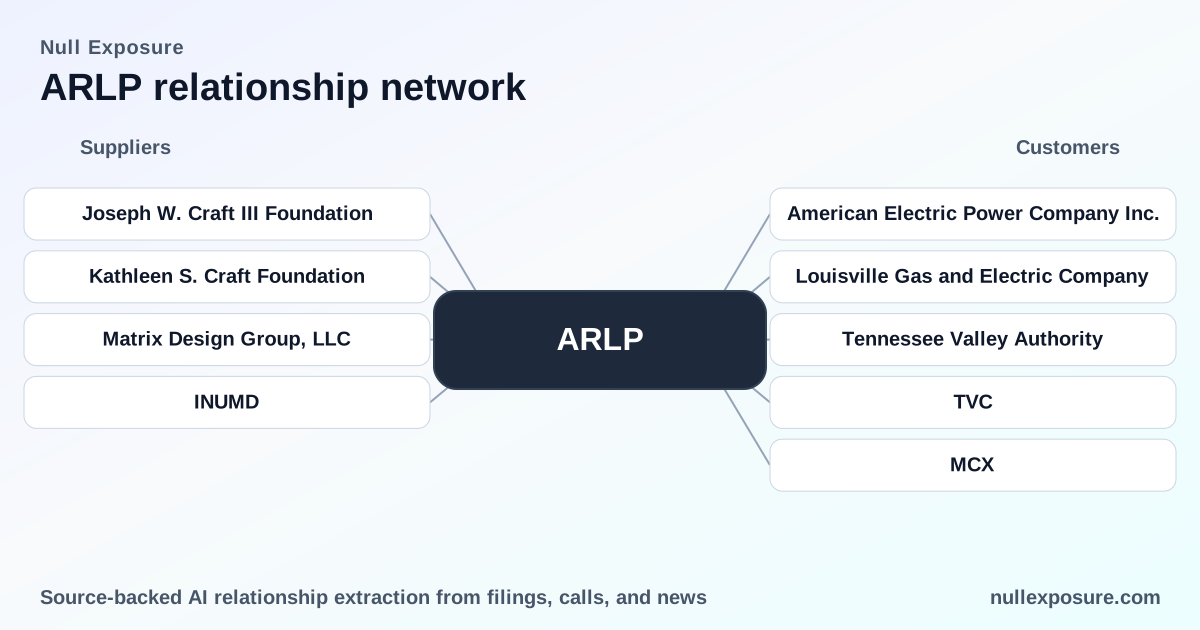
Alliance Resource Partners LP (ARLP): customer relationships that drive cash flow and concentration risk
Alliance Resource Partners LP produces and markets thermal and metallurgical coal to large domestic utilities and industrial users, monetizing through long‑term coal supply contracts, export brokered sales and royalty income from oil & gas leases; the business generates predictable cash flow from committed contracts while retaining exposure to a small number of large counterparty customers and international market swings. For a quick reference on the firm and its investor materials, visit https://nullexposure.com/.
Why customers are the story for ARLP investors
ARLP’s revenue profile is defined by a concentrated base of large utility buyers and a contractual mix that favors long‑dated commitments. Approximately 83.6% of sales tonnage in 2024 was sold under long‑term contracts, and the company recognizes that losing one major buyer can materially affect volumes and pricing. At the same time, about 80.3% of tons sold in 2024 were purchased by U.S. electric utilities and 17.3% were exported through brokered transactions, giving ARLP both domestic stability and exposure to international demand dynamics. These structural features shape ARLP’s credit profile, working capital, and margin stability.
Key relationship takeaways at a glance
- Concentration risk is real and documented: ARLP names three counterparties that each accounted for more than 10% of total revenues in FY2024.
- Contracting posture skews long‑term, providing revenue visibility but creating rollover points as contracts expire between 2025 and 2030.
- Large‑enterprise buyers dominate the demand mix, making ARLP a baseload fuel supplier for utilities rather than a commodity spot merchant.
For deeper company coverage, see the issuer filings and investor materials at https://nullexposure.com/.
What the filings and news say about each customer relationship
American Electric Power Company Inc.
Alliance reported that American Electric Power accounted for more than 10% of total revenues in FY2024, making it a named major customer and a meaningful driver of ARLP’s revenue base (ARLP Form 10‑K, FY2024).
Louisville Gas and Electric Company
Louisville Gas and Electric was also identified as a customer generating over 10% of ARLP’s total revenue in 2024, underscoring the company’s reliance on a small set of utility counterparties for a large share of sales (ARLP Form 10‑K, FY2024).
Tennessee Valley Authority (TVC)
The Tennessee Valley Authority is listed among the trio of customers that individually contributed more than 10% of total revenue in FY2024; ARLP’s 10‑K explicitly names TVA as a major counterparty (ARLP Form 10‑K, FY2024). The filing also records entries where the authority is referenced with the inferred symbol TVC in the company’s relationship inventory.
TVC (inferred symbol entries)
ARLP’s relationship extraction includes entries labeled “TVC” tied to the same FY2024 10‑K disclosure that lists Tennessee Valley Authority as a major customer, reflecting how the company and outside data providers cross‑reference the counterparty in disclosure records (ARLP Form 10‑K, FY2024).
MC Mining / MCX — customer default event
A news report documented a customer default at MC Mining during the first half of FY2025, which ARLP disclosed in its market commentary and press releases; that event is captured in a March 9, 2026 Yahoo Finance article summarizing ARLP’s FY2025 developments (Yahoo Finance, March 9, 2026). The reference to MC Mining—also indexed under the ticker MCX—signals counterparty credit stress on a smaller, non‑utility account.
MCX (duplicate reference)
The relationship index records MCX as an additional listing for the MC Mining default disclosure; both entries point to the same news coverage of the FY2025 customer default (Yahoo Finance, March 9, 2026).
Operating model constraints and investor implications
The company disclosures and relationship signals produce a compact set of operating constraints that should guide valuation and risk assessment:
- Contracting concentration and maturity: With roughly 83.6% of tonnage sold under long‑term contracts (committed expirations range through 2025–2030), ARLP’s near‑term cash flow is supported by contract carry, but revenue renewal points are concentrated and will require active commercial management (ARLP Form 10‑K, FY2024).
- Customer concentration is material: ARLP explicitly reports that American Electric Power, Louisville Gas and Electric, and Tennessee Valley Authority each accounted for more than 10% of revenues in 2024, creating client concentration risk that is earnings‑sensitive (ARLP Form 10‑K, FY2024).
- Large‑enterprise counterparty profile: The buyer mix is dominated by U.S. electric utilities—about 80.3% of tons sold—which increases the predictability of demand but ties ARLP to the regulatory, plant‑fuel and fuel‑switching dynamics of the power sector (ARLP Form 10‑K, FY2024).
- Global exposure is meaningful: Exports represented ~17.3% of tons sold in 2024, exposing ARLP’s pricing and volumes to international freight, demand cycles and brokered transaction dynamics (ARLP Form 10‑K, FY2024).
- Receivables and counterparty exposure: Trade accounts receivable from major customers totaled approximately $50.1 million at December 31, 2024, indicating a mid‑double digit working capital exposure per major buyer cohort (ARLP Form 10‑K, FY2024).
- Business model diversity: Beyond coal supply, ARLP earns royalty income from oil & gas leases and manufactures equipment through Matrix Group subsidiaries, which dampens single‑product cyclicality but does not eliminate coal demand dependence (ARLP Form 10‑K, FY2024).
Investment judgment — what to watch next
For investors and operators, focus on three monitors: contract renewals for the major utility contracts, counterparty credit developments (including any post‑default recoveries tied to MC Mining), and export market pricing and freight dynamics. These variables will determine ARLP’s revenue trajectory and the timing of any re‑rating.
If you want a consolidated view of ARLP’s public filings and customer disclosures, visit https://nullexposure.com/ for organized access to the underlying documents and relationship extractions.
Bold final point: ARLP delivers predictable baseload cash flow today through long‑term contracts with large utilities, but concentrated counterparty exposure and export market volatility are the primary levers of downside risk.