Arm Holdings: Customer relationships that underwrite a licensing powerhouse turned silicon competitor
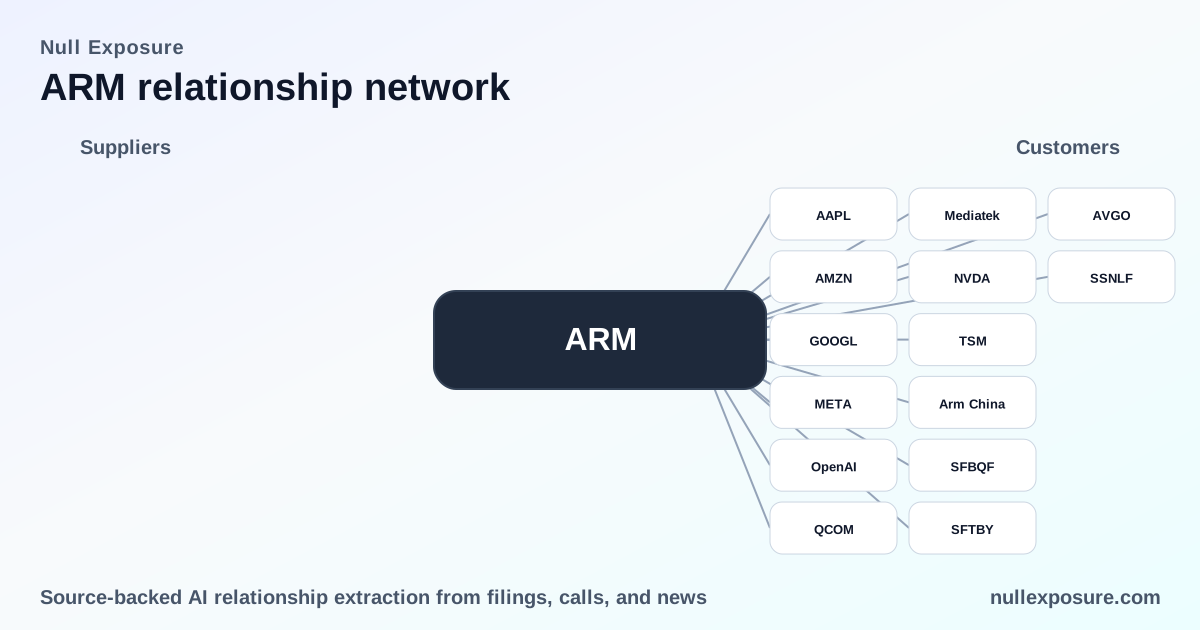
Arm monetizes by licensing CPU architectures and related IP to chipmakers and device OEMs, collecting royalties and license fees as its designs proliferate across mobile, edge and cloud; today the company is executing a strategic pivot into full‑silicon AI CPUs while preserving its core licensing franchise. The transition transforms Arm from an IP landlord into a hybrid vendor—raising revenue upside from product sales and royalties but also introducing customer conflict and concentration risk. Explore a concise, source‑anchored map of Arm’s customer and partner relationships below, and visit https://nullexposure.com/ for continuing coverage.
How Arm’s commercial model looks to investors
Arm’s historic strength is durable, long‑dated licensing: designers embed Arm cores and pay recurring royalties on unit shipments. The new strategy layers directly produced Arm AGI CPUs and co‑developed ASICs on top of that base, creating potential for higher margin product revenue and a faster revenue ramp if hyperscalers convert development commitments into volume. Financially, Arm retains a licensing business with mature cash flow characteristics while adding commercial execution requirements, channel assembly, and customer transition risk.
Key operating characteristics:
- Contracting posture: Arm has historically used long‑term licensing and ecosystem partnerships; recent announcements show material multi‑year commercial commitments and co‑development agreements (company filings and press coverage in FY2026).
- Concentration: A small set of hyperscalers and OEMs drive much of Arm’s addressable AI data center opportunity, increasing revenue concentration risk even as it expands TAM.
- Criticality: Arm’s architecture remains central to mobile and growing in AI infrastructure, making relationships with cloud providers and AI labs strategically critical.
- Maturity: Licensing is mature and recurring; the silicon program is early commercial (production slated in 2026), so investors should treat product revenue as higher variance.
Customer map: the partners and customers named in FY2026 reporting
Below I cover every relationship referenced in the FY2026 results set, with a one‑two sentence plain‑English summary and the cited source.
- Synopsys (SNPS) — Synopsys integrates an Arm Zena virtual platform into its eDT Virtualizer to validate Arm‑based stacks earlier in development, reflecting close tooling alignment between Arm architecture and EDA partners (Synopsys press release, Mar 10, 2026: https://news.synopsys.com/2026-03-10-Synopsys-Launches-Electronics-Digital-Twin-Platform-to-Accelerate-Physical-AI-System-Development).
- Apple (AAPL) — Apple extended a long‑term licensing relationship that now runs beyond 2040, tying its future silicon roadmap to Arm architecture and guaranteeing a durable revenue stream (SahmCapital coverage, Jan 31, 2026; also SimplyWall commentary, Mar 2026).
- Meta Platforms (META) — Meta is described as a lead partner on Arm’s server CPU program and the likely customer for a custom server CPU, positioning Meta as an early commercial anchor for Arm’s AGI CPU (MEXC and multiple market writeups, Mar–May 2026).
- Amazon / Amazon Web Services (AMZN) — AWS has long used Arm‑based processors in its data centers and is referenced as a collaborator in Arm‑based AI and server processor initiatives, underpinning cloud adoption of Arm designs (Finviz/SimpleWall, FY2026 reporting).
- Google / Google Cloud (GOOGL) — Google tapped Arm architecture for its Axiom processors and is listed among hyperscalers building new Arm‑based AI processors, indicating deep cloud integration (Finviz and TradingKey, FY2026).
- Cloudflare (NET) — Cloudflare is cited among early customers and validators of Arm’s AGI CPU demand, signaling cloud edge interest beyond hyperscaler incumbents (Stockstotrade coverage, Apr 24, 2026).
- OpenAI — Arm is connected to an AI XPU ASIC program tied to OpenAI, including collaborative production with SoftBank and Broadcom, which would place Arm inside advanced AI training infrastructure (Finviz and Susquehanna coverage, Mar 2026).
- SAP — SAP is named among early customers committed to Arm’s AGI CPU effort, reflecting enterprise software vendors’ interest in Arm‑based AI infrastructure (Tikr blog and Stockstotrade, FY2026).
- Supermicro (SMCI) — Supermicro expanded Arm‑based server platforms built on Arm AGI CPU technology, demonstrating channel partnerships to deliver Arm silicon into data centers (Supermicro investor release, May 2026: https://ir.supermicro.com/news).
- Ambiq (AMBQ) — Ambiq announced an SoC integrating Arm’s Ethos‑U85 NPU for ultra‑low‑power edge AI, showing Arm’s IP feeding edge NPU designs and OEM differentiation (Ambiq press releases and embeddedcomputing coverage, Jan 2026).
- SK Telecom (SKM) — SK Telecom signed an MOU with Arm and Rebellions to collaborate on next‑generation AI infrastructure, representing telco deployment and regional partnership for Arm silicon (SK Telecom press release, 2026: https://news.sktelecom.com/en/2951).
- Cadence Design Systems (CDNS) — Cadence completed acquisition of Arm’s Artisan Foundation IP business, marking an IP divestiture that changes how parts of Arm’s toolchain interact with external EDA vendors (SimplyWall recap, FY2026).
- Broadcom (AVGO) — Broadcom is cited as a co‑partner with Arm and SoftBank on an AI XPU ASIC program for OpenAI, signaling strategic foundry/partner roles in volume production (SimplyWall and Finviz mentions, Mar 2026).
- SoftBank (SFTBY / SFBQF) — SoftBank figures in co‑development and financing conversations; analysts flagged circular financing concerns given SoftBank’s role in Arm’s ownership and revenue exposure (TradingKey commentary, FY2026).
- Qualcomm (QCOM) — Qualcomm remains both a major licensee and a competitive peer; the shift to Arm‑produced silicon raises strategic tension between vendor and licensee (TradingView/TradingKey coverage, FY2026).
- Nvidia (NVDA) — Nvidia is listed among key licensees and peer competitors, creating a complex relationship as Arm targets AI data center silicon where Nvidia dominates (TradingKey and industry writeups, FY2026).
- IBM — IBM revealed a collaboration with Arm on dual‑architecture hardware to enhance virtualization and enterprise AI performance, indicating enterprise systems integration (SimplyWall, FY2026).
- STMicroelectronics (STM) — STM used Arm cores in new automotive microcontrollers, illustrating Arm’s continued strength in embedded and automotive markets (GlobeNewswire and press coverage, Feb 2026).
- NXP Semiconductors (NXPI) — NXP’s i.MX 93W features Arm Cortex‑A55 and an Ethos NPU, demonstrating Arm IP presence across secure edge compute platforms (Markets BusinessInsider news, FY2026).
- Microchip Technology (MCHP) — Microchip’s new root‑of‑trust controller uses a high‑performance Arm Cortex‑M4F, reinforcing Arm’s embedded microcontroller footprint (GlobeNewswire/Yahoo Finance, Apr 2026).
- Taiwan Semiconductor Manufacturing Company (TSM) — TSMC is named as a manufacturer that builds processors based on Arm design instructions, indicating the foundry link in Arm’s value chain (BBC technology coverage, FY2026).
- Samsung (SSNLF) — Samsung is cited as an Arm customer that constructs processors from Arm‑based designs, supporting mobile and consumer device continuity (BBC, FY2026).
- Framework — Coverage of a Framework laptop offering an Arm option signals continued PC OEM interest in Arm‑based CPUs for client devices (MarketBeat/press coverage, FY2026).
- MediaTek — MediaTek is referenced in reports on Arm‑based PC and mobile SoC collaborations, underlining Arm’s role in multi‑vendor SoC strategies (TradingKey writeups, FY2026).
- Rebellions — Rebellions (a Korean AI chip startup) is a partner in Arm and SK Telecom agreements, reflecting Arm’s engagement with regional accelerator startups (TradingKey and SK Telecom releases, FY2026).
- Arm China — Analysts noted material revenue exposure (20–25%) to Arm China, highlighting geopolitical and control risks tied to an entity outside Arm Holdings’ full governance (TradingKey commentary, FY2026).
What investors should take from the map
- Top‑line upside is credible but concentrated. Early production commitments from Meta, OpenAI, Cloudflare, SAP and SK Telecom create a pathway to significant product revenue; multiple sell‑side notes in FY2026 quantify large committed revenues for future periods.
- Commercial friction is real. Moving from licensor to producer introduces direct competition with existing licensees (Qualcomm, Nvidia and others), which raises strategic and retention risk documented in industry commentary across March–May 2026.
- Ecosystem lock remains Arm’s moat. Partnerships with EDA vendors (Synopsys, Cadence evolution), foundries (TSMC), and system OEMs (Apple, Samsung, Supermicro) preserve broad technical and go‑to‑market reach that underpins royalty streams.
Closing read and how to follow this story
Arm’s dual model—mature licensing cash flows plus nascent high‑margin silicon revenue—creates an asymmetric investment narrative: upside if hyperscalers and AI labs scale Arm XPU production, and downside if licensees defect or geopolitical exposures materialize. For ongoing, source‑anchored updates on customer traction and partnership developments visit https://nullexposure.com/.
Bold positions in the market require precise tracking of customer commitments, production milestones, and licensee reactions; this customer map synthesizes those elements for FY2026 and should be the baseline for next quarter monitoring.