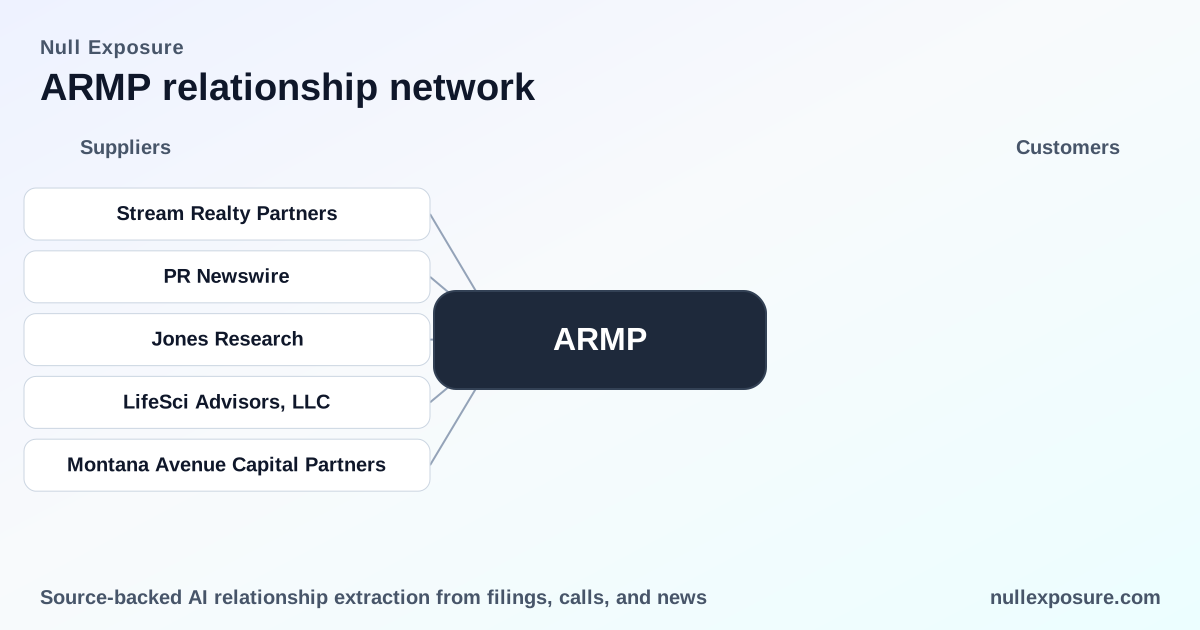
Armata Pharmaceuticals (ARMP) — How a single grant relationship shapes near-term revenue and program momentum
Armata Pharmaceuticals develops bacteriophage therapies and monetizes primarily through research and development grants and program partnerships that underwrite clinical work rather than through commercial product sales. Grant funding tied to the AP‑SA02 Staphylococcus aureus program, administered through the Medical Technology Enterprise Consortium (MTEC), is a material recurring revenue source that underpins near‑term cash flow and program continuity. For a concise view of our coverage and tools, visit the NullExposure homepage: https://nullexposure.com/.
How Armata’s operating model converts research partnerships into runway
Armata is a clinical‑stage biotech with limited commercial revenue; the company finances development through non‑dilutive grants and strategic collaborations that reimburse program costs. This operating model produces episodic but high‑visibility revenue lines that reduce pressure on capital markets while leaving operating leverage—positive upside from clinical success—remote until commercialization. The balance sheet and recent operating metrics reflect that dynamic: Revenue TTM of about $4.9M and negative operating margins indicate dependence on outside funding to sustain R&D.
The MTEC connection: a long‑term award funding AP‑SA02
Armata’s primary documented customer relationship in the public record is with the Medical Technology Enterprise Consortium (MTEC). Two contemporaneous news items in May 2026 report the same operational fact: Armata booked $1.1M of grant revenue in Q4 2025 as MTEC’s share of costs for the AP‑SA02 program, down slightly from $1.2M in Q4 2024.
- Armata’s PR Newswire release for its fourth quarter and full‑year 2025 results states the company recognized $1.1 million of grant revenue for the quarter ended December 31, 2025, representing MTEC’s portion of AP‑SA02 costs. According to the filing release, this revenue line is directly attributable to the MTEC partnership (PR Newswire, Q4 & FY2025 results, published May 2026).
- A secondary report on BayelsaWatch echoes that Q4 2025 grant revenue was $1.1 million, down from $1.2 million in Q4 2024, reflecting MTEC’s contributions to the AP‑SA02 program (BayelsaWatch, coverage of Armata Q4/FY2025, May 2, 2026).
These two sources document the same revenue event from separate editorial perspectives; both are relevant for analysts tracking programized grant recognition.
Contracting posture and program maturity: what the MTEC Agreement signals
Armata disclosed a multi‑year agreement with MTEC that establishes the structure of this relationship. The company’s public disclosures show the initial MTEC Award was $15.0 million (entered June 15, 2020), later modified to $16.3 million on September 29, 2022, and further increased by $5.3 million in July 2024 to a total of $21.6 million, with the program term extended into the third quarter of 2025. This is explicit contract language from Armata’s filings describing the "MTEC Agreement" administered by the U.S. Department of Defense and managed by NMRC/NAMD with funding from Defense Health Agency and Joint Warfighter Medical Research Program.
- Contract type and posture: The MTEC relationship is explicitly long‑term and programmatic, with multiple formal modifications and multi‑year funding tranches that convert program milestones into scheduled reimbursements.
- Program maturity: Multiple modifications and extensions through July 2024 demonstrate a maturing, government‑managed program rather than a one‑off research grant.
Because the contract excerpt names MTEC directly, the long‑term characteristic is attributable to that relationship.
Why this relationship matters to revenue, runway, and risk
The MTEC grants are not ancillary: they provide predictable, program‑linked cash inflows and reduce financing risk while the AP‑SA02 program advances through development. Given Armata’s Revenue TTM of roughly $4.9M and negative operating margins, a recurring quarterly grant in the low‑millions is a meaningful contributor to near‑term revenue and program runway.
Key implications:
- Concentration risk: A material portion of recent grant revenue traces to MTEC and the AP‑SA02 program; sponsorship concentration on a government consortium concentrates counterparty risk into a single program.
- Counterparty quality and criticality: Funding comes through a Department of Defense‑administered vehicle, which increases counterparty creditworthiness relative to smaller private sponsors and elevates the strategic importance of the AP‑SA02 program to Armata’s near‑term financial plan.
- Operational gating: Program extensions and modifications historically drove additional funding; future extensions or milestone approvals will directly affect cash flows and the company’s ability to sustain R&D activities without dilutive financing.
Relationship-by-relationship readout (complete list from public coverage)
Below are the relationships disclosed in the public results set, each followed by a short plain‑English summary and the source.
-
MTEC — PR Newswire (Q4 & FY2025 results, May 2026): Armata recognized $1.1 million of grant revenue in Q4 2025 as MTEC’s share of costs for the AP‑SA02 Staphylococcus aureus bacteremia program. The company cited this grant line in its formal earnings release for FY2025.
Source: Armata press release via PR Newswire, Q4 and full‑year 2025 financial results (published May 2026). -
MTEC — BayelsaWatch coverage (May 2, 2026): Independent reporting noted Q4 2025 grant revenue of $1.1 million, slightly down from $1.2 million in Q4 2024, specifically reflecting MTEC contributions to the AP‑SA02 program.
Source: BayelsaWatch article summarizing Armata Q4/FY2025 results (May 2, 2026).
The two entries reference the same contractual partner and revenue recognition event; both confirm that MTEC funding is the dominant disclosed grant flow in the covered period.
Investment implications and near‑term catalysts
- Positive: Government‑administered, multi‑year funding through MTEC reduces financing tail risk and validates the strategic importance of AP‑SA02; continued grant recognition supports R&D continuity and reduces immediate dilution needs.
- Negative: Revenue concentration and program timing risk mean that delays in milestone payments or lack of further contract modifications would materially pressure operating cash flow; the company’s negative operating margins and limited institutional ownership magnify governance and liquidity sensitivity.
Monitor these catalysts: further MTEC modifications, AP‑SA02 clinical readouts or regulatory milestones, and quarterly grant recognition trends. For ongoing monitoring and richer relationship analytics, see the NullExposure homepage: https://nullexposure.com/.
Bottom line
Armata’s relationship with MTEC is a strategic, long‑term funding mechanism that materially supports the AP‑SA02 program and contributes a meaningful slice of near‑term revenue. For investors, the MTEC arrangement is both a stabilizer of runway and a concentration risk—its evolution will dictate whether Armata can extend development without dilutive capital events.