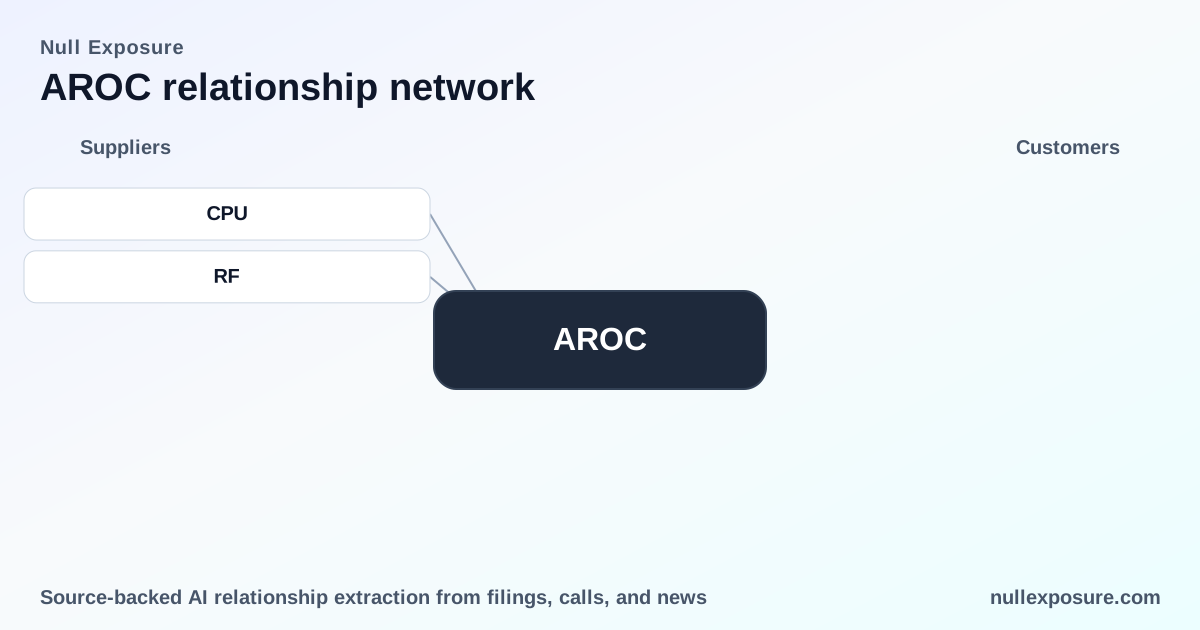
Archrock (AROC): Customer Relationships That Drive Stable Compression Cash Flow
Archrock operates and monetizes as a specialized provider of natural gas compression services and aftermarket support; it earns fixed monthly fees for long‑duration contract operations and transactional revenue from parts and maintenance, while its fleet ownership and services model generates predictable recurring cash flow. For investors, the company presents a subscription‑style revenue backbone with pockets of customer concentration and strategic counterparty relationships. Learn more about how these customer ties shape credit and growth dynamics at https://nullexposure.com/.
How Archrock sells compression as an ongoing service
Archrock’s business is centered on two complementary revenue streams: Contract Operations (installed fleet and operations delivered to customers) and Aftermarket Services (parts, maintenance, overhauls). The company charges fixed monthly fees for contract operations, generally priced by horsepower, creating recurring revenue akin to a subscription for compression capacity. Archrock typically uses a master service agreement framework and supplements it with site‑level agreements, which standardizes terms across customers and simplifies scaling.
Key operating characteristics that drive investor judgments:
- Contracting posture: predominantly long‑term with rolling terms. Archrock reports remaining performance obligations of roughly $840 million tied to contract operations, recognized through 2029, and commonly structures initial terms of 12–36 months (up to 60 months for the largest units) before shifting to month‑to‑month with 30‑day termination rights.
- Framework agreements and modular site addenda reduce negotiation friction and facilitate rapid deployment across new sites while preserving standardized liability profiles.
- Aftermarket business is shorter‑term and transactional—Archrock does not disclose aggregate transaction price for aftermarket remaining obligations because most aftermarket contracts have original terms under one year.
- Geographic footprint is U.S.‑centric, with the core market across major domestic natural‑gas and crude producing regions.
Together, these elements produce high visibility on contract operations revenue and more episodic aftermarket upside, a pattern attractive to income‑oriented investors valuing predictable cash generation.
Concentration and material counterparties — watch the top accounts
Archrock’s customer base is deep but not diffuse. Five largest customers accounted for roughly one‑third of contract operations and aftermarket revenue in recent years, and the company disclosed that one customer comprised $121.4 million (over 10%) of consolidated revenue in 2024. That concentration places Archrock in the middle of two extremes: diversified across hundreds of sites, yet material exposure to a handful of large counterparties.
The company also discloses a specific counterparty relationship with Hilcorp and affiliates, where Hilcorp generated roughly $40.7 million of revenue in 2024 and has a board‑affiliated director, underscoring both commercial scale and governance linkage. These dynamics create revenue predictability but elevated counterparty risk if a major customer reduces demand.
Contract maturity, criticality and service positioning
Archrock’s contracts combine multi‑year initial commitments with rolling month‑to‑month arrangements thereafter. This structure yields several investor‑relevant implications:
- Revenue criticality: Compression services are operationally critical for midstream and production customers; loss of service typically translates into immediate operational pain for counterparts, supporting strong retention economics.
- Maturity and scale: The company sources contract operations revenue from approximately 280 customers across major U.S. basins, reflecting a mature customer base with long operational relationships.
- Concentration trade‑off: While the base is broad, top customers drive a meaningful share of revenue, a factor investors must weigh against the structural stickiness of the service offering.
Customer relationships disclosed in public sources
FlowCo (FLOC) — asset acquirer and post‑deal commentary
FlowCo disclosed that after acquiring HPGL and VRU assets from Archrock in August, the buyer generated significant free cash flow and reduced leverage to below pre‑acquisition levels, implicitly validating the value of the assets purchased from Archrock. This was noted in FlowCo’s Q4 2025 earnings call and in a May 2026 press/earnings summary. (Sources: FlowCo Q4 2025 earnings call; coverage in The Globe and Mail, May 2026.)
Hilcorp and affiliates — recurring buyer and governance link
Archrock’s filings show a multi‑year revenue relationship with Hilcorp and affiliates, which generated $40.7 million in revenue in 2024 and whose affiliates have had board representation since 2019; accounts receivable related to Hilcorp were disclosed in the 2024 financial statements. This establishes Hilcorp as a material, recurring customer with influence at the board level. (Source: Archrock disclosures in fiscal 2024 filings.)
What these relationships imply for investors
- Revenue visibility is high: Long initial contract terms, MSAs, and fixed monthly fee mechanics create durable cash flows that support Archrock’s investment grade‑like operational predictability.
- Concentration is a measurable risk: Single large customers account for double‑digit percentages of revenue; investors should monitor renewals and any customer‑specific operational issues.
- Counterparty governance linkage intensifies scrutiny: Board affiliation with a customer like Hilcorp is a governance signal that blends commercial alignment with potential conflict considerations.
- Strategic monetization of assets occurs: Third‑party acquirers (e.g., FlowCo) have bought Archrock assets, reducing seller leverage and indicating that Archrock’s assets are fungible in secondary transactions—a point investors should track for portfolio optimization and capital allocation implications.
Investment takeaways and next steps
Archrock’s model blends subscription‑like contract operations with transactional aftermarket services, delivering predictable EBITDA and portfolio optionality through fleet and asset sales. Key risks are concentrated exposure to top customers and the operational dependence on U.S. production volumes, but the company’s contractual framework and service criticality support stable cash generation and growth through fleet expansion or asset monetization.
For deeper diligence on counterparty exposures and the asset‑sale activity referenced above, visit https://nullexposure.com/ or review Archrock’s 2024–2025 filings and the FlowCo Q4 2025 call for primary documentation.
Bold takeaway: Archrock is a cash‑generative service provider with subscription economics and tangible concentration risk—investors should value its predictability while monitoring top‑customer renewals and asset monetization cadence.