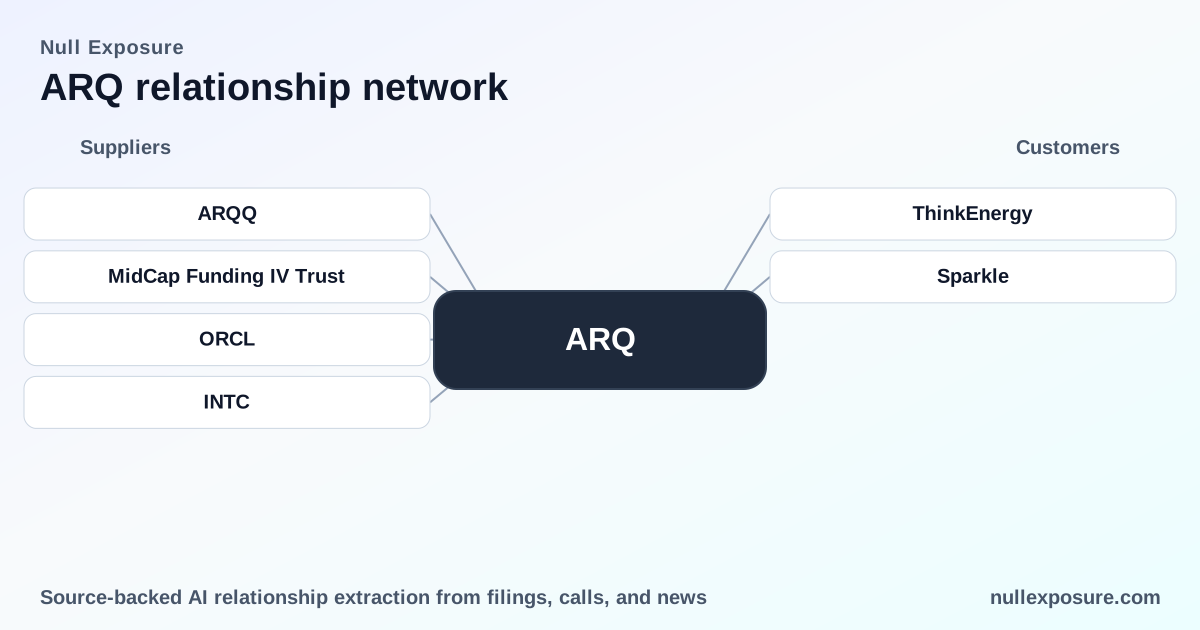
ARQ (Arq, Inc.) Customer Relationships: Concentration, contract mix, and North American exposure
Thesis — Arq monetizes by manufacturing and selling activated carbon and related consumables to utilities, industrial users, and municipal water/wastewater customers; revenue is driven primarily by repeat consumable sales under short-to-medium term contracts while selective long-term supply arrangements create multi-year revenue amortization. Investors should value Arq as a North American consumables supplier with meaningful customer concentration, mixed contract tenors, and operational exposure tied to pollution-control demand. For more signal-driven relationship intelligence, visit https://nullexposure.com/.
What investors need to know up front
Arq’s commercial model is straightforward: sell consumable AC products and related treatment solutions to coal-fired power generators, industrial customers, and municipal water/wastewater plants across North America. The company reported roughly $120.3M in trailing revenue and negative profitability through the latest reported period, reflecting a growth/scale profile with margin pressure. Contracting is a mix: routine consumable sales generally run one to five years, while at least one customer arrangement is being amortized over 15 years, indicating selective long-term supply commitments coexist with shorter-term repeat orders.
Relationship snapshots — the full list
Below are the two customer/partner relationships flagged in the available intelligence. Each entry is summarized plainly and linked to its source.
ThinkEnergy — inaugural issuance tied to Liquidity.io initiative
ThinkEnergy is referenced as the inaugural issuer on Liquidity.io, a platform launch story that also mentions ARQ Securities receiving a digital ATS license; the mention connects ThinkEnergy to a broader financing/distribution event tied to new market infrastructure. According to The Defiant press release dated March 9, 2026, ThinkEnergy debuted as Liquidity.io’s first issuance. (Source: The Defiant press release, 2026-03-09 — https://thedefiant.io/news/press-releases/liquidity-io-to-launch-with-over-a-billion-in-lois-in-alternative-investments-after-arq-securities-receives-its-digital-alternative-trading-system-ats-license)
Sparkle — NaaS uptake linked to licensing of Arqit SKA (reported by Arqit)
A fiscal-year disclosure for Arqit notes that take-up of Sparkle’s Network-as-a-Service offerings requires licenses for Arqit’s SKA software, which would generate revenue to Arqit; this mention positions Sparkle as a commercial channel for SKA licensing. The statement appears in Arqit’s FY2024 results announcement (investor relations release dated March 9, 2026). (Source: Arqit FY2024 press release, 2026-03-09 — https://ir.arqit.uk/news-events/press-releases/detail/98/arqit-quantum-inc-announces-financial-and-operational-results-for-the-fiscal-year-2024)
How the disclosed constraints shape the commercial picture
Arq’s disclosed relationship constraints deliver a coherent operating-model signal that matters for valuation and operational due diligence:
-
Contracting posture is mixed but predictable. The company states that consumable sales are generally contracted for one to five years and that performance obligations for consumables “do not extend beyond one year,” indicating a high cadence of repeat purchasing and relatively short renegotiation cycles for most revenue. Simultaneously, a disclosed accounting treatment references a long-term supply contract executed in 2020 that is being amortized over 15 years, demonstrating the firm also takes on selective, multiyear commitments that smooth revenue recognition. This mix supports recurring sales while creating pockets of longer-term revenue visibility.
-
Geographic concentration is North America. Arq reports the majority of revenue is U.S.-derived, with Canada as a secondary market; a revenue breakdown shows the U.S. accounting for the bulk of top-line dollars. This regional concentration aligns commercial risk with North American regulatory and industrial cycles.
-
Counterparty mix includes public-sector and large enterprise exposure. The company explicitly sells to municipal wastewater and industrial customers, and also serves coal-fired utilities and other large industrial accounts. This blend creates diverse buyer types but also ties revenue to regulated infrastructure and large-ticket procurement cycles.
-
Customer concentration is material. Revenue from the top three customers constituted approximately 36% of 2024 revenue, and a single “Consumables” customer represented about 21% of revenue in 2024; management warns that losing any of these customers would have a material adverse effect. Concentration is a primary investor-level risk.
-
Commercial role and segment focus are clear. Arq functions principally as a seller of core consumable products (activated carbon) and participates in manufacturing of those products for air, water, and soil treatment markets, defining it as a product-centric, manufacturing-led commercial model with repeat purchase economics.
-
Relationship maturity and stage. The firm classifies these customer relationships as active, supporting ongoing revenue streams, but the coexistence of short-term renewals and selective long-term contracts indicates an evolving maturity profile—established buyers with periodic procurement cycles plus deeper commitments where strategically warranted.
Investment implications and risk framing
- Revenue predictability is mixed. The short-term consumable contracts drive recurring orders and predictable volumes from established customers, but material customer concentration increases downside if any large account reduces purchases.
- Contractual smoothing exists. The 15-year amortized arrangement demonstrates management’s willingness to accept longer tenors in exchange for revenue stability, which supports valuation multiple normalization if margins improve.
- Regional exposure is explicit and narrow. North American focus reduces currency/geopolitical complexity but concentrates regulatory and demand risk in U.S./Canada industrial cycles.
- Profitability is unresolved. Arq’s latest results show meaningful revenue but negative profit metrics, underscoring execution and margin improvement as near-term value drivers.
If you are evaluating commercial risk or preparing model scenarios, these relationship signals — contract tenor mix, customer concentration, North American footprint, and buyer types — should be primary levers in your assumptions. For structured relationship intelligence and ongoing monitoring, see our coverage hub at https://nullexposure.com/.
Bottom line
Arq is a manufacturing-focused seller of activated carbon whose business is driven by repeat consumable sales in North America, tempered by material concentration among a few large customers and a hybrid contract mix that includes both short-term consumable arrangements and at least one long-term supply commitment. Investors should weight customer concentration and margin recovery as the two most consequential variables when sizing upside and downside scenarios.