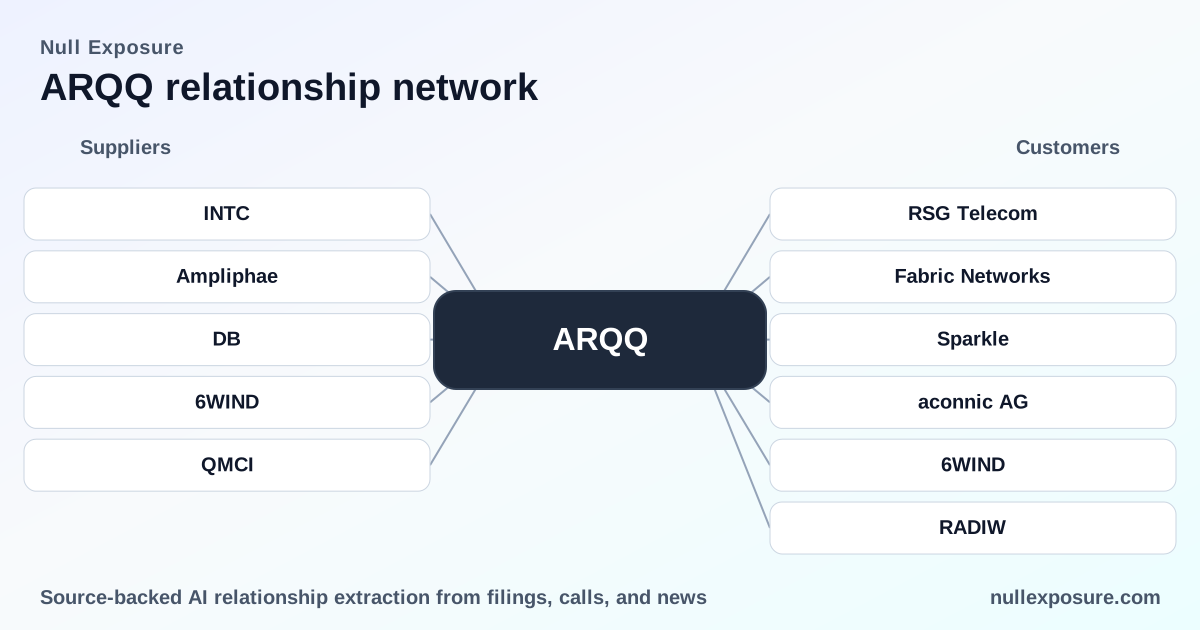
Arqit Quantum (ARQQ): Customer relationships that define an early-stage telco channel play
Arqit builds quantum-safe encryption and cryptographic key generation software that it monetizes by licensing platform components, embedding technology into telco and network vendor products, and signing distribution/master agreements with large carriers and systems integrators. Revenue remains nascent and partner-driven; commercial progress is defined by integrations with optical, routing and carrier-edge vendors and a small set of telecom customers and channel partners. For deeper customer mapping and comparable vendor exposure, visit https://nullexposure.com/.
How to read Arqit's customer map: a concise investor thesis
Arqit is a software-first security vendor targeting telecom operators and network infrastructure suppliers. The company’s commercial model emphasizes channel distribution and OEM integrations rather than direct enterprise sales: it licenses key-generation and quantum-safe tooling to carriers and embeds technology inside vendors’ platforms, then reaches end customers through telco contracts. Given $0.53M of trailing revenue and negative EBITDA, the business is in commercial scale-up mode where each announced telco or vendor integration materially increases market credibility.
Company-level operating signals investors should weigh
- Channel-first contracting posture. Multiple press disclosures describe master distribution deals and portfolio inclusions that position Arqit behind channel partners and service providers rather than selling point solutions directly.
- Concentration risk and early maturity. Commercial traction is concentrated in a handful of telco partners and integrator relationships; revenue and gross profit remain small while product integrations advance.
- Partnership criticality. Arqit’s go‑to‑market depends on vendor integrations (optical transponders, carrier edge routers, virtual service routers) to reach tier‑1 telcos at scale.
- Contract conditionality. Publicly cited distribution agreements include cancelable terms for certain components, which creates downside optionality in projected satellite-related revenue streams.
- Governance and capital structure signals. High insider ownership and a reverse split history indicate founder control and prior capitalization actions that investors should incorporate into expectations about dilution and strategic direction.
For a concise, professional summary of Arqit’s customer exposures and partner progress, see https://nullexposure.com/.
Relationship-by-relationship: what each partner means for revenue and risk
Sparkle
Arqit’s SKA-Platform is integrated into Sparkle’s Quantum‑Safe over Internet (QSI) solution operating at the optical transponder layer (L1), demonstrating optical-layer, telco-grade deployment capability and serving as a reference for other carriers. This integration is documented in Arqit’s press release and third‑party coverage (Arqit IR press release; InvestingNews, March 2026).
RSG Telecom
RSG Telecom is cited among customers in Arqit’s FY2025 financial results as a deployed telco customer, reinforcing the company’s strategy of replicating a single offering across network operators. Arqit’s FY2025 results and related press materials list RSG Telecom as a repeatable commercial reference (Arqit FY2025 press release; GlobeNewswire/StockTitan, Dec 9, 2025).
Fabric Networks
Arqit identifies Fabric Networks as another telecom operator where its product has been deployed and will be used to drive additional telco sales, underlining repeatability within the service-provider segment (Arqit FY2025 disclosure; GlobeNewswire/StockTitan, Dec 9, 2025).
BT Group PLC
Arqit reported having signed a master distribution agreement with BT Group for a still‑unrealized satellite component of its technology; the public language notes these master agreements are cancelable under certain conditions, signaling conditional upside rather than guaranteed backlog (NewsfileCorp release summarizing Arqit disclosures, May 2026).
Sumitomo Corp.
Sumitomo is the other named master distribution partner for the satellite element; the agreement is structured as a master distribution arrangement that is similarly described as cancelable under specified terms, which constrains how investors should treat that revenue opportunity until contractual milestones are met (NewsfileCorp reporting of Arqit comments, May 2026).
Tomorrow Street
Tomorrow Street — the Vodafone/Luxembourg incubator joint venture — selected Arqit as a Scaleup Partner to add quantum security solutions to its portfolio, providing access to Vodafone’s incubation and commercial channels and a notable enterprise/telco endorsement (Arqit press release; GlobeNewswire and SahmCapital coverage, April–May 2026).
aconnic AG
Arqit and aconnic presented a quantum-safe industrial OT security gateway firewall at Mobile World Congress 2026, integrating Arqit’s post‑quantum cryptography into aconnic’s iGate 3000 firewall product and demonstrating industrial and OT use‑case expansion beyond core telco infrastructure (TradingView coverage of MWC 2026).
6WIND
Arqit integrated its NetworkSecure key generation technology with 6WIND’s Virtual Service Router portfolio, enabling telco service providers to deploy quantum-safe services within virtualized network functions and strengthening Arqit’s OEM playbook for software-defined networks (GlobeNewswire, Feb 19, 2026).
RAD (RADIW)
Arqit integrated NetworkSecure with RAD’s ETX Carrier Edge platform to address “harvest now, decrypt later” risk scenarios and to embed quantum-safe key generation at the carrier-edge; multiple press and industry venues report this as a high‑performance telco partnership (Arqit IR press release; The Quantum Insider and industry press, March 2026). The RAD relationship is reported under ticker RADIW in market coverage.
RADIW (market-referenced)
Market outlets referencing RADIW cover the same RAD ETX integration and its implication for carrier-edge security and telco adoption; investors should treat RADIW mentions as market ticker coverage of the RAD collaboration rather than a separate commercial counterparty (industry articles and press aggregation, March 2026).
ARQ (corporate action)
Arqit issued a 25:1 reverse share split in a corporate filing covering FY2024, an action relevant to capital structure and float dynamics that influences investor liquidity and share-count calculations (Arqit IR press release regarding the reverse split, FY2024 disclosure).
Investment implications and risk checklist
- Upside drivers: OEM integrations with optical, carrier-edge and virtual router vendors plus inclusion in Vodafone’s Tomorrow Street program create distribution pathways to tier‑1 telcos. Each announced deployment increases Arqit’s referenceability and contract pipeline.
- Key risks: revenue concentration, small absolute revenue, conditional distribution agreements, and a high insider ownership profile that magnify governance and execution risk. Treat distribution agreements with BT and Sumitomo as optional upside until contracts pass non‑cancellation milestones.
- Time horizon: Commercialization will be stepwise—vendor integrations and telco trials translate into material recurring revenue only after scale deployments across multiple carriers.
Arqit’s customer map shows a classic early‑stage technology monetization strategy: validate in a narrow set of carrier customers and embed into vendor platforms to convert partnerships into scalable revenue. For analysts modeling Arqit, prioritize partner conversion timelines, contract enforceability and the cadence of OEM integration rollouts as primary drivers of valuation.
For more detailed partner exposure analysis and comparable vendor relationships, visit https://nullexposure.com/.