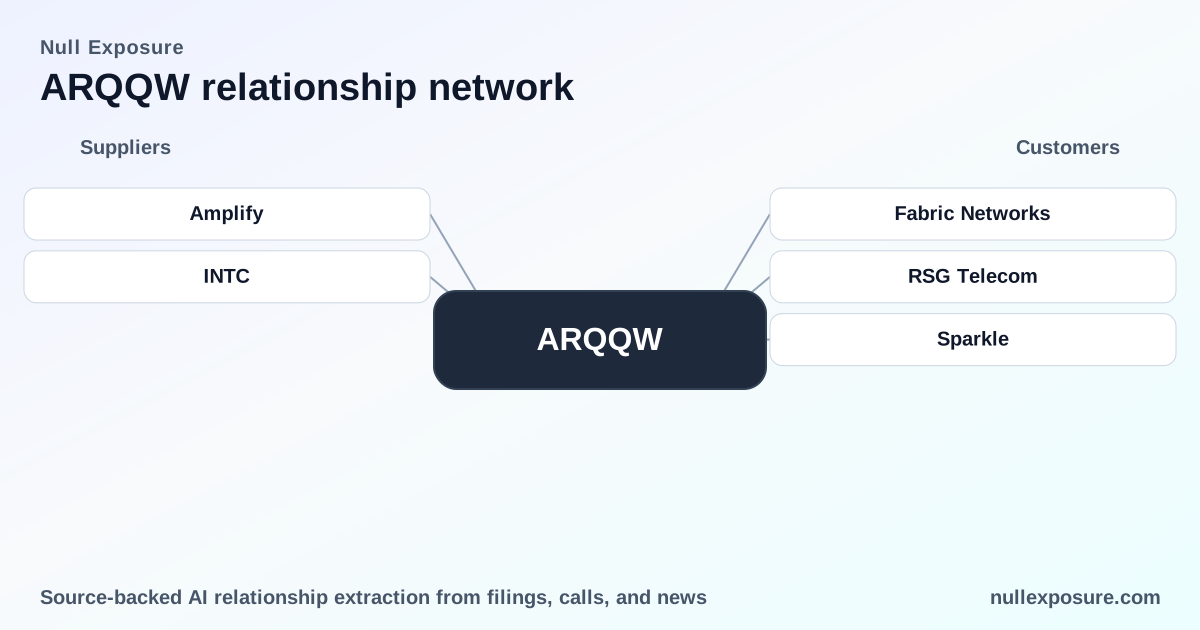
Arqit Quantum (ARQQW) — Customer relationships and what they mean for commercialization
Arqit sells quantum-resistant key distribution as a network service and through license agreements to telecommunications operators and their system partners. The company’s commercial model is focused on multi-year service contracts and licensing deals that enable carriers and infrastructure providers to offer “quantum-secure” connectivity to their customers; revenue recognition today is small but tied to contractual, recurring arrangements rather than one-off hardware sales. For investors and operators evaluating ARQQW relationships, the key question is whether these carrier-scale contracts convert into scalable, repeatable revenue that offsets the company’s current operating losses.
If you want an organized feed of customer signals on Arqit and similar names, visit https://nullexposure.com/ for continuously updated relationship intelligence.
What management disclosed in the 2025 Q4 call — the commercial facts
Management used the 2025 Q4 earnings call to highlight the company’s early commercial traction in the telecom market. Arqit announced a three-year network-as-a-service contract with Sparkle, and additional license agreements with RSG Telecom and its affiliate Fabric Networks. Those disclosures signal a deliberate go-to-market anchored in tier-one and regional carriers rather than broad direct-to-consumer deployments.
Financial context underscores the company’s stage: Revenue TTM is $530k with gross profit of $200k, while EBITDA is negative $34.7 million and diluted EPS is -$0.473. That profile defines Arqit as an early commercial vendor converting pilot and contract wins into modest revenue while still investing heavily in product and sales scaling.
The customer relationships, one by one
Sparkle — a multi-year carrier contract
According to Arqit’s 2025 Q4 earnings call, the company signed a three-year contract with Sparkle, a tier-one network operator to deliver a quantum secure network as a service. This is an explicit multi-year, operator-level deployment that positions Arqit as a platform provider to upstream carriers rather than only a component seller (2025 Q4 earnings call, disclosed March 2026). The three-year term signals contractual revenue visibility and an operator-scale use case.
RSG Telecom — additional license agreements
Management reported that Arqit signed license agreements or contracts with RSG Telecom as part of its telecom activities discussed on the same earnings call. This positions RSG as a regional carrier customer under licensing terms, adding geographic and commercial diversification to the company’s telecom book (2025 Q4 earnings call, disclosed March 2026).
Fabric Networks — affiliate deployment and ecosystem partner
The earnings call also referenced Fabric Networks as an affiliate of RSG Telecom that entered into additional license agreements or contracts with Arqit. That relationship indicates Arqit’s strategy to penetrate operator ecosystems via both primary carriers and their affiliated service providers, which can accelerate distribution across enterprise and wholesale channels (2025 Q4 earnings call, disclosed March 2026).
How these relationships shape Arqit’s operating model
- Contracting posture: The Sparkle deal is explicitly multi-year, and the RSG/Fabric notices are described as license agreements or contracts — this indicates Arqit’s primary contracting posture is term-based, recurring revenue and licensing rather than spot transactions. That structure favors revenue visibility when contracts scale.
- Concentration: Current disclosed wins are concentrated in the telecom vertical, specifically regional and tier-one carriers. High vertical concentration increases execution risk if carrier adoption stalls, but it also reduces go-to-market complexity when focused on operator partners.
- Criticality to customers: Quantum key distribution is positioned as a security infrastructure layer; for carriers seeking differentiated security services, Arqit’s offering is functionally critical. However, the magnitude of revenue today is small relative to the company’s operating losses, so criticality has yet to translate into material financial contribution.
- Commercial maturity: The combination of multi-year contracts and low trailing revenue indicates early commercial maturity: Arqit has moved beyond proofs-of-concept to contract wins, but the business is still scaling revenue and remains loss-making with negative EBITDA.
Note: the relationship-level disclosures are limited to the items management named in the 2025 Q4 earnings call; no additional constraint documents were identified in the customer-scope extraction, which itself is a company-level signal that the disclosed customer list is concise in public remarks.
Risks and what to watch next
- Delivery and scale: The Sparkle three-year engagement creates a performance and ramp risk; investors should monitor implementation milestones and revenue recognition tied to that contract. Arqit’s ability to convert contract terms into sustained cash flows will determine valuation upside.
- Revenue concentration: With the telecom vertical dominating the disclosed customer list, customer concentration risk is high until the company demonstrates scaling across multiple large operators and broader channels.
- Capital intensity and timing: The balance sheet and operating losses (EBITDA -$34.7M) imply continued financing needs until recurring telecom revenues materially increase. Watch quarterly revenue progression and gross margins for evidence of scalable unit economics.
- Competitive adoption: Carrier procurement cycles are long and security standards evolve; Sparkle and RSG/Fabric wins are meaningful but the company must prove that its solution is the standard carrier choice.
Investor takeaway and practical next steps
- Positive: Arqit has established carrier contracts that shift it from pure R&D into commercial service delivery, and a three-year Sparkle contract is a clear validation of operator demand.
- Negative: The business is still early stage from a revenue and profitability standpoint; disclosed deals are telecom-focused and require successful execution to justify a re-rating.
For investment or operational diligence, prioritize obtaining contract-level milestones (deployment timelines, revenue recognition schedules, performance SLAs) and a pipeline breakdown by vertical and geography. If you want continuous updates on Arqit’s customer signals and other enterprise relationships, see https://nullexposure.com/.
Final recommendation: treat the Sparkle, RSG Telecom and Fabric Networks disclosures as proof points of commercial traction — valuable for directional conviction — but require measurable revenue ramps and delivery verification before upgrading financial forecasts or operational commitments.