Arcutis (ARQT): Commercial relationships that shape near-term revenue and geographic expansion
Arcutis Biotherapeutics develops and commercializes dermatology drugs and monetizes through direct product sales in North America and through licensing partnerships in Asia. Revenue today is a combination of U.S./Canada product sales and milestone/upfront license receipts from regional partners, with material customer concentration and short payment terms shaping cash conversion. For a concise view of partner exposure and contract signals, visit https://nullexposure.com/.
Quick read: what drives the commercial profile
Arcutis’s commercial model has two clear pillars: direct sales to wholesalers and distributors in the U.S. and Canada, which generate recurring product revenue, and licensing partnerships in key Asian markets that provide upfront payments and milestone receipts. That mix produces high gross margins on product sales but also a revenue stream that is lumpy — large upfront license fees (e.g., Sato) and milestone payments (e.g., Huadong) punctuate otherwise steady but concentrated distributor revenue.
How each partner fits into ARQT’s revenue map
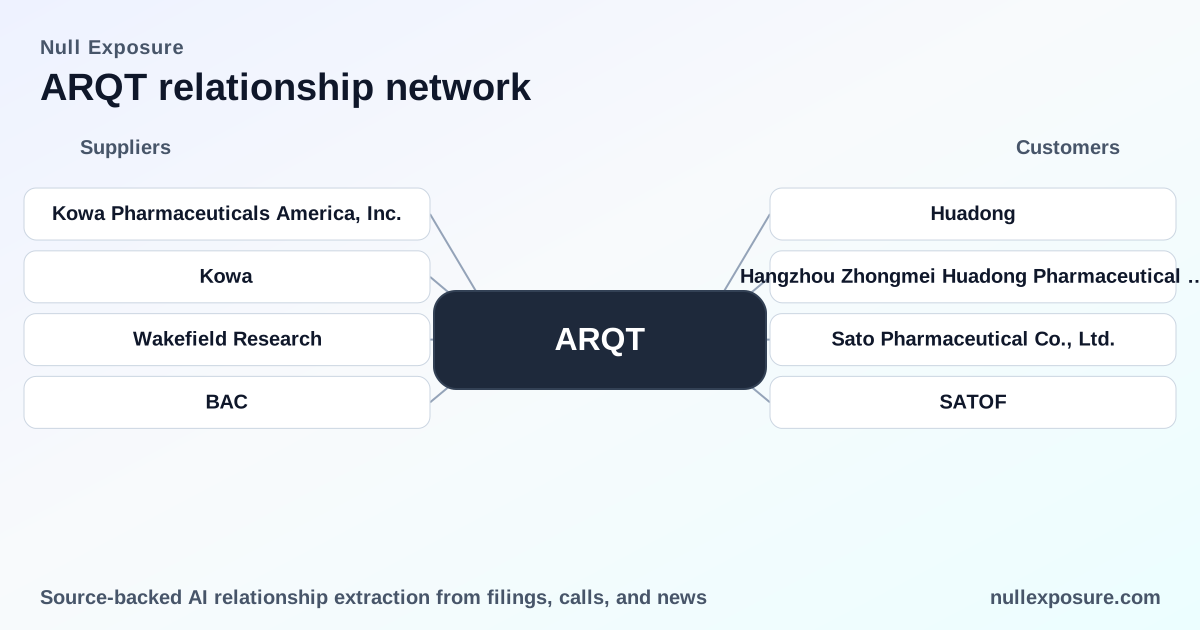
Below I cover every partner relationship listed in public coverage and transcripts. Each short entry states what the relationship is and where the information was reported.
-
Huadong — According to the Q4 2025 earnings call transcript, Arcutis recorded a $2 million other revenue item in the fourth quarter from a Huadong milestone payment, indicating active milestone-based licensing economics in that relationship (InsiderMonkey, FY2026). Source: InsiderMonkey Q4 2025 earnings call transcript (reported Mar 2026).
-
Hangzhou Zhongmei Huadong Pharmaceutical Co., Ltd. — The company’s 10-K summary referenced an agreement with Hangzhou Zhongmei Huadong for Greater China and Southeast Asia, positioning Huadong as Arcutis’s regional commercialization partner in those territories (TradingView recap of ARQT 10‑K, FY2026). Source: TradingView summary of ARQT SEC 10‑K (Mar 2026).
-
Sato Pharmaceutical Co., Ltd. — Arcutis disclosed a licensing agreement with Sato for Japan, establishing Sato as the Japan commercialization partner; the 10‑K language explicitly lists Sato alongside Huadong as strategic regional licensees (TradingView summary of ARQT 10‑K, FY2026). Source: TradingView summary of ARQT SEC 10‑K (Mar 2026).
-
Sato (SATOF) — Management reported that other revenue fell to $4 million in 2025 versus $30 million in 2024 because 2024 included a $25 million upfront payment from Sato under the Japan license agreement, signaling the materiality and lumpiness of the Sato upfront (InsiderMonkey Q4 2025 earnings call transcript, FY2026). Source: InsiderMonkey Q4 2025 earnings call transcript (reported Mar 2026).
-
SATOF — The market record duplicates the Sato disclosure under the SATOF ticker, again documenting the $25 million upfront payment in 2024 and the subsequent decline in license-related other revenue in 2025, which highlights revenue volatility tied to one-off license receipts (InsiderMonkey Q4 2025 earnings call transcript, FY2026). Source: InsiderMonkey Q4 2025 earnings call transcript (reported Mar 2026).
Constraints and what they imply for investors
Public disclosures and the relationship record establish several company-level operational constraints that shape risk and upside.
-
Contracting posture — short payment cycles. The company states payment terms generally between 30–65 days, which produces relatively swift cash conversion but also exposes ARQT to standard distributor timing and chargeback mechanics. This is a working-capital characteristic rather than a long-term barrier to entry.
-
Customer concentration — material. The company reports that major customers account for roughly 55% of gross product sales, a concentration signal that increases revenue volatility if one large buyer shifts demand or negotiates pricing concessions.
-
Geographic footprint — North America is primary for product sales. Arcutis sells product in the United States and Canada; regulatory approvals and commercial revenue are currently limited to these jurisdictions per company disclosures. Licensing deals expand the company’s presence internationally but do not replace North American product economics. This is a company-level geographic signal, not an attribute of any single partner.
-
Counterparty exposure to government pricing and reimbursement rules. Public language highlights risks from mandatory discounts, rebates, and import or reimbursement policy changes that can compress net prices, reflecting the healthcare payor environment rather than specific partner actions.
-
Role and channel — B2B seller to resellers/wholesalers. Arcutis sells to wholesale customers who then resell to pharmacies, providers, and patients; the company recognizes revenue at the point customers obtain control, making distributor terms, chargebacks, and rebates operationally important.
-
Relationship maturity — active commercial phase. Products launched between 2022–2024 are in active commercial stages and generating product revenue; license agreements are generating upfront and milestone revenue, so the business combines mature commercial operations in North America with early-stage regional partnerships.
Key takeaways for investors
-
Revenue mix is bifurcated. Product sales in North America deliver recurring revenue and margins; Asian licensees deliver upfront and milestone cash that is material but irregular. The Sato upfront payment demonstrates how licensing inflates revenue in a single year and then normalizes afterward.
-
Concentration is a real risk. With major customers explaining roughly 55% of gross product sales, small shifts in purchasing or reimbursement could have outsized P&L effects.
-
Operationally simple but commercially exposed. Short payment terms and reseller distribution enable fast cash cycles, but the business remains exposed to payor dynamics, rebates and country-specific pricing rules that affect net realizable revenue.
-
International expansion is partner-led. Arcutis is executing through regional licensees (Huadong and Sato) rather than direct builds in Asia; that is capital-efficient but channels control and future margin to partners.
For further signal extraction on partner exposure, contract terms, and concentration patterns, explore ongoing monitoring and the company filings at https://nullexposure.com/.
Final view
Arcutis is a commercial-stage dermatology biotech with predictable North American product cashflows tempered by lumpy, material license receipts from strategic regional partners. Investors should value the steady margin profile of product sales while explicitly modeling the timing risk attached to license upfronts and milestone payments, and the sensitivity to a concentrated customer base and payor-driven net price adjustments.