Artelo Biosciences (ARTL): Clinical partnerships as the path to value for a research-stage cannabinoid therapeutics developer
Artelo Biosciences operates as a clinical-stage biopharmaceutical company focused on modulating the endocannabinoid system and monetizes through clinical development, supply of investigational product to third-party studies, and eventual licensing or commercialization of clinical-stage assets. Public financials as of the quarter ended December 31, 2025 show no product revenue (Revenue TTM $0) and a negative EBITDA of -$7.44 million, underscoring that near-term value hinges on clinical advancement and partnership-derived funding rather than commercial sales. For a concise diligence platform focused on customer and partner evidence, visit https://nullexposure.com/.
Why a single investigator-initiated agreement matters for investors
Artelo’s recent publicized relationship is not a traditional commercial customer contract; it is an investigator-initiated, third-party funded clinical study agreement. These arrangements are strategically important for clinical-stage companies because they deliver several operational benefits without immediate commercialization obligations: they provide clinical exposure for the molecule, external validation of therapeutic hypotheses, and in some cases non-dilutive funding that reduces direct cash burn. At the same time, supply-only arrangements for investigational medicinal product (IMP) do not constitute recurring commercial revenue and therefore do not alter the company’s near-term revenue profile.
Customer relationships on record — exhaustive coverage
Belfast Health and Social Care Trust (BHSCT) — investigator-initiated glaucoma study
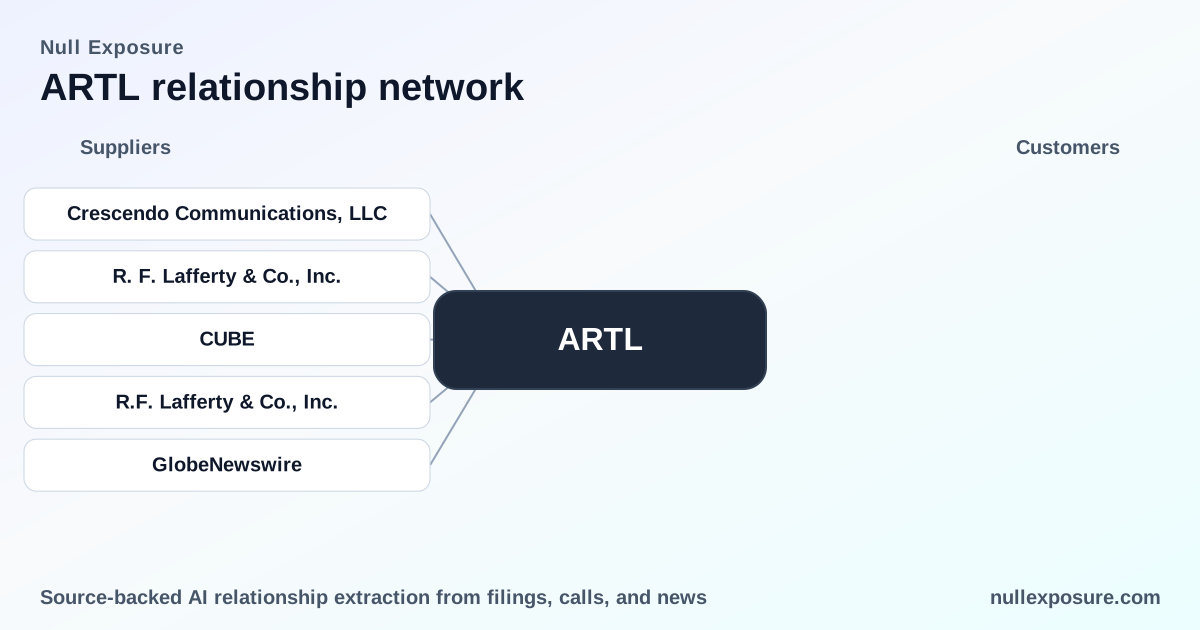
Artelo entered a Definitive Investigator-Initiated Study Agreement with the Belfast Health and Social Care Trust under which Artelo will supply ART27.13 capsules as the Investigational Medicinal Product (IMP) for a fully-funded third-party clinical study evaluating the candidate in glaucoma patients. The agreement is framed as a third-party funded clinical study rather than a commercial supply contract, indicating an R&D partnership focus. According to a GlobeNewswire press release dated March 18, 2026, the trial is fully funded by a third party and Artelo’s role is to provide the investigational product for oral administration in the study.
What this relationship reveals about Artelo’s contracting posture and concentration
The BHSCT agreement illustrates a deliberate R&D partnership posture: Artelo acts as a supplier of investigational product to external clinical investigators rather than as a commercial vendor to payor- or physician-driven markets at scale. From a portfolio concentration standpoint, the public record shows a single documented customer relationship in the reviewed period; this reflects the company’s current stage where partnerships are episodic and study-driven rather than broad transactional customer flows. The agreement’s structure implies low immediate revenue impact but high strategic importance for de-risking the ART27.13 program via independent clinical data.
Company-level operating model signals and constraints
The dataset records no customer-level contractual constraints for Artelo. That absence is itself a company-level signal and carries implications for operating model characterization:
- Contracting posture: Artelo is operating primarily in a sponsor/supplier role for clinical research, engaging in investigator-initiated study agreements rather than long-term commercial supply contracts.
- Revenue concentration: With publicly recorded Revenue TTM at $0 and a single documented clinical partnership, the company’s revenue base is currently non-existent and concentrated on potential future licensing or milestone events rather than recurring customer receipts.
- Criticality of relationships: Clinical partnerships are operationally critical to value creation—each agreement contributes to program de-risking and is therefore disproportionately important relative to its short-term cash contribution.
- Maturity of commercial execution: The company remains pre-commercial; the nature of recorded relationships affirms an early-stage commercialization runway focused on clinical data generation and external validation rather than sales channels or payer contracting.
These signals should be treated as structural characteristics of Artelo’s business model rather than attributes of any single customer unless explicitly stated in a contractual excerpt.
Investment implications — the trade-offs investors must price
- Catalyst-driven upside: The BHSCT study is a clinical catalyst that could improve ART27.13’s evidentiary profile and support future licensing or partner-led commercialization, which is the principal path to material revenue for Artelo given its current financials.
- Limited immediate cash impact: As a supplier to an investigator-initiated, third-party funded study, the arrangement contributes scientific and regulatory value more than near-term top-line growth.
- Concentration and operational risk: With a thin roster of partner relationships documented publicly, single-study outcomes will have outsized impact on perceived program momentum and investor sentiment.
- Capital efficiency benefits: Third-party funded studies reduce the company’s direct cash burden for clinical investigation, preserving capital for parallel activities or additional trials.
Key takeaway: Artelo’s partnerships are value-enhancing through de‑risking and evidence generation, but they do not transform the company into a revenue-generating enterprise in the near term.
Where to focus next in diligence
- Track the BHSCT trial milestones, enrollment progress, and any interim results that could trigger out‑licensing conversations or broaden investigator interest.
- Monitor additional investigator-initiated or sponsor-led agreements: a pattern of repeated third-party funded studies would indicate scalable external validation and a pathway to partnering.
- Watch cash runway and financing cadence given the zero revenue base; partnership funding reduces cash needs but does not replace commercialization receipts.
For a focused view of customer-relationship evidence and how it connects to corporate value drivers, further detail and ongoing updates are available at https://nullexposure.com/.
Closing assessment
Artelo is a research-first, partnership-driven biopharma where investor returns will be determined by clinical progress and the firm’s ability to convert therapeutic validation into licensing or commercial arrangements. The Belfast Health and Social Care Trust agreement is a constructive, non-dilutive clinical partnership that advances ART27.13’s evidentiary base, but investors must price the company as a pre-commercial entity with concentrated relationship exposure and outcome-dependent upside.