Arts‑Way (ARTW): What investors should know about customer relationships
Art's‑Way is a small-cap industrial manufacturer that monetizes through three commercial channels: sale of agricultural equipment and OEM parts, custom modular science and research buildings sold direct to end users, and private‑label manufacturing for larger farm‑equipment brands and dealers. Revenue is a mix of transactional, short‑cycle product sales and project‑based modular contracts, with international dealer distribution supplementing domestic demand. For a compact, relationship‑driven company like Art's‑Way, the composition and durability of customer ties drive both revenue volatility and valuation multiple. Learn more at https://nullexposure.com/.
How the company operates — a practical investor view
Art's‑Way runs a blended operating model. The Agricultural Products line operates with a transactional contracting posture, executing largely short‑term sales where a single performance obligation is delivery of product to a common carrier. The Modular Buildings business executes custom, project‑style contracts that can be short‑ or long‑term and typically sells directly to end users, including academic and government research institutions. The firm also supplies limited OEM parts to larger manufacturers and routes labeled products through independent dealers in North America, the UK, Australia, Canada and Japan.
- Contracting posture: short‑term for commodity agricultural products; variable (including long‑term) for modular building projects.
- Distribution: dual channel — direct end‑user sales for modular buildings and reseller/dealer distribution for farm equipment and private‑label products.
- Counterparties: a mix that explicitly includes government and public research buyers for modular building work, increasing contract criticality and procurement formality for that line.
These operational signals come from Art's‑Way segment disclosures in its fiscal filings and investor materials (company fiscal year ends November, latest quarter filed 2026‑02‑28).
Historical OEM and private‑label relationships — who bought Art's‑Way products
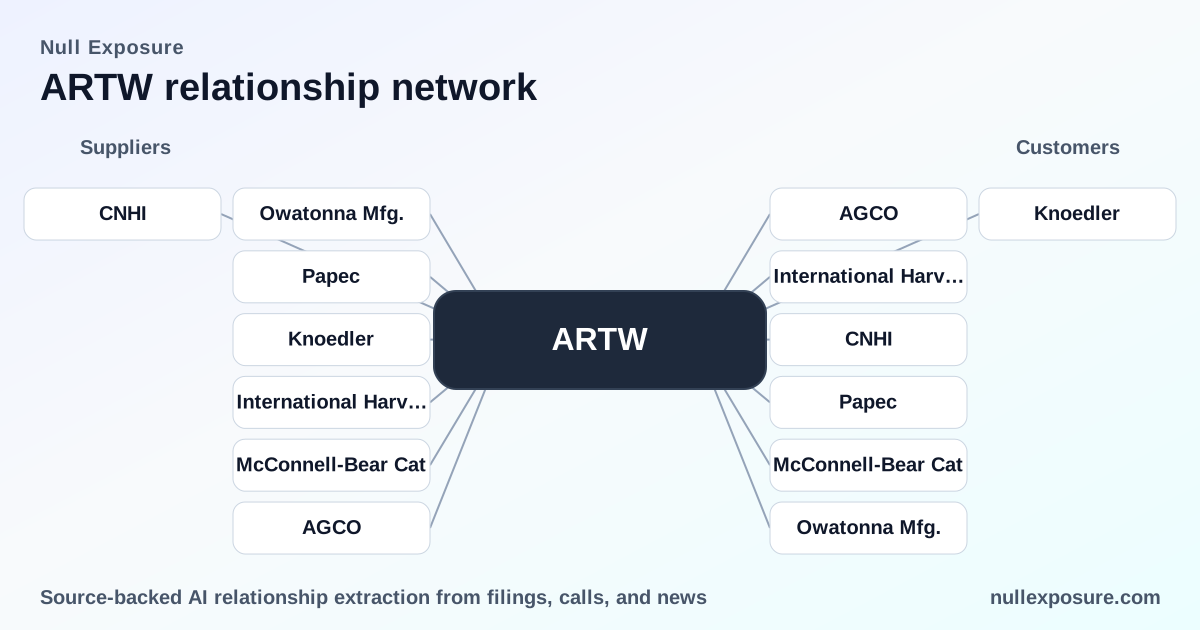
A contemporaneous profile of Art's‑Way documents a history of private‑label manufacturing for several recognizable names in farm machinery. The source for all relationship entries below is a Hoard's Dairyman article first indexed March 9, 2026, which recounts Art's‑Way's manufacturing clients historically (fiscal period referenced FY2016).
- Case New Holland (CNHI): Art's‑Way manufactured and private‑labeled feed mixers for International Harvester and its successor, Case New Holland, indicating a legacy OEM relationship with a major ag‑equipment OEM (Hoard's Dairyman, article noted in March 2026, referencing FY2016).
- CNHI (duplicate listing): The same Hoard's Dairyman report separately identifies CNHI in its entity mapping, reiterating Art's‑Way’s role as a private‑label producer for Case New Holland (Hoard's Dairyman, March 2026 / FY2016).
- International Harvester: The company explicitly lists International Harvester among historical private‑label customers, reflecting legacy production ties before corporate consolidation into CNHI (Hoard's Dairyman, March 2026 / FY2016).
- Massey Ferguson (AGCO): Art's‑Way produced private‑labeled mixers for Massey Ferguson, an entity now associated with AGCO, demonstrating past supply to a second tier of global OEMs (Hoard's Dairyman, March 2026 / FY2016).
- Papec: The Hoard's Dairyman piece includes Papec as a named private‑label customer, indicating Art's‑Way’s reach into smaller or regional manufacturers (Hoard's Dairyman, March 2026 / FY2016).
- McConnell‑Bear Cat: Art's‑Way supplied private‑labeled mixers to McConnell‑Bear Cat, further illustrating its role as contract manufacturer for specialty equipment brands (Hoard's Dairyman, March 2026 / FY2016).
- Owatonna Manufacturing: Listed among private‑label partners, Owatonna Mfg. is a historical buyer of Art's‑Way‑produced equipment (Hoard's Dairyman, March 2026 / FY2016).
- Knoedler: The company also supplied Knoedler under private‑label arrangements, completing the roster of legacy equipment partners cited in the article (Hoard's Dairyman, March 2026 / FY2016).
Each of these entries is drawn from the same industry profile that recounts Art's‑Way's private‑label mixer production history; the list demonstrates the company's longstanding role as a contract manufacturer for both global OEMs and regional equipment brands.
What these relationships mean for revenue quality and risk
- Revenue mix and predictability: Private‑label OEM work and independent dealer sales produce transactional, lower‑visibility revenue, consistent with agricultural product contracts described as short‑term and single‑obligation deliveries. By contrast, the Modular Buildings unit delivers lumpier, higher‑ticket, and higher‑visibility projects that can extend contract durations and require direct sales efforts.
- Concentration and bargaining power: The roster of OEM partners historically includes major manufacturers, which implies scale buyers and potential margin pressure on private‑label lines; however, Art's‑Way’s diversified roles as manufacturer, reseller, and direct seller reduce single‑channel dependence. The company explicitly supplies limited OEM parts and also leverages dealer channels in NA, APAC and EMEA to broaden end markets.
- Criticality and counterparty type: The Modular Buildings segment lists government, public health, academic and private pharmaceutical buyers as primary markets, making those projects mission‑critical for customers and subject to procurement protocols that can lengthen sales cycles but raise switching costs.
- Geographic exposure and growth vectors: Dealer distribution in the United States, Australia, Canada, Japan and the United Kingdom provides international reach but also exposes operations to currency, logistics and dealer inventory cycles.
These operational signals come from company segment disclosures combined with the historical partner list reported by industry media. The firm’s scale — trailing twelve‑month revenue ~$24.5M and market capitalization roughly $13.4M — frames these relationship dynamics in the context of a small, specialized industrial company.
Investment implications — read the balance between steadiness and cyclicality
Art's‑Way presents an investor profile of mixed predictability: stable, transactional agricultural sales offset by episodic, higher‑margin modular projects that can anchor long‑term client relationships with government and academic institutions. Key strengths include diversified go‑to‑market roles (manufacturer, dealer channel, direct seller) and a track record of OEM partnerships. Primary risks are margin pressure from large private‑label customers, the lumpiness of project revenue, and sensitivity to agricultural cycles and capital spending among dealers and OEMs.
For investors focused on customer‑driven revenue durability, the combination of short‑term agricultural contracts and the potential for longer modular contracts requires active monitoring of order backlogs, modular project pipeline, and dealer inventory trends as disclosed in quarterly filings.
Explore a structured summary of Art's‑Way relationships and corporate signals at https://nullexposure.com/.
Bottom line
Art's‑Way is a small but diversified industrial manufacturer with a dual revenue engine: short‑cycle, dealer and OEM‑oriented agricultural products and longer‑form, higher‑criticality modular building projects. Historical private‑label relationships with recognized OEMs corroborate the company’s role as a contract manufacturer, while segment disclosures point to both short‑term transactional revenue and the potential for long‑term, institutionally procured contracts. Investors should triangulate order book disclosures, dealer inventories and the modular project pipeline to assess near‑term volatility versus long‑term structural opportunity.