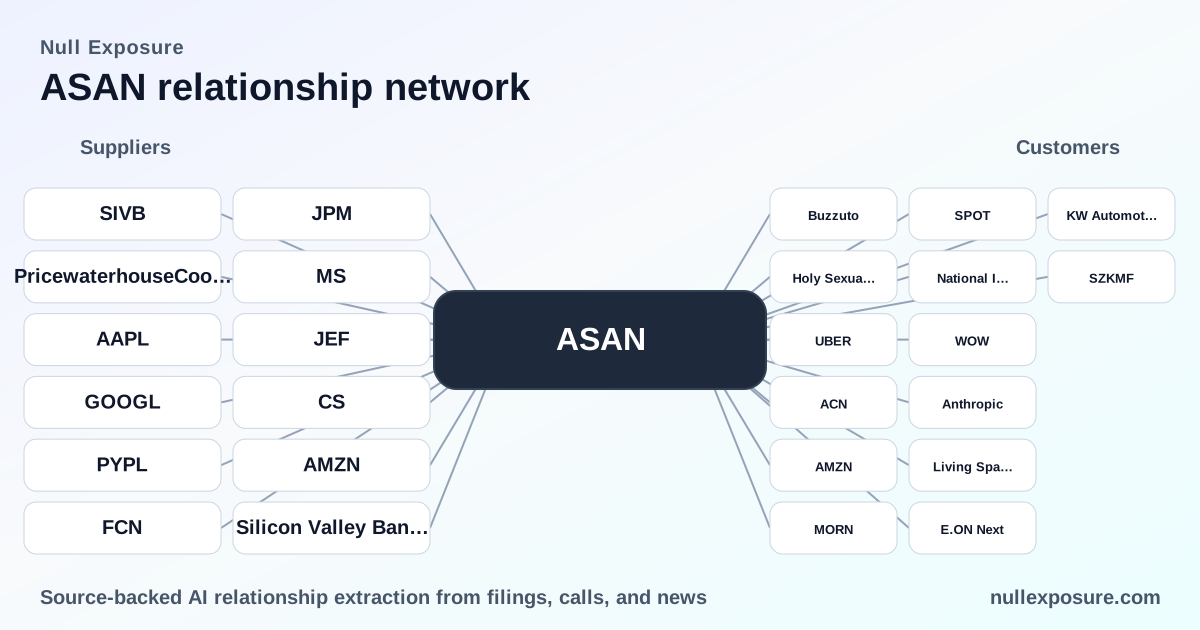
Asana (ASAN): Customer map, monetization and concentration — what investors need to know
Asana sells cloud-native work management software and complementary AI services to organizations and individuals worldwide, monetizing primarily through seat-based subscriptions for its core platform and consumption-based charges for Asana AI Studio. The combination produces a hybrid revenue mix where predictable, recurring subscription dollars coexist with scalable, usage-driven upside from AI features; for a quick customer footprint and deeper signals, visit https://nullexposure.com/.
Snapshot: the business model in plain language
Asana is a software-as-a-service provider whose core monetization is subscription revenue from customers across sectors and geographies, supplemented by consumption billing for AI Studio. The company serves a broad customer base from individuals to global enterprises, and management highlights both scale (over 169,000 paying customers historically, rising to 180,000+ in FY2026 disclosures) and a growing set of large accounts paying six-figure annual contracts. Key investor implications:
- Revenue mix: Subscription-first with an additive usage-based AI product that creates variable upside; this drives both predictability and optionality.
- Concentration: A measured concentration risk exists — hundreds of customers spend >$100k annualized, implying meaningful revenue tied to a set of large enterprises.
- Global footprint: The U.S. remains the largest single market, but international revenue is material and growing, supporting a truly global customer base.
- Role and maturity: Asana operates as a service provider (SaaS) to customers and is in active commercial expansion with both core work management and AI Studio adoption.
For a focused vendor–customer analysis, see more at https://nullexposure.com/.
Contracting posture, concentration and criticality
Asana’s contract architecture supports both subscription stability and usage-driven growth. Management has stated subscription fees are the primary revenue engine while AI Studio runs on a consumption basis, which increases variability but also allows for outsized customer spend as AI adoption deepens. The existence of several hundred customers paying over $100k annually signals enterprise-grade contracts and implies higher retention and deeper product integration — in short, commercial maturity and stickiness among top-tier clients. Geographically, while the U.S. dominates revenue, the product’s global reach rounds out diversification.
Customer relationships called out in recent disclosures and media
Below are every relationship referenced in the compiled results, each given a concise investor-facing summary with its cited source.
-
Buzzuto — Asana highlighted that Buzzuto, a diversified U.S. multifamily real estate operator, expanded its Asana usage under a three‑year deal, signaling multi‑year enterprise adoption. Source: Asana Q1 FY2026 earnings call transcript (Mar 7, 2026).
-
Holy Sexuality — After litigation, Asana agreed to extend the company’s standard 50% nonprofit discount to Holy Sexuality to resolve the dispute over nonprofit pricing. Source: Alliance Defending Freedom press release about the settlement (Mar 2026).
-
Uber — Asana has been cited as a platform employed by high-profile clients including Uber, referenced in a profile of the company’s workplace and client list. Source: TheSoftwareReport profile (citing FY2021 usage; referenced Mar 2026).
-
Accenture — Asana lists Accenture among organizations building the “Agentic Enterprise” with the platform, indicating strategic consulting and systems-integration relevance. Source: StockTitan overview (FY2025 mention; Mar 2026).
-
ACN — The same mention of Accenture appears under the ACN ticker in market summaries that catalog Asana’s customer roster. Source: StockTitan overview (FY2025; Mar 2026).
-
Amazon — Asana includes Amazon among marquee customers using its platform, demonstrating large-cloud and retail adoption. Source: StockTitan overview (FY2025; Mar 2026).
-
Morningstar — Morningstar appears on Asana’s public list of organizations using the platform, showing penetration into financial data and services clients. Source: StockTitan overview (FY2025; Mar 2026).
-
Accenture (8‑K mention) — Asana explicitly noted in an 8‑K that Accenture is among more than 180,000 organizations adopting Asana to connect strategy to execution, reaffirming enterprise-level relationships in FY2026 disclosures. Source: Asana 8‑K / SEC filing summary (FY2026; Mar 2026).
-
ACN (8‑K mention) — The 8‑K repeats Accenture’s inclusion in Asana’s FY2026 customer highlights under the ACN ticker listing. Source: Asana 8‑K / SEC filing summary (FY2026; Mar 2026).
-
Amazon (8‑K mention) — Asana’s FY2026 8‑K again lists Amazon as a user in the “Agentic Enterprise” narrative, underscoring ongoing enterprise visibility. Source: Asana 8‑K / SEC filing summary (FY2026; Mar 2026).
-
Spotify — Spotify is cited among Asana’s high-profile clients in press coverage describing the company’s workplace and client base. Source: TheSoftwareReport feature (citing FY2021; Mar 2026).
-
Uber (duplicate mention) — Press coverage repeats Uber as a high-profile Asana client, consistent with earlier mentions. Source: TheSoftwareReport feature (citing FY2021; Mar 2026).
-
Living Spaces — Living Spaces, a home-furniture retailer, is leveraging Asana’s AI teammates to audit legacy automation and rewrite complex operating procedures, indicating product use beyond pure project tracking. Source: The Globe and Mail press release transcript of Asana Q4 FY2026 earnings commentary (Mar 2026).
-
National Institute of Cybersecurity — Asana reported signing the National Institute of Cybersecurity in the Asia‑Pacific region, reflecting expansion into government/education-adjacent and security-focused institutions. Source: The Globe and Mail transcript of Asana Q4 FY2026 commentary (Mar 2026).
-
Woolworths — Woolworths, a major Australian supermarket operator, implemented Asana’s AI Studio to transform safety and capital governance processes, a concrete example of AI Studio driving operational change at scale. Source: Asana Q1 FY2026 earnings call transcript (Mar 7, 2026).
-
WOW (duplicate Woolworths) — The same Woolworths reference is recorded under ticker WOW in the earnings call disclosure highlighting AI Studio use across store operations. Source: Asana Q1 FY2026 earnings call transcript (Mar 7, 2026).
-
JW (Justworks) — Company listings and profiles reference Asana for project management use within Justworks’ public materials, indicating SMB and HR platform integration. Source: BuiltIn company profile for Justworks (FY2025 entry; Mar 2026).
-
Holy Sexuality (ChristianPost report) — Independent reporting on the lawsuit described Asana’s initial refusal to grant the nonprofit discount, which led to litigation and subsequent resolution. Source: The Christian Post report on the lawsuit (FY2025; Mar 2026).
-
Anthropic — Anthropic is listed among organizations building with Asana in both stock summaries and Asana’s FY2026 8‑K, indicating adoption by AI-first organizations. Source: StockTitan overview and Asana 8‑K (FY2025–FY2026 mentions; Mar 2026).
-
KW Automotive — KW Automotive deployed Asana AI teammates across marketing, IT and support teams, with management claiming measurable ROI from these deployments. Source: The Globe and Mail transcript of Asana Q4 FY2026 commentary (Mar 2026).
-
E.ON Next — E.ON Next, a European sustainable energy provider, uses AI Studio to automate intake and triage for complex energy projects, illustrating vertical-specific automation value. Source: The Globe and Mail transcript of Asana Q4 FY2026 commentary (Mar 2026).
-
Suzuki — Suzuki is documented as a named customer in both FY2025 summaries and FY2026 company filings, supporting automotive-industry penetration. Source: StockTitan overview (FY2025) and Asana 8‑K / SEC filing summary (FY2026; Mar 2026).
What those relationships imply for investors
- Enterprise validation: Multiple Big Tech and enterprise names (Accenture, Amazon, Suzuki, Anthropic) confirm Asana’s acceptance at scale and cross‑industry applicability. This supports premium seat pricing and upsell potential into AI Studio.
- Use-case expansion: Examples from Woolworths, E.ON Next, KW Automotive and Living Spaces show Asana positioning AI features for operational automation and governance — not just task lists — increasing criticality to workflows.
- Reputational/legal risk: The Holy Sexuality litigation and settlement are a reminder that pricing and customer policy decisions can create reputational and legal exposure for enterprise software vendors.
- Revenue structure: The coexistence of subscription revenue and consumption-based AI billing creates both stability and growth optionality; investors should track mix and adoption rates for AI Studio to model upside.
Key signals to monitor next
- Adoption growth and spend per user among the >180,000 organizations cited in FY2026 disclosures.
- Revenue mix movement between subscription and AI consumption; sustained consumption acceleration would materially lift revenue per account.
- Contract retention metrics for the several hundred customers spending >$100k annually — these accounts drive margin stability.
- Any additional disclosures around public-sector or government contracts given the company’s stated industry breadth.
Conclusion: Asana’s customer roster and recent disclosures show a company transitioning from core subscription scale to an AI-enabled monetization layer, with clear enterprise traction and a handful of legal and concentration risks to monitor. For more structured customer intelligence and relationship mapping, visit https://nullexposure.com/.