ASB-P-F (Associated Banc‑Corp Preferred F): Customer relationships and what they mean for income investors
Associated Banc‑Corp issues ASB‑P‑F as a fixed‑income preferred with the appeal of steady dividends backed by a well‑established regional bank. Associated monetizes through traditional banking channels — net interest income on loans and deposits, fee income from wealth and insurance services, and selective M&A to scale customer and product reach — and the ASB‑P‑F instrument is positioned for income‑oriented investors who prioritize yield and capital preservation within a regional banking franchise. Recent public disclosures show a targeted customer integration that will materially affect Associated’s retail and insurance client base.
Learn more about how we surface these customer signals at https://nullexposure.com/.
Investor thesis in one line
Associated Banc‑Corp leverages regional scale and selective acquisitions to grow low‑cost deposit relationships and fee streams; ASB‑P‑F is a dividend vehicle whose risk/reward is driven by deposit stability, credit performance, and the execution of customer integrations.
Why customer relationships matter for ASB‑P‑F holders
Customer flows and integration outcomes determine deposit longevity, fee income trajectory, and the firmness of the bank’s funding base — all of which underpin the capacity to maintain preferred dividends. An effective customer acquisition or integration increases core deposits and recurring fee revenue; a failed integration creates disruption to deposit stickiness and increases integration expenses. For a preferred holder, the operational health of customer franchises is a first‑order driver of dividend security.
Key takeaways:
- Acquisition-driven customer growth is explicit in the latest public commentary.
- Deposit and insurance customer retention will be a vital earnings lever.
- Execution risk on integration is the primary operational risk for ASB‑P‑F holders near term.
What the disclosed relationships show (company‑level operating signals)
The collected records include no explicit contractual constraints or third‑party limitation disclosures. As a company‑level signal this indicates:
- Contracting posture: Associated operates with direct customer relationships and standard commercial/acquisition contracts typical of a regional bank integrating an insurance platform; public commentary emphasizes employee and customer transfers rather than third‑party outsourcing constraints.
- Concentration: The franchise is regionally concentrated in the Midwest; customer additions referenced are additive to the bank’s existing geographic footprint.
- Criticality: Customer retention from acquired entities is operationally critical — these relationships directly affect deposit and fee stability.
- Maturity: Associated is an established, incumbent regional bank executing strategic M&A to extend product mix; integration processes and customer migration capabilities are central to realizing expected benefits.
For deeper signal tracking and analytics, visit https://nullexposure.com/.
Detailed relationship entries (every relationship in the public results)
American National Corporation — According to an earnings‑call transcript published on InsiderMonkey on March 9, 2026, Associated stated it will “welcome American National employees and customers to Associated later this year,” indicating an integration of American National’s customer and employee base into Associated’s operations. The disclosure frames American National as a cultural and operational fit for Associated’s business. (Source: InsiderMonkey earnings‑call transcript, March 9, 2026 — https://www.insidermonkey.com/blog/associated-banc-corp-nyseasb-q4-2025-earnings-call-transcript-1680773/)
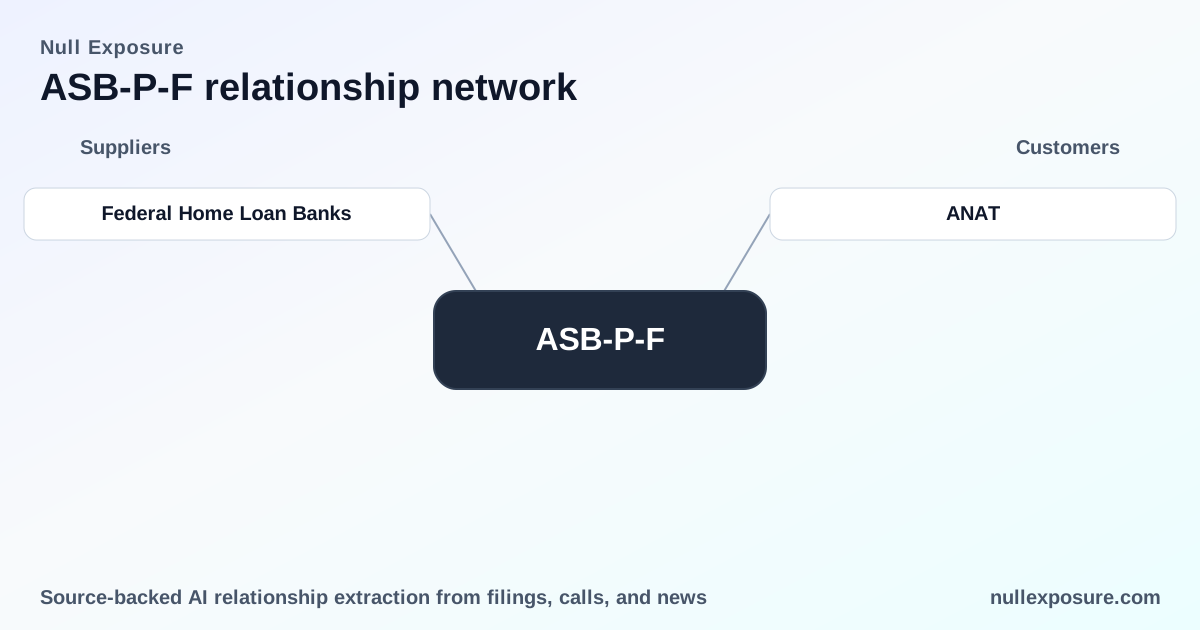
ANAT — The dataset contains a duplicate reference under the ticker ANAT with the identical excerpt and timing; the statement again confirms the planned transfer of American National employees and customers into Associated later in FY2026. Treat this entry as a corroborating mention of the same integration initiative. (Source: InsiderMonkey earnings‑call transcript, March 9, 2026 — https://www.insidermonkey.com/blog/associated-banc-corp-nyseasb-q4-2025-earnings-call-transcript-1680773/)
Interpreting the customer integration: operational and financial implications
The explicit mention of welcoming American National employees and customers denotes a transaction that affects both human capital and the customer base. For investors in ASB‑P‑F, the two most important implications are:
- Deposit and fee stability: Adding insured customers and insurance distribution relationships strengthens recurring revenue channels and can improve deposit stickiness when cross‑selling banking products to an acquired insurance customer base.
- Integration execution risk: Employee and customer migrations expose Associated to retention risk, one‑time conversion costs, and short‑term revenue disruption. Successful operational assimilation is required to realize synergies and protect the dividend profile that supports preferred shares.
Major risk factors to monitor
- Integration execution: Track retention metrics for transferred customers and employees, and watch for incremental integration expenses disclosed in upcoming quarters.
- Funding sensitivity: Any erosion in deposit balances during conversion would increase reliance on wholesale funding and pressure net interest margins.
- Regulatory and capital impact: M&A activity can affect capital ratios and regulatory expectations; monitor Associated’s reported capital metrics and regulatory commentary.
- Market perception: Preferred valuations are sensitive to perceived franchise stability; negative headlines on customer churn or integration missteps have outsized effects on preferred spreads.
What investors should watch next (concrete signals)
- Quarterly filings and earnings calls where Associated discloses retention rates, integration costs, and estimated synergies tied to the American National relationship.
- Deposit growth trends in the Midwest footprint and cross‑sell metrics showing how acquired customers are adopting banking products.
- Any regulatory filings or comment that quantify capital impacts from the transaction.
Bottom line
The public record shows Associated Banc‑Corp executing a targeted customer integration that increases the bank’s operational footprint and revenue diversification. For ASB‑P‑F investors, the core call is execution: a successful assimilation of American National customers strengthens the dividend foundation; poor execution elevates payout risk through deposit attrition and higher costs. Monitor integration KPIs and quarterly disclosures closely.
For ongoing monitoring of customer‑level signals and integration tracking for financial securities, visit https://nullexposure.com/.