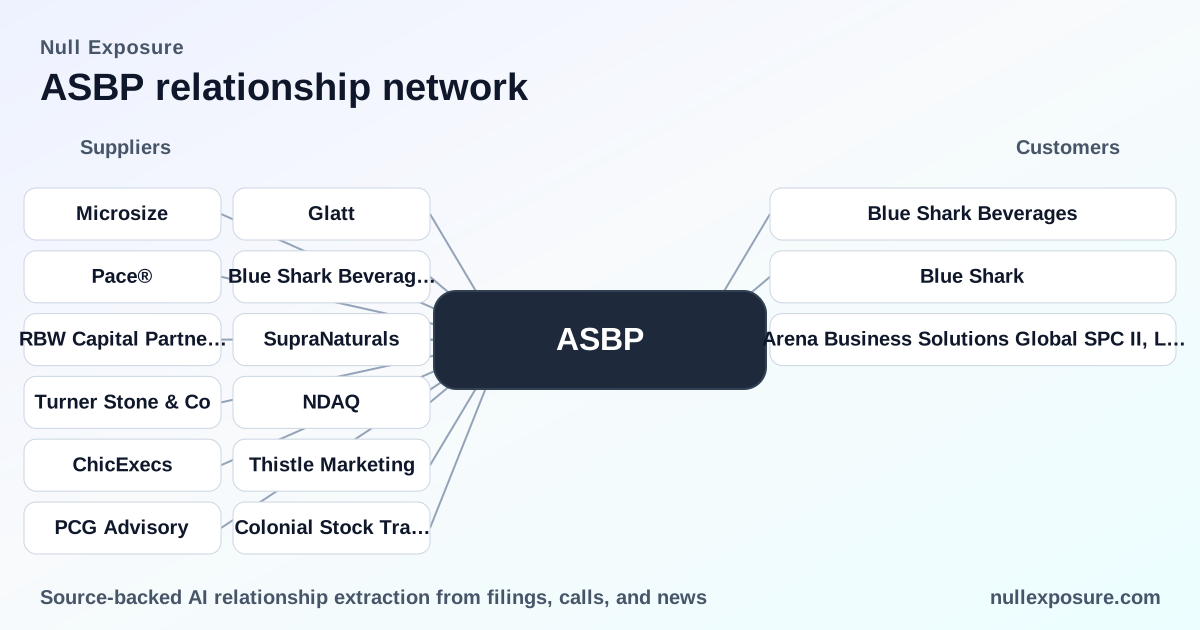
Aspire BioPharma (ASBP): Early-stage commercialization through beverage retail and equity lines
Aspire BioPharma operates as an early-stage biopharmaceutical company that is already monetizing outside classic drug development: it commercializes consumer products through a wholly owned beverage subsidiary (Buzz Bomb Caffeine Company) and accesses capital via equity financing facilities. The company’s near-term revenue trajectory will be driven by retail distribution execution for Buzz Bomb and by the timing and use of equity-line proceeds; investors should value operations as a venture-stage commercial rollout with meaningful financing optionality. For a deeper look at the customer and financing relationships that shape that thesis, visit https://nullexposure.com/.
Quick read: how Aspire makes money today
Aspire’s corporate description identifies two revenue levers: commercialization of consumer delivery mechanisms and product marketing, plus capital raises to finance growth. Revenue is currently negligible (Revenue TTM $6,200) and the business strategy is concentrated on U.S. commercialization and retail distribution. The commercial activity seen in public reports is the Buzz Bomb beverage rollout; the corporate financing posture is illustrated by a large, pre-negotiated equity line.
Blue Shark Beverages — expanding Buzz Bomb’s Southern California footprint
Aspire’s wholly owned subsidiary, Buzz Bomb Caffeine Company, signed a strategic brand management and distribution agreement with Blue Shark Beverages to expand distribution in Southern California. This is an explicit commercialization step: the partnership places Buzz Bomb into Blue Shark’s regional distribution channels and is intended to increase retail availability and sales velocity in a major U.S. market. According to a March 2026 press release syndicated by Marconews and several regional outlets, Aspire announced the Blue Shark distribution agreement for southern California expansion (Marconews, March 9, 2026).
Why this matters: the Blue Shark tie-up is the principal customer/distribution relationship disclosed to date and therefore represents the primary channel through which early product revenue can scale. Stocktitan coverage of Aspire’s February reporting also noted the same distribution partnership as a positive commercial development (StockTitan, FY2026).
Operational implication of the Blue Shark deal
- Execution-critical: this is a go-to-market move, not a licensing or R&D collaboration—sales outcomes depend on shelf placement, promotion, and supply chain execution.
- High optionality, low current revenue: given Aspire’s reported revenue base, any uplift from improved SoCal distribution will be visible relative to a very small baseline but will still require time to meaningfully affect company-level financials.
Arena Business Solutions Global SPC II, Ltd. — access to capital via equity line
Aspire entered a new equity line of credit with Arena Business Solutions Global SPC II, Ltd. that gives the company the right to sell up to $100,000,000 of common stock to Arena over a defined commitment period. The agreement is a financing instrument that provides Aspire with on-demand access to capital, subject to draw mechanics and market conditions. This arrangement was reported in SEC-related coverage aggregated by StockTitan in FY2026 (StockTitan, FY2026 SEC filing summary).
Why this matters: the equity line materially expands financing optionality but introduces dilution risk—the company can fund inventory, marketing and distribution expansion without requiring term debt, yet share count and per-share economics will be sensitive to how much of the facility is utilized and at what prices. From an investor perspective, the equity line is a strategic backstop that supports the Buzz Bomb rollout while shifting capital structure risk toward dilution.
How these relationships combine into a working operating model
Aspire’s business model today is U.S.-centric commercialization supported by convertible equity financing. The Blue Shark distribution agreement is the operational channel for revenue generation; the Arena equity line is the capital channel that funds inventory, marketing and working capital needs required for that roll-out. This combination is typical of early-stage commercial biotechnology or consumer-health companies that are still monetizing but require significant external capital to scale.
- Contracting posture: the company retains U.S. commercial rights and executes distribution agreements rather than licensing global rights; this indicates aspiration to manage U.S. commercialization in-house while leveraging third-party channel partners for execution.
- Concentration: the operational footprint is concentrated domestically—Aspire explicitly plans to retain commercial rights in the United States rather than pursue broader, immediate international licensing (company filing language on commercial rights, FY2026).
- Criticality and maturity: these relationships are early-stage and execution-dependent; Blue Shark is critical for short-term retail traction, while the Arena facility is critical for liquidity. Both are immature in the sense of being newly established and unproven at scale.
Constraints and corporate signals investors should note
Aspire’s public statements include a clear company-level commercial posture: the firm intends to retain commercial rights in the United States for product candidates. This is a corporate-level signal (not tied to any single partner) that shapes strategy: U.S.-first commercialization, concentrated market focus, and in-house control of product rights (company filing language, FY2026). Investors should interpret this as meaning the company is optimized for domestic rollout and will rely on regional distributors and capital markets rather than global licensing revenues in the near term.
Key risks and what to watch next
- Execution risk on distribution: the Blue Shark partnership is necessary but not sufficient—retail placement, promotional spend, and supply chain reliability will determine whether distribution converts into repeatable revenue.
- Dilution risk from the Arena facility: the equity line provides optionality but will dilute current shareholders if utilized; track draw-downs and share issuance terms.
- Revenue base and runway: Aspire reports extremely low trailing revenue (Revenue TTM $6,200) and negative operating margins; any commercial progress will be incremental from a small base and dependent on continued financing.
- Concentration in the U.S.: retaining U.S. commercial rights reduces near-term international revenue channels and places the commercialization burden on domestic partners and distribution effectiveness.
Bottom line for investors
Aspire is transitioning from R&D to commercial rollout through a beverage subsidiary and is funding that transition through an equity line. The Blue Shark distribution agreement is the immediate operational catalyst; the Arena equity line is the financial backstop. Both are necessary components for near-term scale but neither guarantees material earnings given Aspire’s early-stage revenue base and dilution potential. Monitor sales traction reports from Buzz Bomb, distribution metrics in Southern California, and any filings or press releases that document draws on the Arena facility.
For ongoing monitoring and deeper relationship analysis, check coverage and updates at https://nullexposure.com/.
Sources: Aspire press release syndicated by Marconews and regional outlets on the Blue Shark distribution agreement (March 2026); SEC filing coverage reported by StockTitan on the Arena equity line and related FY2026 disclosures.