Ardmore Shipping (ASC): Customer Relationships and the Commercial-Management Growth Axis
Ardmore Shipping Corporation operates as a focused owner-operator and commercial manager of chemical and petroleum product tankers, monetizing through vessel earnings (voyage and time charters), asset ownership appreciation and increasingly through third‑party commercial management fees. The company’s cash flow profile combines fleet-generated charter revenue with fee income from managing externally owned vessels, a hybrid that broadens revenue diversity while leveraging Ardmore’s operational platform. According to reported results through FY2025, Ardmore generated $310.2 million in revenue with $81.0 million of EBITDA and a market capitalization near $757 million, underscoring a mid‑cap shipping operator with predictable fleet cash flows and growing service revenue.
If you want a concise view of Ardmore’s counterparty dynamics and what they mean for underwriting or portfolio exposure, review this analysis — and explore more company relationship coverage at https://nullexposure.com/.
Why the commercial‑management angle matters for investors
Ardmore’s strategic step into managing third‑party tonnage is economically efficient and scale‑accretive: commercial management yields fee margins without the capital intensity or balance‑sheet risk of ownership. This converts Ardmore’s operational know‑how and chartering platform into a recurring fee stream that supports earnings stability in soft freight cycles and offers upside when charter markets strengthen.
- Asset-lite revenue buffer: Management fees add countercyclical income relative to owned-vessel charter revenue.
- Levered operating platform: Growing third‑party relationships amplify Ardmore’s fixed-cost leverage (chartering, commercial staff) without proportional capex.
- Concentration benefits and risks: Fee relationships diversify counterparties but introduce counterparty and reputational exposures that require active contract governance.
The single reported customer relationship: what it is and why it matters
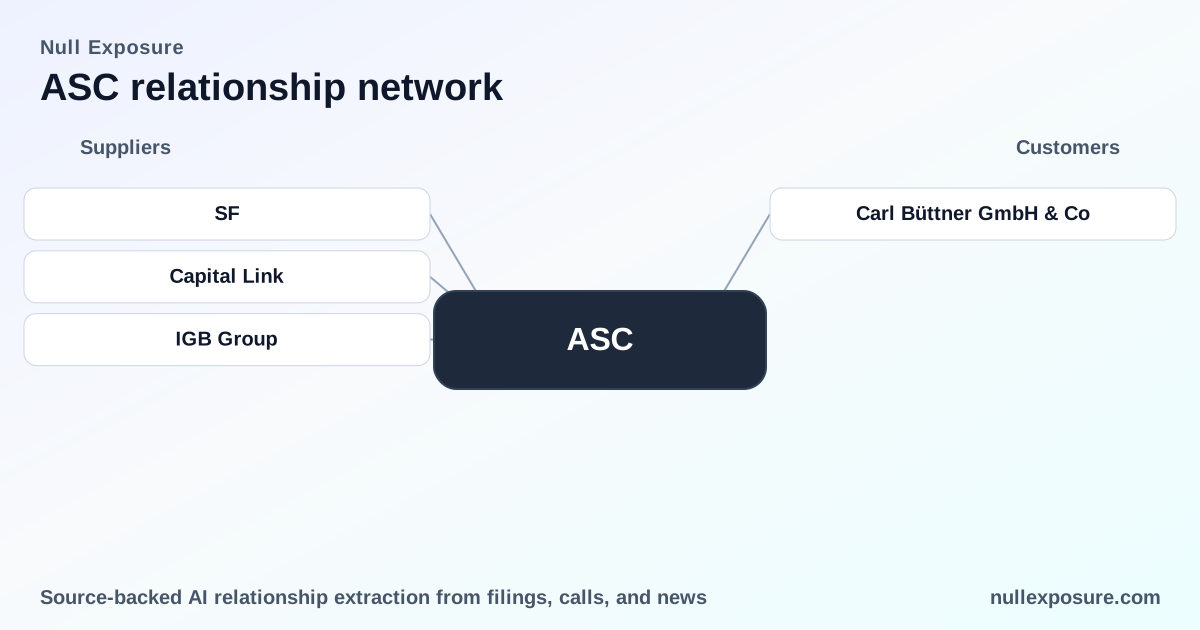
A Royal Gazette report in May 2021 documented Ardmore’s commercial-management engagement with German owner Carl Büttner: Ardmore took on commercial management of four Carl Büttner chemical tankers, effectively doubling the number of similar-sized chemical vessels under Ardmore’s commercial control. This arrangement converts third‑party vessels into fee revenue for Ardmore while expanding its managed fleet (The Royal Gazette, May 2021).
How that relationship fits the business model
The Carl Büttner engagement is a clear example of Ardmore executing an asset-lite revenue strategy: Ardmore provides chartering, voyage optimization and commercial oversight for vessels it does not own, for which it earns management fees and potentially performance-linked remuneration. Such contracts lean Ardmore’s revenue mix toward service income, increasing revenue diversification without adding leverage or capex to its balance sheet.
Company-level operating signals and constraints
Although the dataset of explicit constraints is empty, several company-level signals emerge from Ardmore’s operating model and financial profile:
- Contracting posture — fee and charter contracts: Ardmore operates under a mix of time/spot charters for owned tonnage and fixed commercial‑management agreements for third parties, implying a hybrid contracting posture that blends revenue predictability (time charters, management fees) with spot exposure.
- Revenue concentration and counterparty dispersion: The move into third‑party commercial management reduces single‑source fleet concentration on the revenue line, but successful scale requires multiple counterparties to avoid concentrated fee risk.
- Criticality to customers — specialized service: Ardmore’s experience in chemical tanker operations makes it a specialist counterparty for owners requiring niche expertise, increasing the stickiness of commercial‑management contracts.
- Maturity and scalability: The model is operationally mature for a mid‑cap shipping firm: it leverages existing commercial and technical platforms and scales without proportional capital investment.
- Contract governance imperative: As management contracts multiply, contract tenor, termination rights, indemnities and performance metrics become critical to protect Ardmore’s earnings and reputation.
These are company-level signals derived from the business model rather than constraints tied to any single relationship.
Detailed relationship register (complete)
Below is a concise register that covers every customer relationship captured in the available source results.
- Carl Büttner GmbH & Co — Ardmore assumed commercial management of four chemical tankers, doubling the count of similar chemical vessels under Ardmore’s commercial control; reported by The Royal Gazette in May 2021. (The Royal Gazette, May 2021)
Investment implications: where value and risk concentrate
Ardmore’s combination of owned-ship earnings and commercial‑management fees positions the company as a service-augmented asset owner. For investors and operators evaluating ASC counterparty exposure:
- Value drivers: Rising chemical and product tanker freight rates lift both owned-vessel earnings and management-fee pools through higher voyage income and stronger client demand for professional commercial management.
- Stability uplift: Management fees provide an earnings floor when spot rates are weak, supporting dividend policy and deleveraging potential.
- Operational risk: Quality of commercial-management execution, client selection, and contract terms determine the downside protection afforded by fee income; reputational incidents or underperforming voyages can cascade into both fee losses and charterer claims.
- Balance-sheet prudence: Because management agreements do not require vessel ownership, Ardmore can scale its revenue base with lower incremental capex and without materially increasing leverage, improving return on capital metrics over time.
Financial metrics supporting these points include a trailing P/E of ~20.6, forward P/E of ~5.4, EV/EBITDA near 10.2, and a modest dividend yield (~1.7%), reflecting a company priced for both cyclical upside and a stable underlying cash generation profile.
What to monitor next
- New management contracts: Track announcements of additional third‑party management agreements and the geographic/charter profile of those vessels.
- Contract terms and tenure: Longer tenors and performance fees enhance the quality of fee income; short tenors increase churn risk.
- Freight cycle and charter backlog: Improvement in chemical tanker rates directly lifts both charter revenue and third‑party demand for professional commercial management.
- Counterparty credit: Financial strength of owners under management influences fee realization and potential claims.
For a systematic review of Ardmore’s counterparties, contract structures and commercial exposure, visit NullExposure’s relationship pages for a deeper dataset and primary-source tracking at https://nullexposure.com/.
Bold takeaway: Ardmore’s execution of commercial management converts operational expertise into recurring, scalable fee income that improves revenue diversification while preserving balance-sheet optionality — a material positive for investors who value predictable cash flow and asset management leverage in a cyclical shipping sector.