Ashland (ASH) — EMEA distribution push sharpens the customer map
Ashland Global Holdings operates as a specialty chemicals manufacturer and seller, monetizing through branded additives and ingredient solutions sold to formulators across consumer and industrial markets. The company drives value via product innovation (cellulose ethers, PVPP, BDO-derived intermediates), scale manufacturing, and channel partnerships that expand market reach while preserving manufacturing margins. For investors, the key takeaway is that Ashland is shifting more commercial risk outward through exclusive distribution arrangements in EMEA, while retaining production and product control — a model that enhances revenue leverage without materially increasing fixed selling costs. Learn more at https://nullexposure.com/.
How the Univar alliance changes the commercial footprint
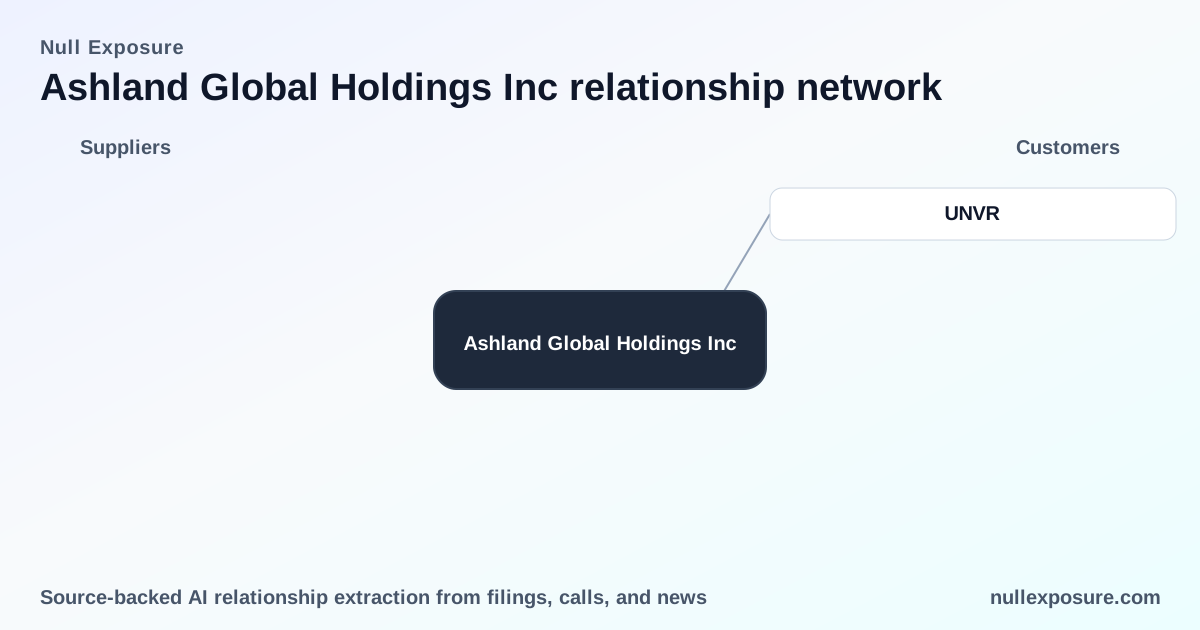
In early 2026 Ashland announced an exclusive distribution agreement with Univar Solutions (operating under Foodology by Univar Solutions in EMEA) to distribute Ashland’s cellulose ethers and polyvinylpolypyrrolidone (PVPP) to food and beverage manufacturers across Europe, the Middle East, and Africa. This is a classic channel-extension play: Ashland keeps manufacturing and product ownership while outsourcing sales coverage and local logistics to a specialist distributor with established customer relationships across EMEA. The transaction is aimed at accelerating penetration in finished-goods verticals where formulators and co-packers value supply reliability and regulatory support.
- Strategic effect: broadens EMEA commercial reach for high-margin formulation inputs without proportional SG&A expansion.
- Financial backdrop: Ashland’s FY2025 sales split shows Europe representing a meaningful share (~37% of sales), so EMEA penetration is directly aligned with regional revenue mix.
Detailed relationship roster — every result, one by one
-
Univar Solutions — PR Newswire (March 9, 2026). Univar Solutions B.V., through its Foodology by Univar Solutions business, announced an exclusive distribution partnership to distribute Ashland’s cellulose ethers in the food and beverage sector across EMEA. Source: PR Newswire (Mar 9, 2026), https://www.prnewswire.com/news-releases/univar-solutions-and-ashland-forge-exclusive-partnership-for-cellulose-ethers-in-food-and-beverage-sector-throughout-emea-302670741.html
-
Univar Solutions — PR Newswire duplicate entry (March 9, 2026). A second indexing of the same PR Newswire release confirms the exclusive EMEA distribution arrangement between Univar Solutions B.V. and Ashland for cellulose ethers. Source: PR Newswire (Mar 9, 2026), https://www.prnewswire.com/news-releases/univar-solutions-and-ashland-forge-exclusive-partnership-for-cellulose-ethers-in-food-and-beverage-sector-throughout-emea-302670741.html
-
Univar Solutions — Investing.com (May 2, 2026). An analyst note on Investing.com referenced the Univar partnership as effective January 1, 2026, highlighting the commercial timing and its relevance to Ashland’s pricing power narrative. Source: Investing.com (May 2, 2026), https://m.investing.com/news/analyst-ratings/jefferies-reiterates-ashland-stock-buy-rating-on-pricing-power-93CH-4590419?ampMode=1
-
Univar Solutions — Investing.com (May 2, 2026, Argus coverage). A separate Investing.com summary of Argus commentary reiterated the exclusive EMEA distribution deal and cited it as a factor in short-term demand outlooks. Source: Investing.com (May 2, 2026), https://m.investing.com/news/analyst-ratings/argus-lowers-ashland-stock-price-target-on-demand-weakness-93CH-4575177?ampMode=1
-
Univar Solutions B.V. — MillingMEA (March 9, 2026). MillingMEA reported that Foodology by Univar Solutions will distribute Ashland’s portfolio of cellulose ethers and PVPP to food and beverage manufacturers throughout EMEA, emphasizing product scope and regional sales mechanics. Source: MillingMEA (Mar 9, 2026), https://millingmea.com/univar-solutions-enters-exclusive-partnership-with-ashland-for-cellulose-ethers-across-emea/
-
UNVR — SahmCapital (Feb 9, 2026). SahmCapital’s Q1 coverage referenced the Univar Solutions B.V. exclusive distribution and contextualized it alongside Ashland’s FY2026 sales guidance ($1.84B–$1.91B), underscoring management’s growth emphasis on innovation-driven product lines. Source: SahmCapital (Feb 9, 2026), https://www.sahmcapital.com/news/content/is-ashlands-q1-results-buybacks-and-new-partnership-altering-the-investment-case-for-ashland-ash-2026-02-09
-
UNVR — SahmCapital note (March 25, 2026). SahmCapital further discussed Ashland’s product-price actions and singled out the expanded global distribution partnership with Foodology by Univar Solutions for cellulose ethers and PVPP as strategically material. Source: SahmCapital (Mar 25, 2026), https://www.sahmcapital.com/news/content/ashlands-broad-price-hikes-to-offset-cost-volatility-might-change-the-case-for-investing-in-ash-2026-03-25
-
UNVR — MillingMEA duplicate (March 9, 2026). A second indexing of the MillingMEA story reiterates that the exclusive EMEA distribution covers both cellulose ethers and PVPP and positions Univar as Ashland’s local market arm. Source: MillingMEA (Mar 9, 2026), https://millingmea.com/univar-solutions-enters-exclusive-partnership-with-ashland-for-cellulose-ethers-across-emea/
-
Foodology by Univar Solutions — SahmCapital mention (May 2, 2026). SahmCapital referenced Foodology by Univar Solutions in a broader review of Ashland’s go-to-market strategy, noting the expanded distribution partnership as a tangible commercial lever. Source: SahmCapital (May 2, 2026), https://www.sahmcapital.com/news/content/ashlands-broad-price-hikes-to-offset-cost-volatility-might-change-the-case-for-investing-in-ash-2026-03-25
What Ashland’s constraints reveal about its operating model
Ashland’s public disclosures and contextual excerpts produce clear company-level signals about how the business contracts and who it serves:
- Contracting posture: Ashland operates primarily as a seller and manufacturer of specialty inputs; it frequently uses contractual sales and structured receivables programs to manage working capital and credit exposure. The firm has executed receivables sales programs (U.S. and Europe), indicating a proactive approach to liquidity and credit risk transfer.
- Customer concentration and diversity: The customer base spans large multinational branded consumer companies and smaller boutique formulators, reflecting a two-pronged go-to-market: high-volume enterprise customers and specialized niche accounts.
- Geographic coverage and criticality: Ashland is global, serving customers in more than 100 countries, with material revenue contribution from EMEA, North America, Asia Pacific, and Latin America — the Univar EMEA distributor deal directly targets a region that represents a significant revenue pool (Europe ~37% in FY2025).
- Maturity and role: The company is mature in manufacturing capabilities (including BDO intermediates) and positions core products (cellulose ethers, PVPP, additives) as steady, innovation-led revenue drivers rather than speculative growth assets.
These signals combine into an operating model that prioritizes manufacturing control, scaled distribution through partners where appropriate, and active balance-sheet management.
Investor implications: upside, risks, and monitoring
- Upside: The Univar/Foodology partnership accelerates penetration into EMEA food and beverage formulators and should improve sales velocity for cellulose ethers and PVPP without commensurate SG&A increases. Given Ashland’s FY2026 guidance range ($1.84B–$1.91B), successful channel execution can convert into incremental top-line and fixed-cost leverage.
- Margin and working-capital dynamics: Outsourced distribution typically reduces direct selling expense but introduces margin-sharing with distributors; watch gross-to-operating margin conversion. Also monitor receivables exposure evolution given Ashland’s structured receivables programs.
- Concentration and counterparty risk: Exclusive distribution agreements concentrate commercial execution in a single partner for the territory; manageable if the distributor delivers volume, but a single-channel reliance raises execution risk for EMEA penetration. Investors should track order flow, regional revenue growth, and distributor inventory dynamics.
Bottom line
Ashland’s exclusive EMEA deal with Univar/Foodology is a strategic extension of proven go-to-market logic: preserve manufacturing and product control, scale sales through a specialist distributor, and convert regional penetration into measurable revenue growth while keeping fixed costs contained. The combination of Ashland’s global footprint, receivables management programs, and targeted channel partnerships positions the company to convert product innovation into predictable cash flows — with the customary distribution execution risks that attentive investors should watch.
For a concise, investor-ready dossier on ASH customer relationships and partner footprints, visit https://nullexposure.com/.