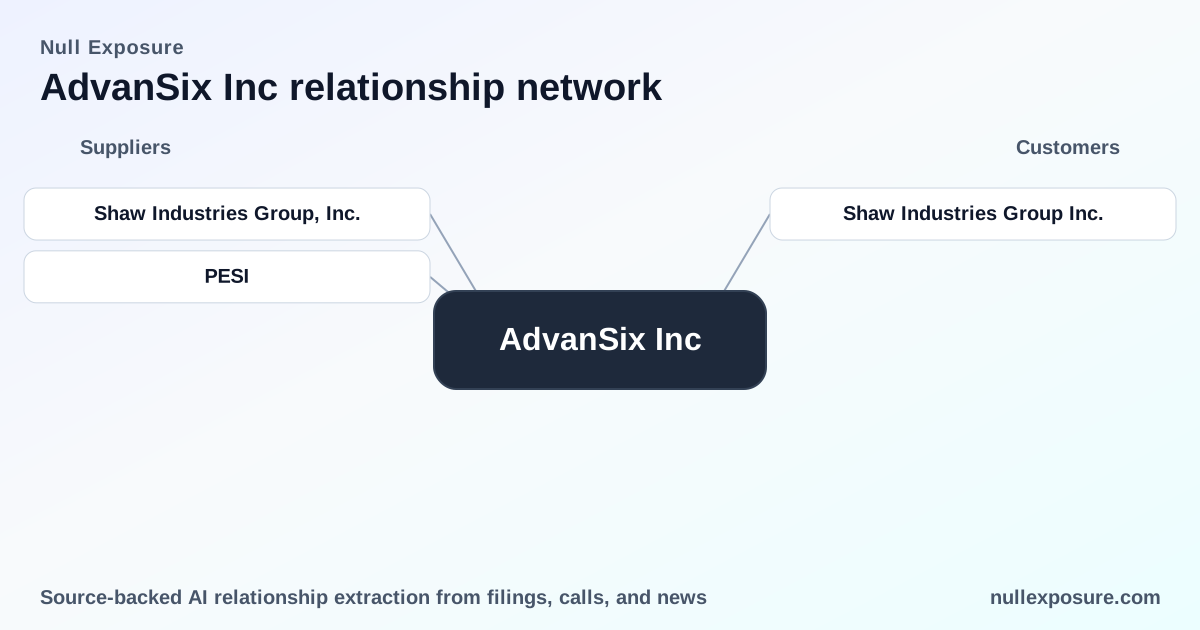
AdvanSix (ASIX): Customer Map and Commercial Signals for Investors
AdvanSix manufactures and sells caprolactam, Nylon 6 resin and related chemical products, monetizing through a mix of long-term supply agreements, recurring contracts and spot sales to industrial manufacturers and distributors. The company’s revenue model blends supply security for large industrial buyers with transactional sales to a broad base—creating both steady cash flow from entrenched relationships and cyclical exposure tied to end‑market demand. For deeper relationship intelligence, see https://nullexposure.com/.
Investment thesis in one paragraph
AdvanSix’s commercial strength rests on a concentrated but durable customer base: a small number of large industrial customers drive a meaningful share of revenue while an approximately 400‑customer book provides breadth. That combination supports high plant utilization and margin stability when demand is healthy, but creates concentration risk if a major buyer reduces volumes. Investors should underwrite cash flow stability from long-standing contracts and balance that against exposure to cyclical end markets and occasional spot sales.
Where customers matter: who buys from AdvanSix
AdvanSix discloses customers both by name and by commercial behavior. The FY2024 disclosures identify a clear anchor account and a second named buyer with declining purchases. Below I summarize each relationship disclosed in the public record.
Shaw Industries Group Inc.
Shaw is AdvanSix’s largest customer and a significant consumer of caprolactam and Nylon 6 resin; the two companies transact under a long‑term supply agreement. According to AdvanSix’s 2024 Form 10‑K, the company “sells caprolactam and Nylon 6 resin to Shaw under a long‑term agreement,” underscoring Shaw’s role as a demand anchor for the Nylon 6 business. (AdvanSix 2024 Form 10‑K)
IOSP
IOSP recorded no purchases from AdvanSix in 2024, after small volumes in prior years ($0.4m in 2023 and $0.5m in 2022), suggesting a lapse in purchasing activity or migration to other suppliers. This detail comes from IOSP’s FY2024 disclosure noting the 2024 purchase figure and the prior-year comparators. (IOSP FY2024 10‑K)
Commercial and contractual posture — what drives revenue stability
AdvanSix’s customer disclosures and constraints paint a nuanced operating model that investors should model directly when forecasting revenue and risk.
- Contract mix: Sales are executed under a hybrid posture—master services agreements and one‑year term contracts are common, but the company also relies on spot transactions and purchase orders for incremental volumes. The 10‑K states that most customer agreements have a term of at least one year and that sales occur under master services agreements or purchase orders.
- Framework usage: The company often sells under master services agreements that act as framework contracts; individual deliveries are governed by monthly or quarterly volume estimates.
- Geography and supply footprint: Manufacturing is concentrated in the U.S., and roughly 86% of sales occur domestically, although Nylon 6 resin is marketed globally under the Aegis® brand.
- Customer scale and concentration: AdvanSix serves roughly 400 customers annually, but the 10 largest customers represented approximately 38% of total sales in 2024, creating meaningful concentration risk.
- Maturity and switching costs: Customer relationships are mature and long‑lived, with an average relationship duration of about 20 years, which supports higher plant utilization and favors incumbency.
- Role differentiation: The company operates as a direct seller to manufacturing customers and as a supplier to distributors—particularly for ammonium sulfate sold to North and South American distributors, cooperatives and retailers.
Taken together, these signals indicate a business model that delivers predictable base volumes via long‑standing industrial contracts, while allowing revenue upside (and downside) through spot market activity.
Key implications for valuation and risk
Investors should translate the commercial facts into forward-looking modeling assumptions.
- Revenue durability: Base revenues tied to multi‑year and one‑year contracts provide downside protection relative to pure spot businesses, but 38% concentration among the top 10 customers requires stress testing for large account volume changes.
- Cyclicality and price pass‑through: Where contracts are short‑term or volume‑based, profitability tracks feedstock cost cycles and end‑market demand, increasing EPS leverage in downturns.
- Operational criticality: High plant utilization and integrated domestic supply chains strengthen delivery reliability, a competitive advantage for customers prioritizing security of supply.
- Counterparty exposure: The existence of a single largest customer (Shaw) and accounts that can lapse to zero (IOSP) means scenarios should include both stable base demand and abrupt downticks from smaller buyers.
Quick analyst checklist
- Model base load from long‑term agreements and one‑year contracts; treat spot sales as variable.
- Stress test top‑10 customer share down by 20–40% in downside scenarios.
- Adjust gross margin sensitivity to feedstock swings given mixed contract terms.
- Consider geographic resilience from the U.S. concentrated manufacturing footprint versus global marketing of Aegis® Nylon 6.
Relationship summaries (concise, sourced)
- Shaw Industries Group Inc.: AdvanSix identifies Shaw as its largest customer and sells caprolactam and Nylon 6 resin under a long‑term agreement, making Shaw an anchor demand source for the company’s Nylon 6 franchise (AdvanSix FY2024 10‑K).
- IOSP: IOSP’s FY2024 filing states it purchased no product from AdvanSix in 2024 after modest purchases in 2023 and 2022, indicating the relationship yielded negligible revenue in the latest year (IOSP FY2024 10‑K).
Final takeaways for investors
AdvanSix combines the predictability of long‑standing industrial contracts with the variability of spot sales. The company’s commercial structure—U.S. manufacturing, global marketing of Nylon 6, and a customer base concentrated among a handful of large buyers—creates a valuation case built on stable utilization and contract renewal, but also necessitates careful monitoring of major customer volumes and commodity cost dynamics. For a deeper, transaction‑level view of customer relationships and constraints, consult the full relationship intelligence at https://nullexposure.com/.
Bold exposure to concentrated customers and feedstock cycles is both the company’s strength and its principal risk; model accordingly.