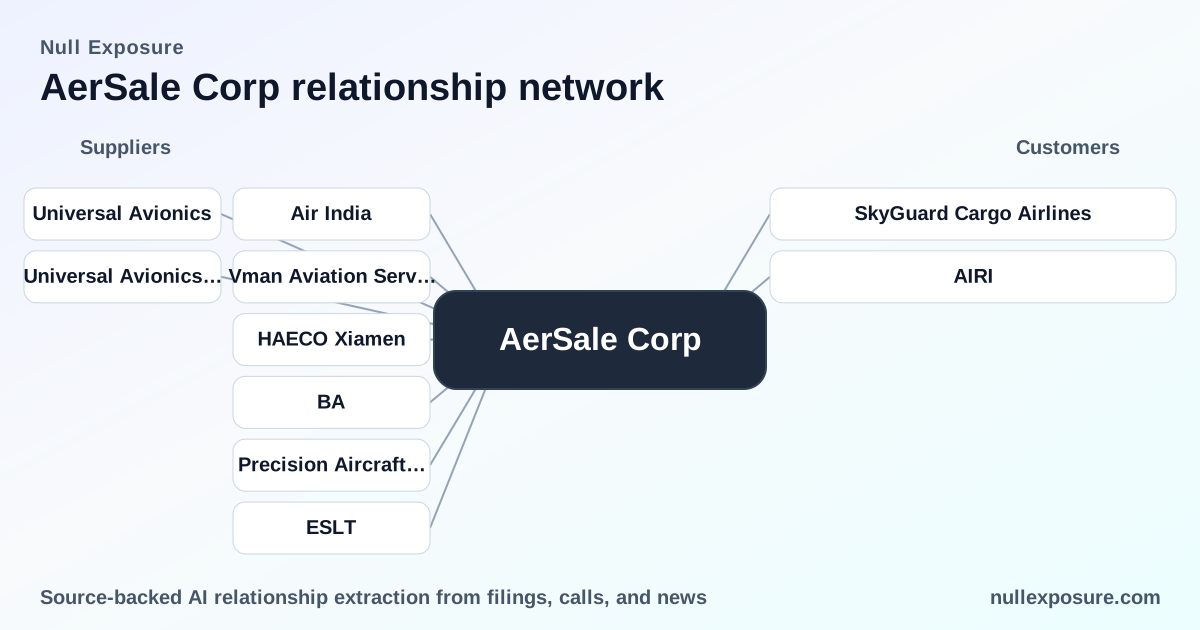
AerSale (ASLE) — Customer Relationships That Drive an Asset-Light MRO & Leasing Franchise
AerSale operates a hybrid aftermarket aviation business that monetizes through the sale of parts and engineered hardware, short-term and spot leasing of converted freighters and engines, and MRO and asset management services to airlines, lessors and government agencies. Revenue mixes across Products and Services, usage-based supplemental rent clauses, and a global customer base create recurring cash flows with variable margin sensitivity tied to asset lifecycle decisions. For an operational primer and relationship intelligence, see https://nullexposure.com/.
Why customers matter to AerSale's valuation
AerSale's financials show a mid-single-digit operating margin and modest profitability on roughly $335m revenue TTM; its business is driven as much by transactional asset sales as by recurring leasing and services revenue, which creates cyclical exposure to cargo demand and aircraft lifecycle timing. The company discloses a high degree of global reach and some customer concentration: one customer generated $50.9m of revenue in 2024 (over 10% of sales), which is material for a ~$336m revenue base. These dynamics make customer composition, contract tenor, and usage-based billing crucial to near-term cash flow forecasts.
Key customer relationships — what the public record shows
Below I cover every customer relationship found in the public results and summarize the commercial point in plain English.
Stratos Freight — Central Asia freighter lease (FY2026)
AerSale announced leasing a Boeing 757-200 Precision Converted Freighter to Stratos Freight, an emerging all-cargo carrier based in Tashkent, Uzbekistan, aimed at expanding cargo capacity across Central Asia, Europe and the Middle East. This transaction is presented in AerSale press releases and echoed by MarketScreener and GlobeNewswire in early 2026, indicating an asset-leasing relationship rather than a sale. (Sources: GlobeNewswire press release, Mar 31, 2026; MarketScreener, May 2, 2026.)
Takeaway: This lease underscores AerSale’s focus on converting used passenger frames into PCFs and monetizing via short-term or medium-term leases into fast-growing cargo markets.
SkyGuard Cargo Airlines — Delivered B757-200 PCF (FY2025)
AerSale delivered a second Boeing 757-200 Passenger-to-Freighter conversion to SkyGuard Cargo Airlines, a Uzbek cargo carrier focused on e‑commerce and courier routes. The delivery was reported in aerospace trade press in October 2025 and appears in later aggregated news coverage in 2026. (Sources: ASDNews, Oct 7, 2025; Avitrader, Oct 8, 2025.)
Takeaway: Repeat deliveries to SkyGuard indicate follow-on demand from niche cargo operators for converted freighters — an important end market for AerSale’s asset conversion and sales pipeline.
Air Indus (AIRI) — Historical leased aircraft incident (FY2014 referenced in FY2024 10‑K)
AerSale’s 2024 Form 10‑K discloses that an aircraft leased to Air Indus suffered significant damage as the result of a terrorist attack on June 9, 2014. The mention is part of legacy portfolio risk disclosures in the 10‑K. (Source: AerSale Form 10‑K, FY2024.)
Takeaway: The 10‑K disclosure is a reminder that AerSale’s asset management carries geopolitical and counterparty risk when aircraft operate in higher-risk environments.
What the relationship signals tell investors about AerSale's operating model
The public record and AerSale’s own disclosures produce a coherent operating profile. Below are the company-level signals and the implications investors should factor into modeling and risk assessment.
-
Contracting posture: short-term and spot leasing dominate part of the book. AerSale explicitly offers customized full-service, short-term leases and frequently uses “green time” spot leases where assets are returned and disassembled after the lease term; this drives high asset churn and cyclical revenue recognition. (Company filings, FY2024.)
-
Revenue contains usage-based components that tie cash flow to utilization. Leases include supplemental rent based on hours or cycles, which aligns lessor and operator economics but increases revenue variability tied to flight activity and cargo demand. (Company filing excerpts.)
-
Customer mix is global but with material domestic exposure. AerSale sells worldwide, with non‑U.S. customers accounting for roughly 37% of revenue in 2024, and domestic (North American) revenue forming the bulk of the remainder — a global footprint that diversifies demand but imports currency, regulatory and geopolitical risks. (Form 10‑K, FY2024.)
-
Role diversification: seller, manufacturer and service provider. The company sells parts and whole equipment (Products ~$215m in year referenced), provides services and engineered solutions (Services ~$108m), and offers asset management and installation — creating multiple revenue levers but also operational complexity. (Segment disclosures.)
-
Customer maturity vs. concentration. AerSale reports that nine of its top ten customers had relationships longer than five years, which supports renewal visibility and cross-sell potential; simultaneously, one customer alone generated $50.9m of revenue in 2024, creating concentration risk that can amplify earnings swings if that relationship changes. (Form 10‑K, FY2024.)
-
Counterparty mix includes governments and defense contractors. Government agencies are stated principal customers, which stabilizes some revenue lines but also introduces procurement, compliance and long payment-cycle dynamics that affect working capital. (Form 10‑K.)
-
Spending profile consistent with mid‑range commercial contracts. The disclosed top-customer spend band ($10m–$100m) positions AerSale’s largest commercial relationships in a material but not monopolistic tier relative to total revenue.
Investment implications and risk checklist
-
Earnings sensitivity is high to cargo demand and conversion activity. Leases to Stratos and deliveries to SkyGuard show AerSale’s revenue growth lever: converting passenger frames into freighters and placing them with regional cargo operators. If cargo volumes slow, supplemental rent and short-term lease utilization will compress revenue faster than fixed-cost reductions.
-
Asset lifecycle and inventory decisions matter to gross margins. The “green time” and disassembly strategy implies AerSale manages a large inventory pipeline where timing of overhauls, parts sales and teardown economics drive margin volatility.
-
Concentration and geopolitical exposure are real risks. One customer >10% of revenue and operations in higher-risk jurisdictions (as reflected by historical Air Indus incident disclosure) increase downside scenarios for revenue and asset recoverability.
-
Diversified revenue composition supports resilience. The mix between Products and Services and the company’s roles as manufacturer and service provider give multiple monetization paths and support margin recovery during periods of weaker leasing demand.
If you evaluate AerSale for modeling or transaction diligence, focus on lease tenor and utilization assumptions for freighter conversions, counterparty credit quality for top customers, and timing assumptions on teardown and parts monetization.
For broader relationship analytics and comparable coverage, visit https://nullexposure.com/ for curated commercial intelligence and portfolio-level insights.