Assembly Biosciences (ASMB): Customer Relationships That Drive Option Value and Near-Term Cash
Assembly Biosciences develops and licenses antiviral therapeutics, monetizing primarily through collaborations, exclusive licensing arrangements, option and milestone payments, and occasional equity placements tied to partner investments. Its commercial model is built around being a specialized licensor and R&D service provider for larger biopharma and marketing partners, creating near-term cash inflection points from option exercises while retaining upside through royalties and milestone economics. For a concise view of the firm's positioning and relationship-driven revenue levers, visit https://nullexposure.com/.
Why partnerships are the company’s revenue engine
Assembly operates a focused biotech playbook: discover and advance antiviral candidates through early clinical stages, then monetize via partner option/licensing agreements and strategic collaborations. This model concentrates risk around early clinical execution while transferring late‑stage development and commercialization costs to licensees. The firm’s capital events — option fees, upfront payments and equity placements — historically account for the most material, discrete revenue items, with recurring program economics expected only if programs progress to commercialization.
Key operating signals from public filings and press coverage show Assembly acts as a licensor and service provider under long-term licensing frameworks, and reports its business as a single operating segment focused on serious viral diseases. These characteristics translate into concentrated customer counterparties, high program criticality, and episodic cash inflows tied to partner decisions.
What every customer relationship says about the business
BeiGene, Ltd.
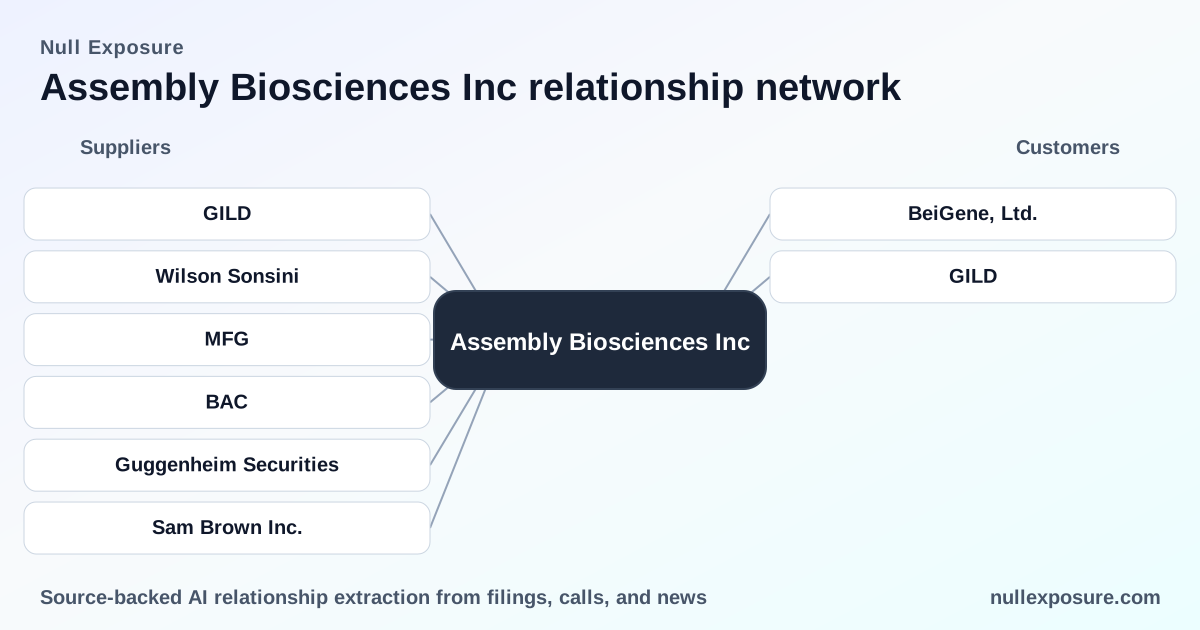
Assembly entered a territory-specific collaboration with BeiGene in July 2020 to develop and commercialize core inhibitor candidates (vebicorvir, ABI‑H2158, ABI‑H3733) for chronic hepatitis B in China, Hong Kong, Taiwan and Macau; the relationship is structured around licensed product candidates and territory rights. This arrangement is disclosed in Assembly’s FY2024 Form 10‑K.
Source: Assembly Biosciences FY2024 10‑K filing (excerpt describing the July 2020 BeiGene Agreement).
Gilead Sciences, Inc.
Gilead is Assembly’s largest and most consequential partner: Gilead invested and structured an earlier collaboration that included an $84.8 million upfront payment plus a $15.2 million equity investment (a combined $100 million consideration) in 2023, and holds option and exclusive license rights across multiple Assembly programs. In late 2025 and into 2026 Gilead exercised combined options to exclusively license HSV helicase‑primase inhibitor programs (ABI‑1179, ABI‑5366) and also holds opt‑in rights on HBV candidates; Assembly reported receiving a net $35 million option fee under the collaboration in FY2026 reporting. Multiple press releases and coverage confirm that Gilead now has the sole responsibility for further clinical development and commercialization of these programs.
Sources: PharmiWeb press release (Oct 17, 2023) on the $100 million arrangement; biospace, Yahoo Finance, and other 2025–2026 press coverage on the option exercises; Assembly FY2025/FY2026 reporting summarized by GlobeNewswire/ManilaTimes (FY2026) noting the $35 million option fee.
CRI / Carter’s (agency context)
Prior to a recent agency change, Carter’s listed Assembly as its agency of record, indicating Assembly’s operations extend into marketing/activation services for brand clients in addition to biotech licensing activities. This relationship appears in campaign coverage of Carter’s agency arrangements in 2026.
Source: Campaignlive article on Carter’s agency transition (FY2026).
T. Rowe Price (campaign activation)
T. Rowe Price engaged Assembly to develop an activation plan as part of a broader campaign partnership (with Digitas NY producing the creative campaign), demonstrating Assembly’s role in channel activation and campaign execution for institutional asset managers. The engagement is described in LBBOnline’s coverage of the campaign in 2026.
Source: LBBOnline coverage of the T. Rowe Price campaign (FY2026).
Stagwell (STGW) — product partnership
Stagwell’s global launch of Stagwell Search+, an AI search platform, lists Assembly as a co‑builder (with Emberos) on the product, indicating Assembly participates in technology and platform partnerships outside of pharmaceuticals. This demonstrates diversification of Assembly’s customer base into digital marketing and technology services.
Source: SimplyWall.St coverage referencing Stagwell Search+ launch and partners (FY2026).
Constraints and operating model implications for investors
- Long‑term, licensing‑centric contracting posture. Public disclosures identify multi‑year collaboration terms (examples reference 12‑year collaboration windows subject to extension fees) and the delivery of exclusive, royalty‑bearing licenses — a company‑level signal that Assembly structures partnerships for sustained, stepwise monetization rather than one‑off services.
- Licensor and R&D service dual role. Assembly reports combined performance obligations for R&D services while delivering exclusive licenses; this hybrid role implies Assembly both executes development work and transfers rights to partners, increasing revenue recognition complexity but preserving option-driven cashable events.
- Geographic concentration in the U.S. for revenue and assets. Assembly reports its revenues and long‑lived assets as U.S.-based for recent years, which is a company‑level signal on geographic operating concentration despite territorial licensing arrangements (e.g., BeiGene China territory).
- Single operating segment and core product focus. The company presents itself as a single operating segment focused on innovative antivirals, a structural signal that upside is tightly tied to clinical progress and partner commercialization decisions rather than diversification across therapeutic areas.
Investment implications: concentrated upside, episodic cash, partner dependency
- Upside via partner option exercises and milestones. Gilead’s option exercises and prior $100 million arrangement illustrate how partner actions create discrete value inflection points and liquidity for shareholders.
- Concentration risk is material. The Gilead relationship dominates near‑term monetization potential; a change in Gilead’s strategic calculus would materially affect Assembly’s commercial runway.
- Operational leverage to clinical readouts. Assembly’s business model amplifies returns from successful Phase 1b/2 results because option and licensing economics convert clinical validation into partner investment and development funding.
- Service‑and‑platform revenue provides non‑clinical diversification. Engagements with marketing and technology clients (Carter’s, T. Rowe Price, Stagwell) show Assembly extracts revenue outside drug development, reducing absolute dependence on biomedical milestones but not offsetting the core program risk.
Bottom line and action steps
Assembly is a specialist licensor with a proven track record of converting early clinical progress into partner deals and option payments; Gilead stands as the pivotal counterparty for ASMB’s asset monetization strategy. Investors should treat the stock as option‑value on multiple antiviral programs plus measured service revenue upside, with concentrated counterparty risk and clear, discrete cash events to monitor.
For a concise intelligence snapshot and to track partner‑driven catalysts, visit https://nullexposure.com/.