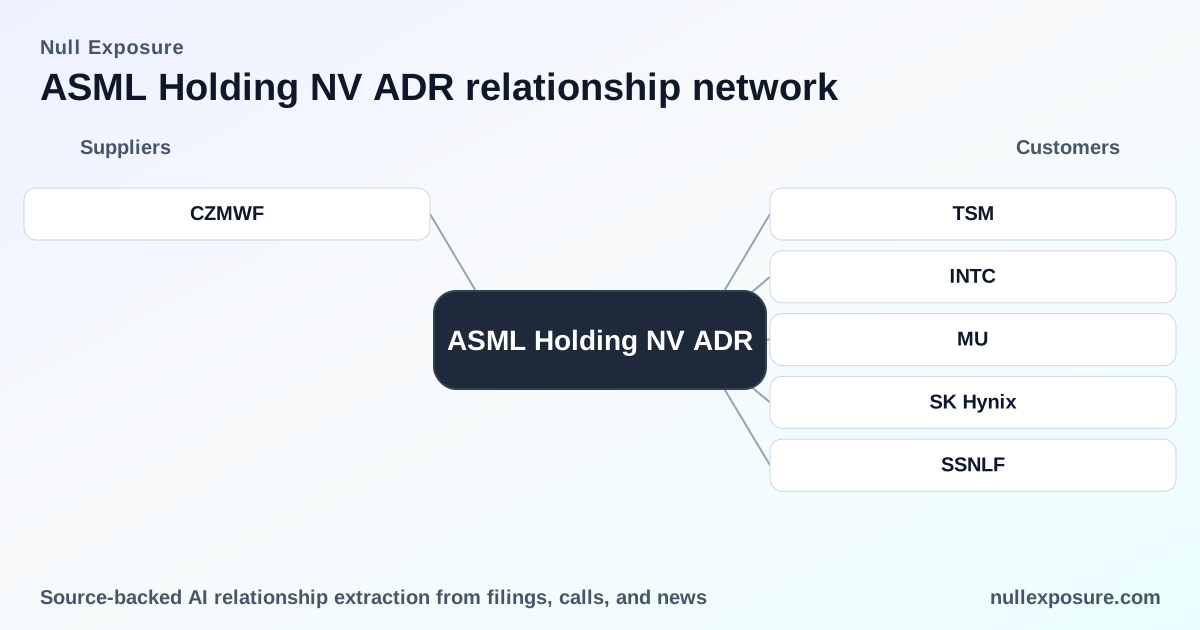
ASML’s Customer Footprint: Why a Handful of Chipmakers Drive Growth and Risk
ASML sells world-class photolithography systems and captures recurring revenue through services, upgrades, spare parts and software support for those machines. The company monetizes by shipping highly concentrated, long-lead capital equipment (EUV/DUV) and then extracting high-margin lifetime services and upgrade revenue, effectively pairing one-time system sales with durable aftermarket cash flow. For investors, ASML is a capital-equipment platform business whose top customers — TSMC, Samsung, Intel, Micron, SK Hynix and others — determine the cadence and scale of orders and the optionality of next‑generation product rollouts. Read a concise company-focused model brief at https://nullexposure.com/.
How ASML’s customers shape its operating model and earnings rhythm
ASML’s commercial structure is not a typical hardware vendor relationship; it combines long order lead times, co-development with customers, and a dominant technology position. Key company-level operating characteristics:
- Contracting posture: long, bespoke capital orders. Customers place multi-year, high-value machine orders with long qualification cycles and acceptance milestones that stretch revenue recognition across quarters and years.
- Concentration: a small number of customers drive a disproportionate share of demand. Public reporting and press coverage consistently identify TSMC, Samsung and Intel as strategic partners and the largest sources of systems and service revenue.
- Criticality: ASML supplies an enabling technology for advanced nodes. EUV lithography is functionally required for bleeding-edge logic and leading-edge memory, giving ASML pricing power and influence over roadmap timing.
- Maturity and co-development: product timelines are multiyear and closely coordinated with customers. New platforms (e.g., High‑NA EUV) are co‑developed and qualified with foundries, which affects adoption cadence and revenue timing.
No structured constraints were supplied in the source material; the above operating signals are derived from the customer relationships and recent market reporting in the public record.
Customer map: every relationship flagged in the coverage (one‑to‑two sentence summaries)
TSMC (TSM / Taiwan Semiconductor Manufacturing Company)
TSMC is consistently referenced as ASML’s largest and most strategically important customer, whose capex plans directly drive ASML order books and outlook; announcements of large increases in TSMC capex were repeatedly cited as supporting higher demand for ASML’s EUV systems (CNBC, 2026-01-16; eand.co, March 2026). At the same time, TSMC’s decision to delay broad adoption of ASML’s next‑gen High‑NA EUV until later (limited R&D purchases only) creates a clear timing risk for ASML’s highest‑margin roadmap items (TradingKey and MarketBeat coverage, April–May 2026).
Sources: CNBC (2026-01-16); TradingKey / MarketBeat reporting (Apr–May 2026).
Intel (INTC)
Intel is both a long-term partner and a strategic co‑developer for ASML’s EUV roadmap, and recent reporting highlights Intel’s role in qualifying ASML’s High‑NA EXE:5200B system for high-volume manufacturing — a concrete commercial milestone that accelerates ASML’s next‑gen deployment timeline (Tikr, March 2026; TradingView, May 2026). Intel’s investments and joint development history underpin ASML’s technology leadership and reduce single-vendor execution risk on certain product features.
Sources: Tikr (Mar 2026); TradingView (May 2026).
Samsung (SSNLF / 0L2T.LON)
Samsung is a major foundry and memory customer, regularly cited alongside TSMC and Intel as a co‑investor in EUV development and a direct purchaser of advanced lithography tools; industry commentary places Samsung among the handful that support ASML’s product roadmap through orders and technical collaboration (Finterra / TradingView, Apr–May 2026). Samsung’s capex decisions therefore materially influence ASML’s memory and logic order flow.
Sources: Finterra (Apr 2026); TradingView (May 2026).
Micron Technology (MU)
Micron features in coverage as one of the memory makers driving DUV and EUV demand for memory nodes — especially with the rise of HBM variants for AI — making Micron an important source of equipment orders and aftermarket services (FinancialContent / Finviz, Mar 2026). Memory capex cycles at Micron translate directly into equipment orders and service contracts for ASML.
Sources: FinancialContent / Finviz (Mar 2026).
SK Hynix
SK Hynix is documented as placing substantial multi‑billion‑dollar orders for ASML’s EUV tools through 2027, reflecting a sizable memory‑driven revenue stream for ASML tied to HBM and other advanced memory production (TradingKey / Finterra, Mar–Apr 2026). These orders bolster ASML’s medium‑term book-to-bill and reduce near‑term revenue volatility by adding committed backlog.
Sources: TradingKey (Mar–Apr 2026); Finterra (Apr 2026).
IBM
IBM shows up in coverage as a meaningful growth channel for ASML through increased sales in services and upgrades tied to wafer fabrication equipment; one report notes IBM-related sales growth as a driver of ASML’s service and upgrade business in 2025 (TradingView research, May 2026). That emphasizes ASML’s diversified aftermarket opportunities beyond pure foundry spending.
Source: TradingView research note (May 2026).
ASMU (ETF mention)
A analysis of new leveraged ETFs (ASMU referenced) lists ASML among the core underlying holdings for a Direxion 2x bull product, indicating that ASML is now widely represented in thematic leveraged vehicles — a market‑structure detail that affects investor flows but not ASML’s commercial customer base (Bitget coverage, Mar 2026). This is a capital-markets relationship rather than an industrial customer relationship.
Source: Bitget (Mar 2026).
What investors should take from the customer map
- Top‑heavy demand profile is both a lever and a risk. Large capex commitments from TSMC, Samsung, Intel and memory players amplify upside when chips are in an upcycle, but create concentrated downside exposure if one customer delays next‑generation purchases.
- Service and upgrades smooth revenue and improve margins. ASML’s aftermarket business is a durable margin driver that partially offsets lumpiness in system shipments.
- Technology timing is an earnings hinge. High‑NA adoption timing — specifically TSMC’s stated delay and Intel’s qualification — determines when ASML captures the full revenue and margin uplift from its next‑generation platform.
- Geopolitics and supply‑chain posture matter. Customer capex is influenced by national policy and regional investment incentives; changes in market access or tariffs feed directly into ASML order trajectories.
Key takeaway: ASML’s revenue growth and valuation multiple reflect a near‑monopoly position in essential advanced lithography but also concentrate execution risk around a handful of foundry and memory customers and the timing of next‑generation product adoption.
For an investor-ready executive brief and ongoing coverage of customer signals and order-flow dynamics, see https://nullexposure.com/.