ASP Isotopes (ASPI): Commercial Partnerships Driving a Specialty-isotope Growth Story
ASP Isotopes operates and monetizes by producing and selling specialist isotopes and enriched materials — including HALEU, carbon-14 and silicon-28 — to nuclear developers, radiopharmacies, semiconductor customers and industrial gas firms. Revenue derives from a mix of multi-year supply contracts, tolling arrangements and shorter purchase orders, with recent commercial commissioning and pilot programs translating development-stage assets into cash-generating operations. For investors evaluating customer relationships, the company combines high-contract criticality (nuclear fuel and medical isotopes) with concentration risk and a transition from project to commercial stage that is material to near‑term revenue trajectory. Learn more at NullExposure.
Why customers matter to valuation: high value, high concentration
ASP Isotopes’ customers buy products that are both technically specialized and strategically critical to their operations — reactors, PET imaging and advanced semiconductors depend on reliable isotope supply. That creates pricing power and long lead times for contracts, but also exposes ASP Isotopes to customer concentration: one unnamed customer accounted for roughly 14% of specialist-isotopes revenue (~$592k) in 2024, which signals notable single-counterparty exposure on an otherwise still-small revenue base (company disclosure, FY2024).
Operationally, the company’s commercial posture blends long-term anchoring and short-term opportunism: documented 10‑year contracting constructs exist alongside purchase orders and pilot arrangements, creating a revenue mix that supports both capital recovery for production facilities and flexible spot sales into adjacent markets.
What the relationships look like today — line‑by‑line
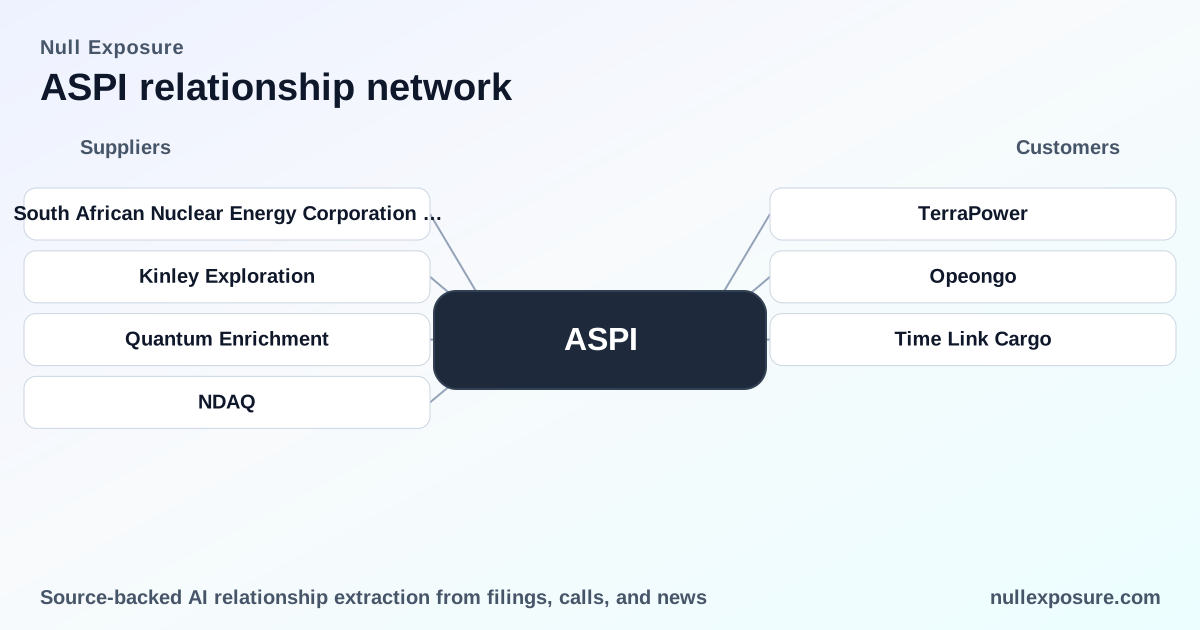
Below I cover every customer relationship referenced in the available coverage, with concise takeaways and source context.
Renergen Limited — milestone for helium project execution
ASP Isotopes announced completion of phase 1 drilling on the Renergen helium project, finishing four months ahead of schedule, signaling execution capability on gas/helium initiatives that complement isotope activities. Source: Traders Union news report, May 2, 2026 — https://tradersunion.com/news/companies/show/1852804-helium-project-milestone-achieved/
TerraPower — strategic HALEU supply discussions and conflicting public narratives
ASP Isotopes is connected to TerraPower through public statements that describe an arrangement for initial fuel-core delivery and a proposed 10‑year supply commitment to deliver up to 150 metric tons of HALEU through 2037; separately, activist and legal notices allege the company overstated the commercial firmness of that relationship, describing the publicized arrangement as a non‑binding MOU. Source: StockTwits market note, Mar 9, 2026 — https://stocktwits.com/news-articles/markets/equity/asp-isotopes-stock-surged-today-why-the-company-stands-to-gain-from-meta-nuclear-energy-deal-with-terra-power/cmU2hJCR4dX; and shareholder-alert filing coverage, Newsfile, May 2, 2026 — https://www.newsfilecorp.com/release/236012/SHAREHOLDER-ALERT-Faruqi-Faruqi-LLP-Investigates-Claims-on-Behalf-of-Investors-of-ASP-Isotopes?lang=fr. Additionally, ASP Isotopes referenced TerraPower in a business‑update conference call, underscoring the relationship’s centrality to investor messaging (GlobeNewswire, Apr 10, 2026 — https://www.globenewswire.com/news-release/2026/04/10/3271708/0/en/asp-isotopes-to-host-business-update-conference-call-on-april-13-2026-at-8-00-am-et.html).
Opeongo — commercial pipeline linkage for isotope supply
ASP Isotopes disclosed an investment that underpins potential isotope supply opportunities tied to Opeongo’s programs, reflecting business development work to convert R&D pipelines into supply contracts for specialized isotopes. Source: TradingView news, Mar 9, 2026 — https://www.tradingview.com/news/tradingview:86af0c28bab9a:0-asp-isotopes-signs-multiple-material-agreements/
Time Link Cargo — logistics pilot for LNG-powered fleet
A fourth-quarter 2025 pilot with Time Link Cargo deployed LNG‑powered Volvo trucks in a dedicated logistics program, demonstrating the company’s attention to operational execution and low‑emission logistics for product movement. This is a commercial‑operations signal rather than a product‑sale relationship. Source: GlobeNewswire production update, Jan 29, 2026 — https://www.globenewswire.com/news-release/2026/01/29/3228480/0/en/asp-isotopes-inc-provides-production-update-on-the-renergen-helium-project.html
The South African Nuclear Energy Corporation (Necsa) — R&D and collaboration channel
ASP Isotopes referenced collaboration with Necsa (the South African Nuclear Energy Corporation) in its investor update, positioning Necsa as a strategic partner in development and testing activities that feed the company’s manufacturing pipeline for nuclear materials. Source: GlobeNewswire business update, Apr 10, 2026 — https://www.globenewswire.com/news-release/2026/04/10/3271708/0/en/asp-isotopes-to-host-business-update-conference-call-on-april-13-2026-at-8-00-am-et.html
Fermi America — strategic partner mentioned in investor communications
Fermi America is cited alongside TerraPower and Necsa in ASP Isotopes’ corporate presentation of strategic partnerships and commercial initiatives, indicating a role in the company’s SMR/HALEU go‑to‑market positioning. Source: GlobeNewswire business update, Apr 10, 2026 — https://www.globenewswire.com/news-release/2026/04/10/3271708/0/en/asp-isotopes-to-host-business-update-conference-call-on-april-13-2026-at-8-00-am-et.html
Commercial constraints and what they imply for investors
The company-provided signals collectively define an operating model with distinct characteristics:
-
Contracting posture — mixed maturity. ASP Isotopes operates with both long‑term commitments (a disclosed 10‑year framework tied to HALEU in available company disclosures) and shorter purchase orders, giving it a two‑tier commercial book that supports capex recovery while enabling agile spot sales. The TerraPower excerpt explicitly references a ten‑year purchase construct (company filing, Oct 2024), and purchase orders for silicon‑28 in 2024 show the short‑term element.
-
Concentration risk is real. A single customer represented ~14% of specialist‑isotopes revenues in 2024, which is significant given the company’s current revenue base; this heightens counterparty risk and underlines the importance of broadening the customer mix.
-
Criticality of product to customers. The materials supplied — HALEU for reactors and isotopes for medical imaging — are operationally critical for customers, elevating the commercial significance and the potential durability of high‑value contracts.
-
Maturity: transitioning into commercial production. The company reports commissioning completed and commercial production started at C‑14 and Si‑28 facilities in Pretoria, and pilot programs (e.g., logistics with Time Link Cargo) indicate an operational shift from R&D to revenue generation.
-
Spend and financial underpinning. A tolling agreement carries a minimum “take or pay” of roughly $2.5 million per year, supported by a bank guarantee, which provides a revenue floor for a portion of the business and supports working‑capital planning.
-
Geographic footprint is global with EMEA presence. Transactions span North America and EMEA (radiopharmacy deliveries in South Africa are explicitly in scope), positioning the company as a global supplier but also exposing it to multinational regulatory complexity.
Investment implications — what to watch next
- Revenue growth will depend on converting MOUs and pilot programs into binding long‑term contracts and on scaling production at Pretoria. The TerraPower narrative shows both promise and reputational risk; investors should prioritize documentary proof of binding off‑take agreements.
- Customer diversification is essential to reduce the current concentration that amplifies downside risk if single counterparties withdraw or delay purchases.
- Contract enforceability and payment support (e.g., letters of guarantee for tolling) are positive structural elements that reduce cash‑flow volatility.
A mid‑cycle reassessment should focus on contract schedules, take‑or‑pay enforcement, and evidence of sustained commercial orders beyond pilot volumes. For a concise tracking feed and relationship intelligence, visit NullExposure for the company’s live relationship map.
Bold, critical customer relationships and contract structures are central to ASP Isotopes’ valuation story: long‑term HALEU potential and short‑term silicon and C‑14 commercial sales together determine whether the firm successfully converts technical capability into scalable revenue.