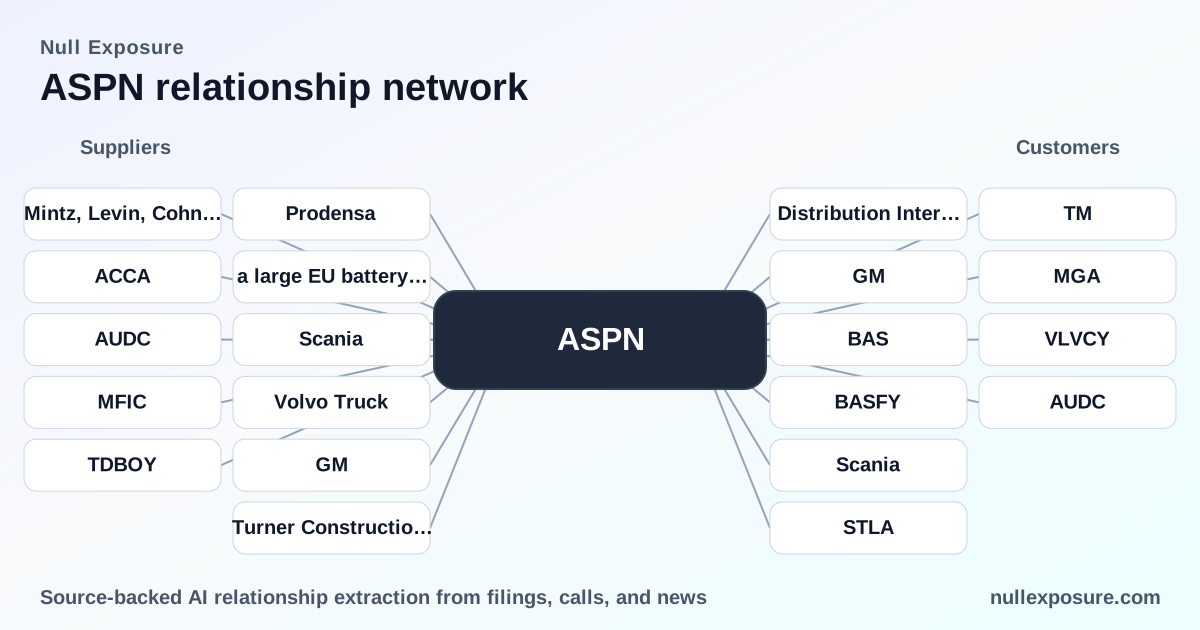
Aspen Aerogels: customer map, concentration risks, and contract posture
Aspen Aerogels designs, manufactures and sells high-performance aerogel insulation and fabricated thermal barriers primarily into the energy infrastructure and electric vehicle (EV) supply chains. The company monetizes through product sales to distributors and direct OEM contracts—including multi-year, fixed-price production agreements for EV battery thermal barriers—and through strategic supply partnerships that include financing and capacity support with chemical majors. Investors should view Aspen as a manufacturer with concentrated OEM dependency, growing distributor channels, and explicit long-term contractual commitments to at least one large automaker. Learn more at https://nullexposure.com/
Quick read: what matters for valuation and operations
- Customer concentration is high. Aspen disclosed that its ten largest customers accounted for approximately 84% of 2024 revenue, creating revenue volatility tied to a small set of counterparties.
- OEM contracts introduce both revenue visibility and execution risk. The company has multi-year production contracts with EV OEMs that establish fixed prices and volume frameworks through staggered expirations.
- Geographic revenue mix is diversified but U.S.-weighted. In 2024 Aspen reported 57% U.S. product revenue and material exposure across Latin America, Europe and Asia.
- Distributor channel is strategically important. A significant portion of sales flow through distributors who then service end-users in energy industrial markets.
Detailed customer relationships (one-by-one)
Distribution International, Inc.
Aspen reported $33.6 million of energy industrial sales to Distribution International in 2023, down from $39.3 million in 2022, indicating a material distributor relationship in the energy segment. This figure is drawn from Aspen’s 2024 Form 10‑K disclosures covering FY2024.
General Motors (GM)
GM is Aspen’s single largest OEM exposure: news reporting and company commentary attribute roughly 59% of 2025 revenue to a single large OEM, identified as GM, and Aspen has multi-year production contracts to supply fabricated thermal barriers to GM with terms that expire at various times between 2026 and 2034. Aspen discussed GM’s production rate shifts in its Q4 2025 earnings call and the revenue split is noted in market coverage following the 2025 filing.
Sources: Aspen Q4 2025 earnings call; company disclosures and market write-ups in mid‑2026 summarizing FY2025 revenue.
Toyota
Aspen supplies encapsulated aerogel products that are routed to multiple global OEMs, including Toyota, as part of finished-component shipments from its Apodaca, Mexico production footprint. Mexico‑Now reported Toyota among the named customers delivered by the new Apodaca plants in FY2024.
Source: Mexico‑Now coverage of Aspen’s Apodaca plant openings (FY2024).
Audi
Aspen lists Audi among OEMs receiving encapsulated aerogel products from its Apodaca operations, signaling penetration into premium European vehicle programs. This customer affiliation was reported in the plant inauguration coverage.
Source: Mexico‑Now report on Apodaca plants (FY2024).
Scania
Aspen’s Apodaca production was described as servicing heavy‑duty and commercial OEMs including Scania, which aligns with the company’s push into thermal protection for a range of vehicle architectures. This connection was identified in the same plant launch reporting.
Source: Mexico‑Now plant inauguration article (FY2024).
Stellantis‑ACC
The Apodaca plant announcement lists Stellantis‑ACC among customers receiving Aspen’s encapsulated aerogel products, indicating relationships across multiple global OEM platforms and supplier ecosystems.
Source: Mexico‑Now coverage of the Apodaca facility (FY2024).
Magna
Magna is named as a recipient of encapsulated aerogel components produced at Aspen’s Mexican facilities, reflecting Aspen’s role both as a supplier to OEMs and to large global tier‑one suppliers. This was presented in media coverage of the Apodaca plants.
Source: Mexico‑Now article on Aspen’s new plants (FY2024).
Volvo Car
Aspen reported securing a new award with Volvo Car, bringing the total to seven European design wins, a signal of broadening OEM design engagement in Europe and a move from pilot to production design wins in that market. The company made this remark in its Q4 2025 earnings call and it was repeated in subsequent transcripts.
Source: Aspen Q4 2025 earnings call and Q4 2025 call transcript coverage (FY2025).
VLVCY (ticker reference for Volvo Car)
Market transcripts and aggregator reports reference VLVCY when reporting Aspen’s design‑win announcements with Volvo Car; these entries duplicate the Volvo Car commercial update and confirm investor awareness of that European pipeline.
Source: Q4 2025 earnings commentary and third‑party transcript coverage (FY2025).
BASF / BASF SE / BASFY
Aspen and BASF expanded a strategic partnership by signing an addendum to an exclusive supply agreement, and Aspen received capacity‑expansion support and financing under the partnership terms—linking Aspen to a global chemical partner that can facilitate product commercialization and scale. BASF’s 2019 press release announced the extension of the exclusive supply agreement, and later legal/transaction commentary referenced financing support as part of the strategic relationship.
Sources: BASF press release (2019) and subsequent case study coverage referencing the expanded partnership and financing (FY2021).
How the relationships map back to Aspen’s operating model
Aspen runs a hybrid go‑to‑market: direct OEM production contracts for high‑value EV thermal barriers plus distribution channels for energy industrial insulation. The company’s disclosures and market reporting present several structural characteristics investors should factor into risk and upside:
- Contracting posture: Aspen holds long‑term, fixed‑price production contracts with OEMs—explicitly named with GM—delivering revenue visibility but concentrating execution risk around volume commitments and on‑time manufacturing through at least 2026–2034 where stated.
- Concentration risk: Company statements show the top ten customers produced ~84% of 2024 revenue, and an individual OEM accounted for a majority of 2025 revenue, amplifying single‑counterparty exposure.
- Channel mix and criticality: Aspen sells through distributors for energy markets while acting as a manufacturer/seller to OEMs; distributors are essential for end‑market penetration, but OEM contracts are critical for scale in EV‑related products.
- Geographic maturity and diversification: Revenue is U.S.‑weighted (57% in 2024) with meaningful Latin America, Europe and Asia presence—Aspen is global in reach but concentrated in North America for shipments.
- Relationship stage profile: The company operates both active production relationships (GM, Toyota, select distributors) and pilot/design win stages (multiple European OEM design wins such as Volvo), implying near‑term revenue from production contracts and multi‑year upside from pilots converting to production.
For a deeper read on customer exposures and contract structure, visit https://nullexposure.com/ — the contextual detail improves modeling and sensitivity work.
Investment implications: what to watch next
- Execution against GM contracts is the dominant operational risk — production rates, inventory alignment at GM, and the company’s ability to meet fixed‑price volume commitments will drive near‑term top‑line stability.
- Conversion of European design wins into production (Volvo and others) is the primary path to de‑risking concentration and restoring margin leverage.
- Distributor performance and energy industrial demand (including end markets served by Distribution International) will determine cyclicality outside EVs.
Aspen’s customer set delivers both revenue visibility via multi‑year OEM contracts and concentrated counterparty risk via a few very large relationships; active monitoring of contract fulfillment, OEM production plans, and the conversion of design wins to production are the critical variables for valuation.