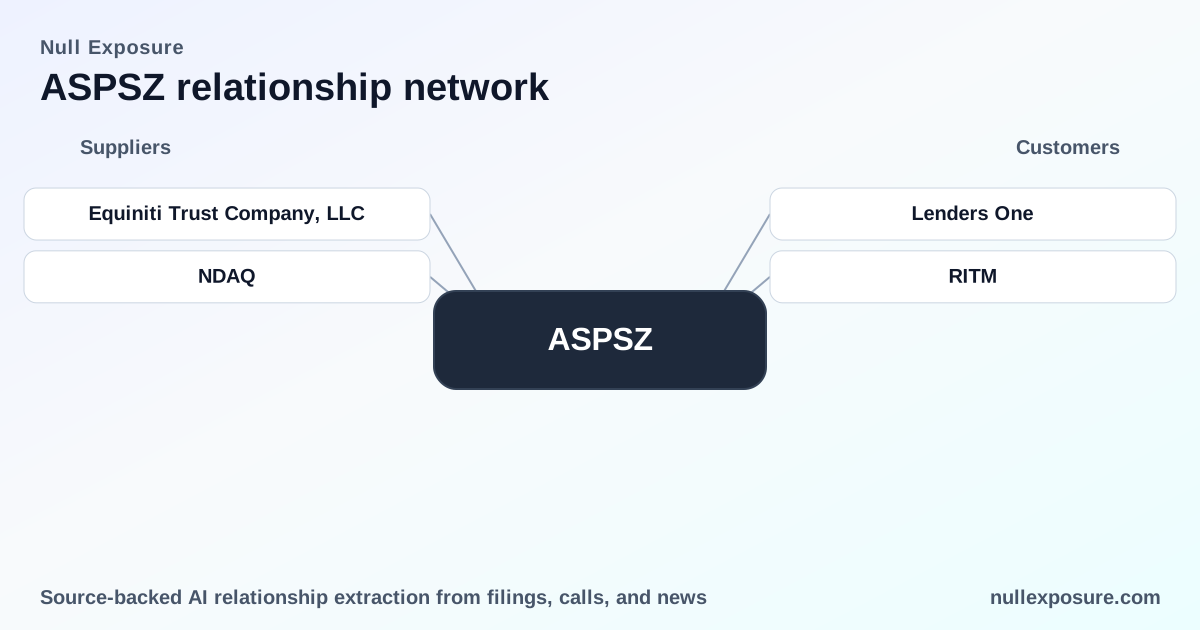
Altisource Portfolio Solutions (ASPSZ) — customer map, concentration and commercial posture
Altisource Portfolio Solutions is an integrated service provider and marketplace for the U.S. real estate and mortgage sectors. The company monetizes through a two-pronged model: fee-based services (property management, REO brokerage, title and inspections) and recurring SaaS/technology subscriptions (Equator, RentRange, REALSynergy, etc.), with the services segment dominating recent revenue. For investors, the critical lens is revenue concentration and contract duration: a small number of large servicers drive a material share of revenue, while long-term service agreements and SaaS contracts underpin predictable cashflows. For further corporate analytics visit NullExposure.
Why the customer roster matters to valuation
Altisource’s operating model is built to sell integrated services into large servicers, GSEs and institutional buyers. That structure creates a mix of high-margin, recurring technology revenue and variable, volume-driven service revenue that scales with mortgage servicing activity. However, the company’s economics are heavily influenced by a handful of counterparties: filings disclose that a significant portion of revenue is concentrated among two customers, and that one customer alone accounted for a very large share of total revenue in 2024. This concentration compresses optionality for investors but amplifies upside if retention and contract renewals occur on favorable terms.
Company-level constraints and what they imply for operators and investors
- Long-term contracting posture exists for select relationships. Altisource disclosed services agreements with terms extending through August 2030 for certain customers, indicating multi-year locked-in revenue streams for at least part of the book. According to the company’s disclosures, these long-term service agreements are part of their commercial posture (Form 10-K, FY2024 filings).
- High customer concentration is a material risk. Management states that revenue from two customers represents a significant portion of total revenue; the loss of either would negatively impact results. This is a company-level materiality signal that increases earnings volatility linked to contract renewal outcomes.
- A critical customer accounted for 44% of revenue in 2024. The filing explicitly names that the largest customer (Onity) generated 44% of total revenue during 2024, demonstrating one-to-few dependency that must be modeled explicitly in downside scenarios.
- Customer mix skews to large enterprises and government-sponsored entities. Filings list GSEs, asset managers, and large bank and non-bank servicers among customers; Rithm and Onity are mentioned as examples, positioning Altisource as a supplier to institutional counterparties rather than retail clients.
- North America is the dominant geography. Services are provided predominantly to U.S.-based customers, which focuses regulatory, macro and mortgage-cycle exposure to the U.S. market.
- Services remain the revenue driver with SaaS as a growing, stabilizing element. The company recognized $150.4 million in service revenue in 2024 and distinguishes a software/SaaS product suite that provides recurring recognition patterns—this blend influences working capital and margin dynamics.
- Spend/billing bands for the largest customers are meaningful. Onity generated $70.4 million of revenue in 2024; filings place large-customer spend in a $10M–$100M band, pointing to sizeable counterparty invoices that are material to cash collections and contract economics.
- Sales pipeline maturity is meaningful but not guaranteed. Management reported a weighted average pipeline of $38M–$47M for a stabilized annual run-rate, indicating active business development but requiring conversion to offset concentration risk.
Collectively, these constraints define a company with institutional customer focus, significant counterparty concentration, contractual anchors that extend multiple years for select clients, and a diversified but service-weighted revenue base.
Customer-by-customer lens: the relationships investors should track
Lenders One — managed and integrated into Altisource’s solutions
Altisource lists management of Lenders One within its mortgage and real estate solutions suite, indicating it operates platforms and services that support lender networks and their mortgage workflows. This relationship reflects Altisource’s role as a marketplace and service integrator for originators and investor networks. According to a TradingView company summary referencing FY2025 disclosures, the mortgage and real estate solutions business includes management of Lenders One (TradingView, March 9, 2026).
Rithm / RITM — a principal servicer client and exclusive brokerage buyer for REO
Altisource’s FY2024 Form 10-K identifies Rithm as one of its largest servicing clients and discloses that Rithm purchases REO brokerage services exclusively from Altisource for certain MSRs under a Rithm Brokerage Agreement that extends through August 2025, subject to contract limitations. This establishes Rithm as a high-value, contractually-bound buyer for Altisource’s brokerage services and signals concentrated buyer economics for REO channels (Altisource 10-K, FY2024).
Note: Rithm is recorded under both "Rithm" and ticker-like "RITM" in filings; both entries refer to the same servicing relationship as documented in the 2024 annual filing.
What investors should monitor next (actionable checklist)
- Contract renewals and extension terms for Rithm after August 2025 and for other named long-term customers—renewals materially affect revenue visibility.
- The status of the largest customer (Onity) relationship given it contributed 44% of revenue in 2024; changes to that relationship will drive near-term P&L sensitivity.
- Conversion of sales pipeline into contracted revenue to assess whether the company can diversify its top-line concentration.
- SaaS adoption and margin expansion within Equator, RentRange and REALSynergy—software recurring revenue will de-risk seasonality inherent in volume-based services.
- Collections and working capital performance, since large invoices to a limited set of counterparties concentrate credit and cashflow risk.
For a deeper view of Altisource’s customer exposures and to model concentration scenarios, visit NullExposure.
Bottom line: concentrated revenue with contract levers
Altisource offers investors a clear commercial profile: institutional client focus, sizable service revenue with complementary SaaS, and material concentration that creates binary outcomes around contract renewals. The company’s disclosed long-term agreements and exclusive REO brokerage arrangements create predictable revenue pockets, but the financial outcome for shareholders hinges on retention of a very small set of large customers and successful growth of recurring technology revenue. Investors should price in both the upside of contract renewals and the downside of customer loss when evaluating ASPSZ.