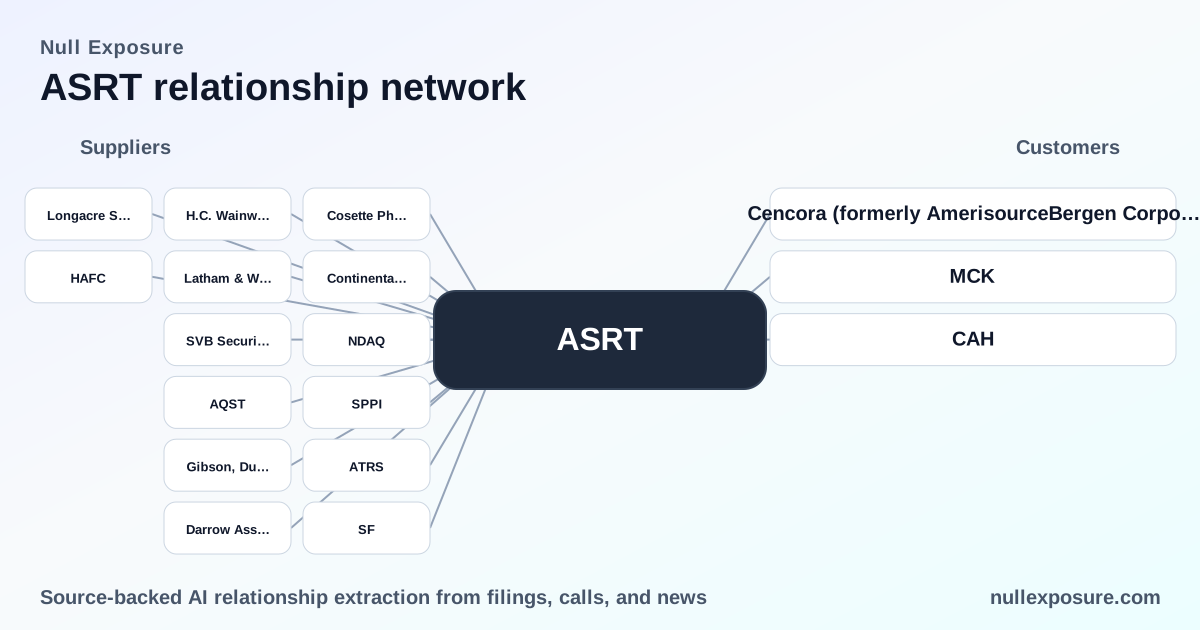
Assertio (ASRT): Customer Map and Concentration Risks for Investors
Assertio is a commercial pharmaceutical company that monetizes by selling branded and legacy prescription products primarily in the United States through wholesale distributors and specialty pharmacies, while opportunistically monetizing non-core assets via asset sales. Revenue comes from net product sales to a small set of large distribution partners, and the company has recently executed a multi‑pronged corporate transaction that includes a take‑private agreement and the sale of several legacy brands. For a strategic data-driven view of counterparties and implications for investors, see more at https://nullexposure.com/.
Quick take: what investors need to know up front
Assertio’s customer base is highly concentrated and U.S.-centric. The company reports that three large, national wholesale distributors represent the majority of its consolidated revenue, and management runs the business as a single reported segment focused on product sales. That structure creates concentration risk (few customers), geographic risk (predominantly U.S.), and transactional sensitivity (reliance on distributor channels and occasional asset sales).
The relationship roll call — who Assertio sells to and deals with
Below I summarize every customer/partner relationship surfaced in the available records and news coverage, with concise sourcing.
-
Cencora (formerly AmerisourceBergen Corporation)
Assertio identifies Cencora as one of the large national wholesale distributors that account for a meaningful portion of consolidated revenue, reflecting the company’s distributor-centric go-to-market model. Source: Assertio FY2024 Form 10‑K (filed Dec 31, 2024). -
McKesson Corporation (MCK)
McKesson is listed among Assertio’s principal wholesale distributors in the FY2024 10‑K, underscoring another concentrated distribution relationship central to product flow and cash collection. Source: Assertio FY2024 Form 10‑K (filed Dec 31, 2024). -
Cardinal Health (CAH)
Cardinal Health appears in Assertio’s FY2024 disclosures as a key national distributor customer, completing the trio of major wholesalers that collectively represent the bulk of product revenue. Source: Assertio FY2024 Form 10‑K (filed Dec 31, 2024). -
Cosette Pharmaceuticals, Inc. (Cosette)
Cosette closed on the purchase of U.S. sales and distribution rights for seven branded Assertio products in a transaction announced in early May 2026; the deal included upfront consideration (reported at $35 million in press coverage) plus contingent payments. This is an explicit example of Assertio monetizing legacy assets through divestiture. Source: Biospace press release and contemporaneous news coverage (May 2, 2026). -
Garda Therapeutics
Assertio agreed to be acquired by Garda Therapeutics in an $18.00-per-share cash tender offer plus a contingent value right (CVR), a transaction that simultaneously included asset sales of non‑core brands; the deal and ensuing shareholder litigation scrutiny were covered in market news. Source: TradingView coverage and Intellectia report on the Halper Sadeh investigation (May 2026).
What the contractual and counterparty constraints tell you about the business
The public filings and news items collectively reveal several decisive operating model traits:
-
Concentration and counterparty scale. Assertio’s revenue profile is dominated by three large national wholesale distributors; management explicitly states these distributors represent the majority of consolidated net product sales. That places high commercial leverage in a handful of counterparties and elevates counterparty negotiation and collection risk. (Company-level signal from FY2024 10‑K.)
-
Distributor channel dependence. Assertio’s primary role is that of a seller to wholesale distributors and specialty pharmacies, not a direct-to-consumer marketer at scale; this shapes contract terms, payment cycles, and logistics exposure. (Company-level signal.)
-
Geographic concentration. The company reports that substantially all revenues and assets are U.S.-related, creating single‑market exposure to reimbursement, regulatory, and pricing dynamics in the United States. (Company-level signal.)
-
Single-segment commerciality. Assertio manages the business as one reportable segment focused on pharmaceutical product sales—this simplifies reporting but reduces internal diversification across product lines or geographies. (Company-level signal.)
-
Criticality of distributor relationships. Filings describe the distributor relationships as material and critical to consolidated revenue, implying that any disruption (contract disputes, inventory interruptions, or pricing pressure) would have an outsized financial impact. (Company-level signal.)
Implications for investors and operators
-
Operational sensitivity is high. With revenue concentrated among a few large distributors and the U.S. market accounting for substantially all sales, Assertio’s top-line is sensitive to distributor purchasing patterns, formulary decisions, and payer dynamics. That translates into earnings volatility if any distributor reduces orders or if pricing pressure accelerates.
-
Asset monetization is a deliberate strategy. The sale of multiple legacy brands to Cosette and the concurrent Garda acquisition demonstrate an active approach to reshaping the portfolio and extracting value from non-core assets; investors should treat future divestitures as both potential upside (cash proceeds) and downside (shrinking recurring revenue). Source: Cosette and Garda transaction coverage (May 2026).
-
Transaction execution risk exists. The Garda tender offer and CVR structure introduced scrutiny from claimants and proxy plaintiffs, highlighting governance and execution risk during take‑private processes. Source: Intellectia news on Halper Sadeh’s investigation (May 2026).
Key takeaways for credit and equity decisioning
- Concentration is the central risk factor — three wholesalers drive the bulk of revenue; monitor contract renewals, payment terms, and inventory dynamics with those partners.
- U.S.-only exposure increases regulatory and reimbursement sensitivity. Any U.S. policy changes around drug pricing would have immediate impact.
- Recent asset sales reduce base product revenue but improve near-term liquidity, which is relevant when modeling post-transaction capital structure and covenant headroom.
- Monitor the Garda transaction close and CVR mechanics for potential contingent payouts and litigation outcomes that affect shareholder returns.
For institutional clients evaluating counterparties and portfolio fit, a more detailed counterparties map and archival filings analysis is available at https://nullexposure.com/.
Bold, actionable insights: Assertio’s commercial model is simple and concentrated—that simplicity drives both valuation upside through targeted asset sales and downside through distributor concentration risk. Track distributor contract activity, the Garda transaction timetable, and any further divestitures as primary catalysts for value realization.