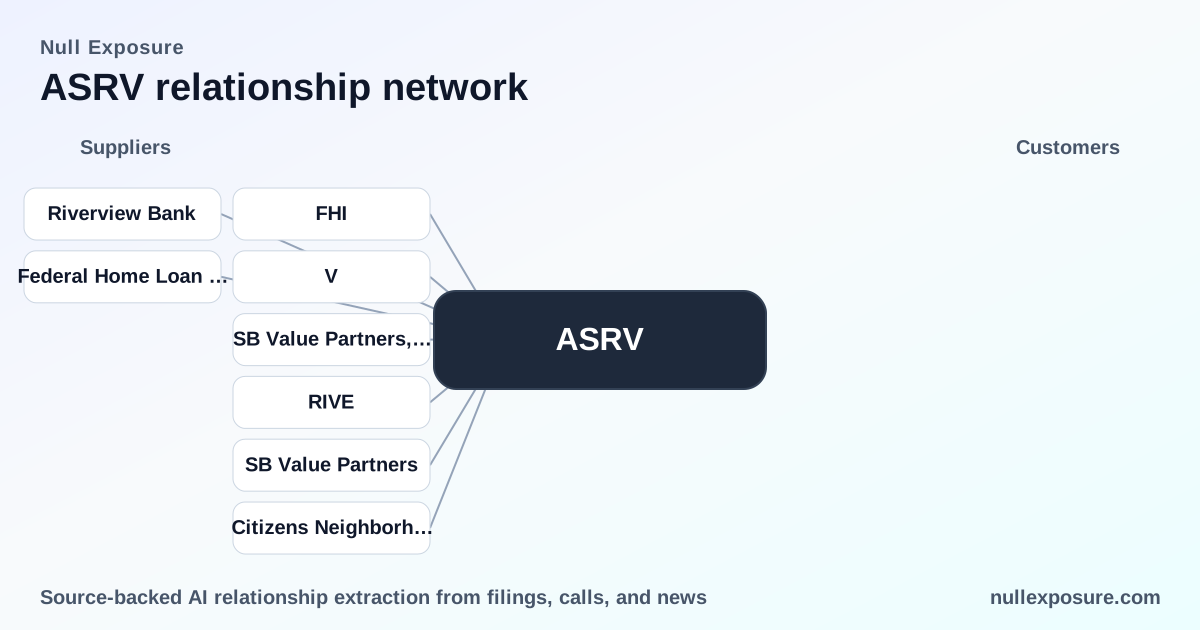
AmeriServ (ASRV): Regional bank with stable local franchise, light material customer concentration
AmeriServ Financial operates and monetizes as a traditional regional bank: it collects deposits from retail, commercial and governmental clients across southwestern Pennsylvania and Hagerstown, Maryland, and generates net interest income and fee income from lending, payments, trust and wealth-management services. Revenue derives from spread on loans and deposit funding plus ancillary service and trust fees, delivered through a 16-branch footprint and a customer base concentrated within a 250-mile radius of Johnstown, PA. For a quick path to the data and monitoring tools, visit https://nullexposure.com/.
Why the business model matters for customer relationships
AmeriServ’s operating model is a classic branch-driven regional bank. That structure produces a few predictable characteristics that investors should treat as constraints on customer relationship economics:
- Contracting posture — long-term orientation. AmeriServ’s consumer and commercial banking products (deposits, mortgages, business loans, wealth management) embed long-lived customer ties and recurring revenue characteristics, consistent with the company’s stated intent to provide comprehensive, ongoing financial solutions.
- Counterparty mix — retail- and institution-heavy, with government exposure. The bank serves individuals and commercial borrowers and reports lending activity to governmental counterparties as part of its public-sector business.
- Geographic concentration — regional footprint. A significant majority of customers live within a 250-mile radius of Johnstown, PA, and the franchise operates 16 branches in southwestern Pennsylvania and Hagerstown, MD.
- Materiality and concentration risk — deposits are broadly dispersed. AmeriServ states that loss of a single depositor or related group would not be materially adverse, signaling low single-counterparty concentration risk.
- Role and revenue mix — seller and service provider. The company both sells financial products and provides a broad set of banking and wealth-management services, meaning revenue is a blend of interest margin and fees rather than transaction-only or one-off sales.
- Segment focus — services-centric. The firm’s portfolio centers on consumer, mortgage, commercial banking and wealth services, reinforcing recurring revenue and balance-sheet sensitivity to local economic cycles.
Those constraints together imply stable, relationship-driven deposits and lending spreads but sensitivity to local economic and interest-rate dynamics, not to single large corporate customers.
All reported customer relationships (complete coverage)
Below is the single customer relationship identified in the sources we reviewed; it is described verbatim and cited.
- BODI — A StockTitan news post dated March 9, 2026 lists AmeriServ as “Official Performance Apparel Partner,” placing ASRV in a marketing/sponsorship role with BODI. (Source: StockTitan news, March 9, 2026: https://www.stocktitan.net/news/BODI/bo-di-unveils-p90x-generation-next-the-next-evolution-of-the-world-s-zb5shicg43hx.html)
What that BODI mention means for investors
The BODI item is a marketing partnership mention rather than evidence of material commercial revenue or client concentration. This relationship is promotional and not likely to affect AmeriServ’s core deposit or lending economics. The placement in a public news post on March 9, 2026 signals brand- or community-focused outreach rather than a major client engagement; the company’s core customer economics remain dominated by its branch network, loan book and wealth-management flows (as reflected in company disclosures).
Interpreting the constraints for strategy and risk
Use these company-level signals to set expectations for how customer relationships evolve and how to monitor them:
- Contracting posture (long-term): Customer lifecycles are measured in years, so revenue changes are gradual; monitor loan amortization schedules, mortgage pipelines and retention metrics to spot inflection points.
- Counterparty mix (individuals + government): Retail deposits and municipal/commercial lending form the backbone of balance-sheet stability. Watch municipal deposit wins/losses and local CRE exposure for concentrated downside.
- Geography (regional): Growth and risk are tightly linked to southwest Pennsylvania and nearby markets. Economic stress in that region, not idiosyncratic counterparty events, drives most credit and deposit shocks.
- Materiality (immaterial single-depositor risk): The bank is not dependent on a handful of large depositors, reducing idiosyncratic funding-run risk but still leaving it exposed to regional deposit flight in stress scenarios.
- Role (seller + service provider): Revenue diversification exists between net interest income and fee-based trust/wealth services, an important hedge versus pure spread compression.
These characteristics imply a conservative, relationship-oriented posture: steady margins in normalization, local-cycle sensitivity, and limited one-off counterparty concentration.
Risk vectors and monitoring priorities for investors
Focus on three monitoring priorities that flow directly from AmeriServ’s customer-profile signals:
- Local economic indicators: unemployment, CRE vacancy, and small-business loan performance in southwestern Pennsylvania and Hagerstown, MD. These drive both credit quality and deposit stability.
- Deposit composition and liquidity metrics: although single-depositor risk is low, the bank’s funding remains regionally concentrated — track core deposit stickiness and wholesale funding usage.
- Fee income and wealth-management flows: service-provider revenue can offset margin pressure, so retention and AUM trends in trust accounts are meaningful leading indicators.
Investment takeaway and next steps
AmeriServ is a compact, branch-centered regional bank with stable, long-term customer relationships and limited single-counterparty concentration. The BODI mention from March 2026 is a peripheral marketing tie and does not alter core economics. For investors, the story is disciplined: monitor regional macro indicators, deposit dynamics and the bank’s fee-income trajectory for directional signals.
For a concise, ongoing tracker of customer relationships and company-level signals, visit https://nullexposure.com/ and review the ASRV profile and alerts. Actively monitoring filings and local-market updates will surface the early signs that matter for valuation and credit outlook.
— End —