Astrotech (ASTC) — customer map and what it means for investors
Astrotech Corporation commercializes explosive-trace detection hardware (TRACER 1000) and related services, selling devices, consumables, maintenance and training to both government and commercial customers while pursuing grant and R&D income through its 1st Detect business. The company monetizes through one-time hardware sales plus recurring consumables and service contracts, with an explicit push into aviation and homeland security channels and selective space-operations services. For quick access to relationship analytics see NullExposure’s research hub: https://nullexposure.com/.
Why customers tell the story: a compact commercial model with government anchors
Astrotech is a small, concentrated commercial operator: total revenue last twelve months is roughly $1.2 million against an EV and market cap in single-digit millions, and the company reports four material customers that drove substantially all revenue in FY2025. That structure creates both opportunity and risk — strong government and airport relationships validate the product for safety-critical screening markets, but the top-heavy customer mix means a single contract decision can materially swing revenue. Astrotech’s revenue mix shows hardware-led sales with complementary services and consumables, consistent with a classic instrumentation vendor monetization model.
The relationship roll call — what public records show
Below I run through every relationship item in the public results so investors understand counterparties, timing and context. Each element is a concise, plain-English summary with the source noted.
U.S. Space Force
Astrotech Space Operations won a $77.5 million contract to expand satellite processing capacity at Vandenberg Space Force Base, positioning the company to participate in higher-volume pre-launch ground services. Source: SpaceNews, May 2, 2026 — https://spacenews.com/astrotech-wins-77-5-million-contract-to-accelerate-pre-launch-satellite-processing-at-vandenberg/
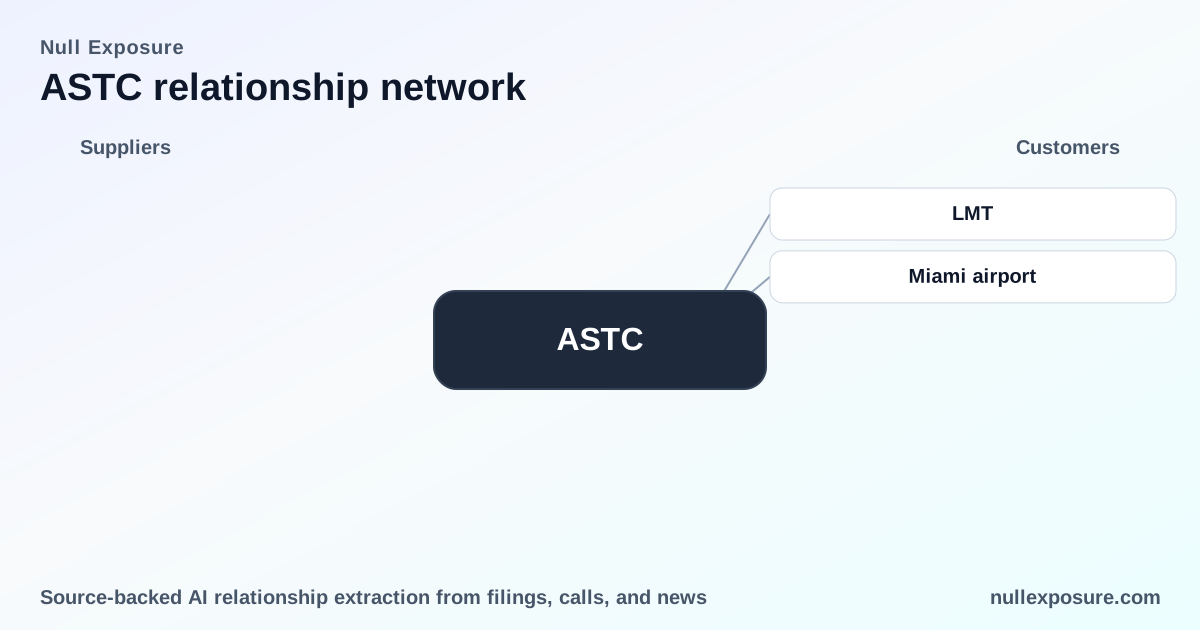
LMT (ticker: LMT)
A historical disclosure notes that Lockheed Martin completed an acquisition in August 2014 of Astrotech’s Space Operations assets, transferring Titusville and Vandenberg operations to Lockheed and reflecting prior divestiture activity in ASTC’s space business. Source: FloridaToday (reporting on local business incentives), FY2016 — https://www.floridatoday.com/story/news/local/2016/12/12/lockheed-extend-our-deadline-add-jobs-incentive-grant/95325468/
Lockheed Martin Corp. (duplicate entry)
The same FloridaToday article reiterates that Lockheed acquired Astrotech Space Operations’ assets in 2014, underscoring that a portion of Astrotech’s historical space-operations capability left the company via sale. Source: FloridaToday, FY2016 — https://www.floridatoday.com/story/news/local/2016/12/12/lockheed-extend-our-deadline-add-jobs-incentive-grant/95325468/
Miami airport
Public commentary and user reports indicate the TRACER product has been used operationally at Miami International Airport, a commercial deployment that demonstrates real-world screening application beyond test sites. Source: TimothySykes blog post, FY2023 — https://www.timothysykes.com/blog/lessons-from-astc/
Department of Homeland Security (DHS)
Astrotech announced formal support for DHS aviation-security modernization plans and has engaged in R&D activity related to explosives-trace detection for DHS, aligning the company with U.S. federal modernization spending priorities. Source: Investing.com press notice summarizing the FY2025 announcement — https://ng.investing.com/news/company-news/astrotech-supports-dhs-1-billion-aviation-security-upgrade-plan-93CH-2253261
TSA (Transportation Security Administration)
Astrotech communicated support for TSA’s nationwide initiative to modernize screening equipment, positioning the TRACER 1000 as relevant to federal passenger- and baggage-screening procurement conversations. Source: Investing.com summary of the company announcement, FY2025 — https://ng.investing.com/news/company-news/astrotech-supports-dhs-1-billion-aviation-security-upgrade-plan-93CH-2253261
HGLB (FY2026 notice)
A shareholder communications release references that investors can contact AST (transfer agent) to reinvest distributions or receive cash, and the release language names AST in relation to the fund’s dividend reinvestment plan. This indicates Astrotech’s name appears in investor-service contexts for external funds. Source: PR news release via ADVFN, FY2026 — https://br.advfn.com/noticias/PRNUS/2020/artigo/81492091
HGLB (FY2019 notice)
An earlier PRNUS release uses nearly identical language instructing shareholders to contact AST or their broker for dividend reinvestment, again tying Astrotech-related transfer-agent or investor communication references into third-party fund notices. Source: PR news via ADVFN, FY2019 — https://br.advfn.com/noticias/PRNUS/2019/artigo/79427849
Smiths Detection
1st Detect (Astrotech’s explosives-detection business) has previously collaborated with Smiths Detection to enhance passenger and carry-on baggage screening, indicating channel or technology partnerships within the airport-security ecosystem. Source: CNBC coverage referencing the collaboration, FY2016 — https://www.cnbc.com/2016/03/09/pickens-son-celebrates-4-million-dollar-day.html
What the constraints tell investors about operating posture
The compiled constraints point to a government-facing, hardware-dominant business that is globally distributed but revenue-concentrated:
- Contracting posture: Company documents reference long-term government purchasing frameworks such as IT Schedule 70, signaling that Astrotech has structured channels to sell to federal buyers under multi-year contract vehicles. This is a company-level signal (not tied to a single named counterparty in the excerpt).
- Government counterparty presence: Astrotech has explicit government relationships; the filing-level evidence names DHS as a research and development counterparty, confirming direct federal engagement on trace-detection R&D.
- Geographic footprint: The company reports TRACER deployments in roughly 34 locations across 16 countries spanning North America, EMEA and APAC, supporting a globally addressable product market.
- Concentration and materiality: FY2025 revenue is concentrated — four customers comprised substantially all of ~$1.0 million in revenue — which creates near-term volatility risk if contracts are not renewed.
- Product vs. services mix: The business is hardware-led (mass spectrometry and GC equipment) with complementary recurring services (maintenance, warranties, consumables), supporting margin expansion only if recurring service attach rates scale.
Investment implications and final read
- Positive read: Astrotech has validated airport and federal security use-cases (TSA/DHS) and a pipeline into government funding and procurement vehicles, which is essential for commercialization in security-critical markets. The Space Force contract evidence indicates the company or its spin-outs retain relevance in space operations as well.
- Key risk: Revenue concentration and a very small revenue base make current financials highly sensitive to single contracts; reported EBITDA and EPS are negative and market capitalization is modest, so investor returns depend on execution and contract scaling.
- Operational focus: The company’s seller role in hardware plus services and active deployment internationally suggest a classical instrumentation growth path — scale attach rates for recurring services and consumables, and leverage government frameworks to win larger, long-term order flow.
For a deeper look at counterparties, procurement timelines and how these relationships map to revenue risk, see NullExposure’s relationship intelligence center: https://nullexposure.com/.
Bold takeaway: Astrotech is a validated supplier in aviation and federal security markets with a hardware-first monetization model, but current revenues are small and highly concentrated — the next major procurement wins or recurring-service growth will determine investor outcomes.