Astrana Health (ASTH): Customer Relationships that Drive Revenue and Risk
Astrana is a physician-centric, technology-powered healthcare manager that monetizes through two clear channels: Care Enablement fees (management and software revenues charged as a percentage of provider gross revenue or on a per-member-per-month basis) and Care Delivery cashflows (fee-for-service reimbursements, capitation, and performance incentives). Together these streams produce a mix of recurring, contract-linked revenue and volume/usage-linked reimbursements that underpin Astrana’s revenue base and its risk exposures. For readers evaluating ASTH customer relationships, the firm's 2024 Form 10-K provides direct windows into both operational ties with provider partners and the revenue scale of specific customers. Learn more at https://nullexposure.com/.
How Astrana’s contracting posture shapes investor outcomes
Astrana’s public filings establish a predictable contracting posture that investors should treat as a business-model feature rather than ancillary disclosure. The company operates under long-term management contracts (terms from one to thirty years are typical) while also relying on PMPM/subscription-style fees for its Care Enablement platform and usage-based reimbursement in Care Delivery. This hybrid monetization creates a revenue mix with both durable recurring components and cyclical fee-for-service volatility.
- Concentration and criticality: Four payers accounted for roughly two-thirds of net revenue in recent years, producing a material counterparty concentration that elevates payer negotiation risk and cashflow sensitivity.
- Geographic concentration: All revenues derive from the United States, with a substantial portion from California; regulatory shifts or reimbursement changes in the state would create asymmetric downside for the group.
- Role and maturity: Astrana functions primarily as a service provider to affiliated physician groups, health plans, and provider networks, and the company reports active arrangements covering roughly 1.1 million patients through more than 10,000 contracted physicians—evidence of a mature network footprint.
These attributes combine to create a business with recurring contractual backbone and exposure to payer mix and regional policy, which should factor directly into cashflow models and downside scenarios.
Customer relationships disclosed in the 2024 Form 10‑K
Below are the relationships disclosed in Astrana’s FY2024 filing; each entry contains a plain-English summary and the filing reference.
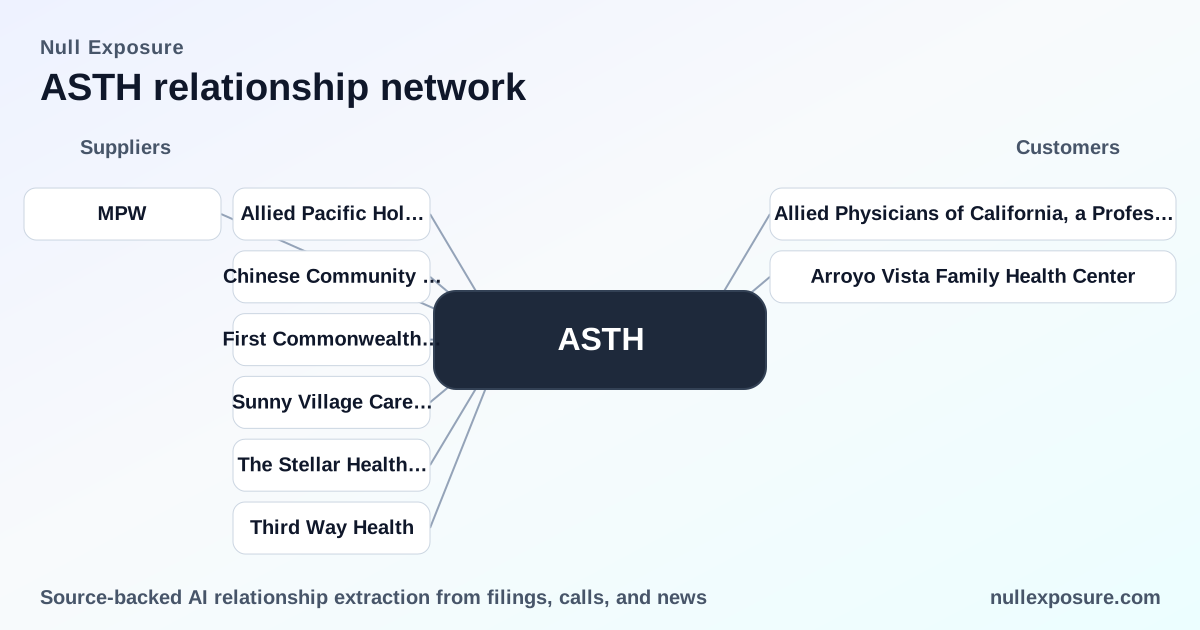
Allied Physicians of California, a Professional Medical Corporation
Astrana repurchased 300,000 shares of its common stock from Allied Physicians of California for an aggregate purchase price of approximately $10.6 million on January 17, 2025, which signals a previously material equity relationship between the company and this physician group and a willingness by management to settle or reconfigure that ownership. This transaction is recorded in Astrana’s Form 10‑K for the year ended December 31, 2024 (filed in 2025) as a specific post-period share repurchase.
Source: Astrana Health, Form 10‑K for the year ended December 31, 2024 (transaction disclosed January 17, 2025).
Arroyo Vista Family Health Center
Astrana recognized revenue net of costs from Arroyo Vista of approximately $1.9 million in 2024, $2.2 million in 2023, and $1.5 million in 2022, indicating a modest but recurring revenue relationship with this community health center over multiple years. The multi-year figures are documented in Astrana’s FY2024 10‑K revenue disclosures.
Source: Astrana Health, Form 10‑K for the year ended December 31, 2024 (revenue recognized for 2022–2024).
What these relationship disclosures mean for investors and operators
The two disclosed items offer complementary signals:
- The Allied Physicians repurchase is corporate-finance evidence of alignment and active capital restructuring between Astrana and a physician-owner constituency, which can reduce governance friction but also signals potential legacy equity arrangements with providers.
- The Arroyo Vista revenue stream illustrates Astrana’s role as a recurring supplier of services to community health centers and demonstrates the company’s ability to secure multi-year revenue from smaller provider partners.
Both items are consistent with the broader company descriptions showing a mix of long-term contracts, subscription-style Care Enablement fees, and usage-based Care Delivery reimbursements—a combination that produces relatively stable base fees with variable upside and downside tied to patient volume and payer dynamics.
Key investment takeaways and risk checklist
- Business model diversification: Astrana combines subscription/PMPM management fees with fee-for-service and capitation; this reduces single-mode exposure but requires active operational execution across distinct revenue engines.
- Concentration risk is material: Four payers account for ~66% of revenue (2024), which elevates downside should major payers renegotiate rates or shift membership.
- Regional policy sensitivity: Heavy revenue concentration in California creates outsized exposure to state-level Medicaid and HMO rules.
- Operational leverage: Long-term management contracts give Astrana a durable base; conversely, usage-based elements make near-term results sensitive to patient volumes and reimbursement cycles.
- Governance and capital posture: The Allied Physicians share transaction indicates prior physician equity stakes and management’s willingness to use cash to reconfigure ownership ties.
For a concise, investor-focused model of Astrana’s partner ecosystem and contract-level risks, see the company’s operational summaries and full disclosures at https://nullexposure.com/.
Valuation implications and strategic signals
Astrana’s mix of recurring management fees and variable care-delivery revenue justifies a premium relative to pure fee-for-service peers if execution on value-based contracts scales and margin expansion continues. The company’s forward P/E and EV/EBITDA metrics already price expectations of improved profitability; investors should model scenarios where payer concentration compresses margins versus scenarios in which expanded Care Enablement penetration and higher capitation capture drive better cash conversion.
Operators and partners should view Astrana as a strategic service provider with deep provider relationships and a demonstrated willingness to transact (equity repurchases, revenue-sharing arrangements). These dynamics favor partners who seek long-term administrative scale and access to value-based contracting infrastructure.
Bottom line
Astrana’s FY2024 disclosures show a company built on long-duration provider arrangements, subscription-style enablement fees, and usage-based care reimbursements, with material payer and regional concentration that amplifies both upside and downside. The two explicit relationships in the 10‑K—an equity repurchase involving Allied Physicians and recurring revenue from Arroyo Vista—are consistent with Astrana’s role as a service provider to provider groups and community health centers and should be integrated into any diligence on counterparty risk, contract renewal timing, and cashflow projections.
For detailed relationship mapping and to monitor further disclosures, review Astrana’s filings and our summarized signals at https://nullexposure.com/.