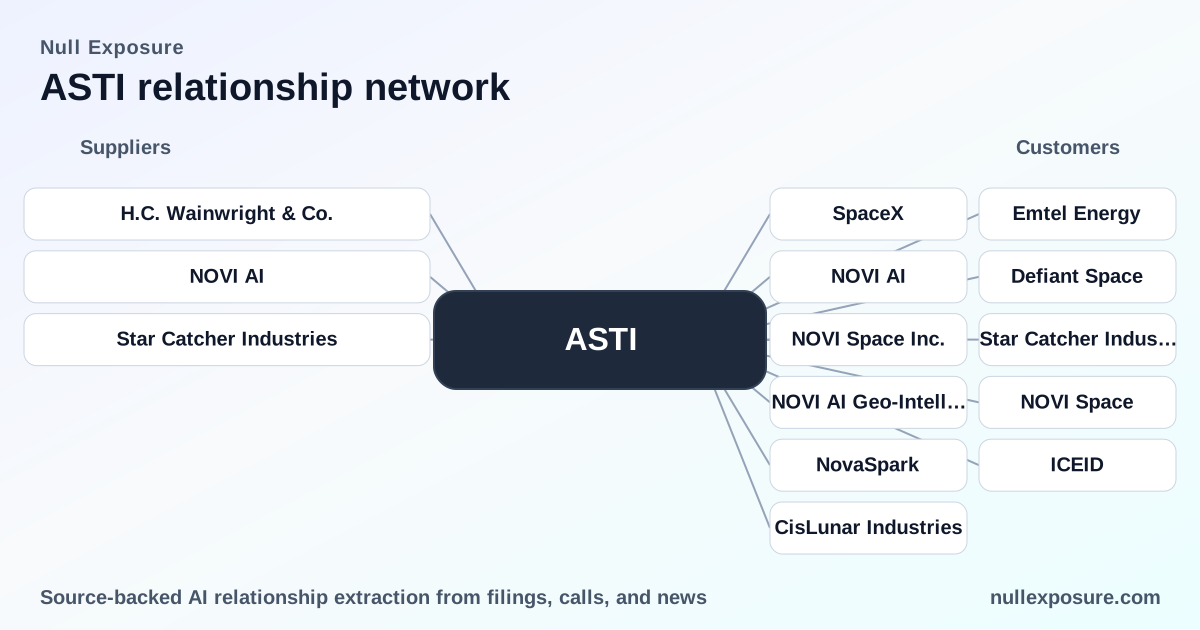
Ascent Solar (ASTI): Commercializing flexible CIGS for aerospace and defense
Ascent Solar Technologies designs and manufactures featherweight, flexible CIGS thin‑film photovoltaic (PV) blankets and sells them into aerospace, defense, emergency management and OEM channels. The company monetizes through product sales and manufacturing agreements for complete rollable PV arrays and engineering services, while also engaging in long‑term government research and development contracts and teaming arrangements that convert engineering IP and manufacturing capacity into recurring program revenue opportunities.
For a concise view of the relationships driving Ascent’s commercial rollout and technical validation in space and defense markets, see https://nullexposure.com/ — the source behind the curated relationship signals.
Why customers matter for ASTI’s valuation
Ascent Solar’s business model is execution‑and‑contract driven: a small number of high‑value customers and program partners validate the technology and generate milestone or batch revenues. This structure produces high customer concentration, leverages the company’s thin‑film manufacturing capabilities, and makes each successful integration (for example, in orbital spacecraft) a potential multiplier for revenue and follow‑on orders. Financially, Ascent is operating with very low revenue and negative operating margins, so customer wins function as the primary path to scale and investor re‑rating.
For more on how relationship signals map to program risk and runway, visit https://nullexposure.com/.
What the relationship data shows — who Ascent is working with today
Below are the relationships pulled from recent public releases and press coverage; each entry is 1–2 sentences with a source reference.
- NOVI Space Inc. — Ascent signed a Master Services Agreement to supply rollable PV array blankets so NOVI can deliver real‑time Earth observation from space, reflecting a direct product supply and systems integration role (EQS News, March 2026; https://www.eqs-news.com/news/corporate-news/from-space-to-the-seas-how-ascent-solar-s-advanced-pvs-powered-the-world-in-2025-and-what-s-in-store-for-2026/d492881f-7ef2-45d0-8f8b-a241db54e562_en).
- NOVI / NOVI AI (N‑1 ATLAS / Pathfinder programs) — Ascent’s previously delivered flexible PV blankets were announced as integrated into NOVI’s N‑1 ATLAS and Pathfinder spacecraft slated for SpaceX Transporter launches, signaling fielded flight hardware status (GlobeNewswire, Feb–Mar 2026; https://www.globenewswire.com/news-release/2026/02/25/3245086/0/en/corrected-version-ascent-solar-technologies-pv-blankets-to-power-novi-ai-geo-intelligence-spacecraft-n1-atlas-scheduled-for-launch-this-spring.html).
- SpaceX — Ascent’s PV blankets are reported to be integrated onto NOVI spacecraft scheduled to fly on SpaceX Falcon 9 Transporter missions, indicating Ascent’s hardware is qualifying for commercial rides and launch manifesting via SpaceX missions (PRLog/FinancialContent coverage, March 2026; https://markets.financialcontent.com/stocks/article/prlog-2026-2-25-asti-ignites-the-space-economy-powering-spacexs-novi-ai-pathfinder-with-breakthrough-solar-technology-ascent-solar-technologies-n-a-s-d-a-q-asti).
- NOVI AI Geo‑Intelligence — Market commentary and equity‑news services noted that Ascent Solar’s PV blankets are powering NOVI AI’s Geo‑Intelligence spacecraft, a public‑facing confirmation that the product is being used for operational EO missions (QuiverQuant, May 2026; https://www.quiverquant.com/news/Ascent+Solar+Technologies+Stock+%28ASTI%29+Opinions+on+NOVI+AI+Geo-Intelligence+Spacecraft+Contract).
- ICEID (as reported / ticker association for NOVI) — Several press releases and re‑issuances list ICEID as the identifier for NOVI in disclosures about integration of Ascent’s PV blankets into flight hardware, reflecting how third‑party press syndication identifies customers in the public record (GlobeNewswire, Feb 2026; https://www.globenewswire.com/news-release/2026/02/25/3244605/0/en/Ascent-Solar-Technologies-PV-Blankets-to-Power-NOVI-AI-Pathfinder-Spacecraft-Scheduled-for-Launch-This-Spring.html).
- NovaSpark — Ascent announced a teaming agreement with NovaSpark in November 2025 to bring thin‑film PV solutions to defense and space markets, representing early commercial partnership activity to access defense channels (StockTitan summary of ASTI announcements, March 2026; https://www.stocktitan.net/news/ASTI/ascent-solar-technologies-reflects-on-2025-achievements-and-sdlk3nqtqv07.html).
- CisLunar Industries — Ascent reported a teaming agreement with CisLunar to pursue U.S. space and defense opportunities, an indication ASTI is building an ecosystem of systems integrators and prime‑contract partners (GlobeNewswire/press summaries, Jan 2026; https://www.globenewswire.com/news-release/2026/01/22/3223703/0/en/Ascent-Solar-Technologies-Reflects-On-2025-Achievements-and-Milestones-Outlines-2026-Strategy-and-Goals.html).
- Defiant Space — Listed as a strategic partner in Ascent’s 2025/2026 partnership announcements, Defiant Space is part of ASTI’s teaming network to pursue defense and commercial space programs (GlobeNewswire and press syndication, Jan 2026; https://www.globenewswire.com/news-release/2026/01/22/3223703/0/en/Ascent-Solar-Technologies-Reflects-On-2025-Achievements-and-Milestones-Outlines-2026-Strategy-and-Goals.html).
- Star Catcher Industries — Named in ASTI’s partnership rollouts as a teaming partner for defense and space market access, contributing to Ascent’s channel strategy (GlobeNewswire press release, Jan 2026; https://www.globenewswire.com/news-release/2026/01/22/3223703/0/en/Ascent-Solar-Technologies-Reflects-On-2025-Achievements-and-Milestones-Outlines-2026-Strategy-and-Goals.html).
- Emtel Energy — Included among strategic partnerships in Ascent’s 2025 achievements and 2026 strategy communication, representing commercial energy channel reach beyond pure space programs (GlobeNewswire / OpenPR coverage, Jan–Mar 2026; https://www.globenewswire.com/news-release/2026/01/22/3223703/0/en/Ascent-Solar-Technologies-Reflects-On-2025-Achievements-and-Milestones-Outlines-2026-Strategy-and-Goals.html).
Operating model and risk constraints — what the signals imply for investors
Ascent’s public disclosures and filings establish several company‑level operating characteristics that control valuation and program risk:
- Contracting posture: long‑term and programmatic. Ascent recognizes revenue under cost‑based methods for long‑term government R&D contracts, indicating the company engages in multi‑period, performance‑obligation contracts with government counter‑parties (company filings describing revenue recognition for government R&D).
- Counterparty profile: government and defense channels. The company explicitly reports revenue generated under cost‑plus or firm‑fixed‑price government R&D contracts, signaling a material portion of work is tied to government program cycles and procurement rules.
- Geography: primarily North America, with global shipping capability. Ascent states it primarily sells PV products and services in North America while producing finished rolls for shipment worldwide, giving it both regional concentration and international fulfillment capability.
- Customer concentration: high and material. Disclosures show a Swiss customer accounted for 74% of product revenue in 2023 and one customer represented 53% of product revenue in 2024; this high concentration is a critical financial vulnerability and a key driver of revenue volatility.
- Role and maturity: manufacturer and active supplier with core product focus. The company acts as both manufacturer and seller of flexible PV modules, reporting active product sales and strategic teaming agreements—this positions ASTI as a supplier of core flight‑qualified hardware but still at an early commercial scale given the company’s low absolute revenue base.
Collectively these constraints indicate high program dependency on a few large customers, long sales cycles tied to government/space programs, and operational leverage concentrated in specialized thin‑film manufacturing.
Investment implications: upside drivers and primary risks
- Upside drivers: flight‑validated hardware on SpaceX launches and NAVI/NOVI integrations can convert technical validation into follow‑on production orders and larger program contracts; teaming agreements broaden addressable defense markets.
- Primary risks: extreme customer concentration, limited revenue scale (Revenue TTM ~$76.8k; negative gross profit), and reliance on program milestones and launch schedules. Failure to convert current integrations into recurring production would materially impair cash flow.
Key takeaway: Ascent Solar is a technology‑first manufacturer trading at early commercial scale where a handful of program wins determine near‑term valuation movements. Investors should weigh flight integrations and teaming announcements against the hard reality of concentrated revenue and negative operating economics.
If you evaluate supplier networks, program risk, or commercial traction in niche hardware companies, NullExposure’s relationship signals provide the structured context investors need — visit https://nullexposure.com/ for a deeper set of relationship and constraint signals.