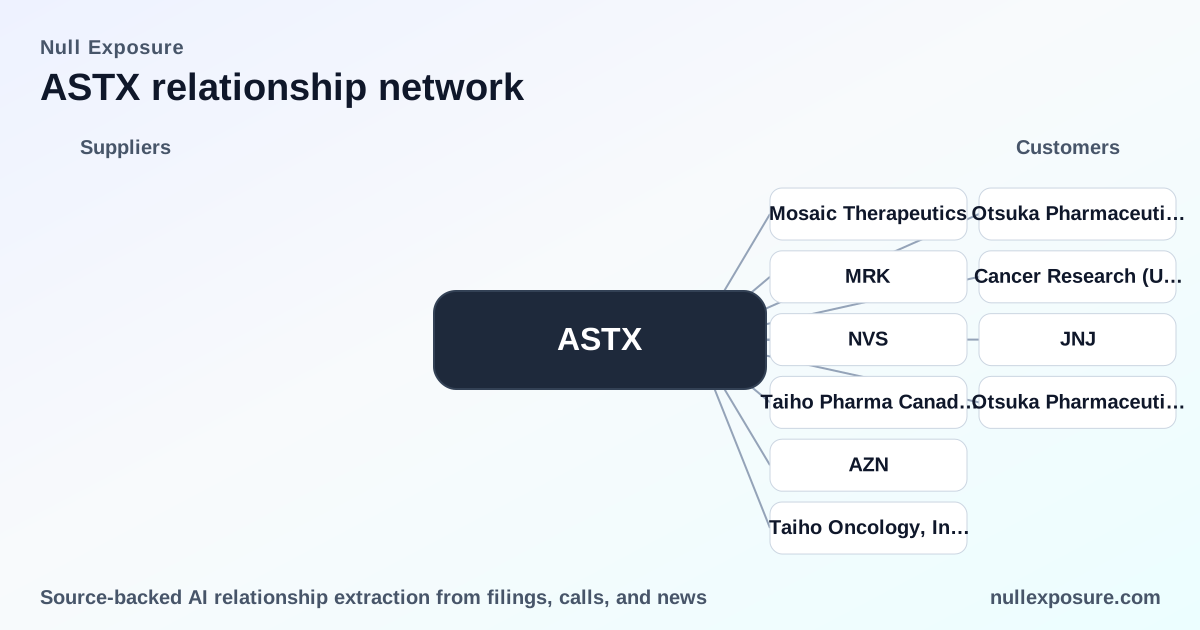
Astex Pharmaceuticals (ASTX) — customer relationships and commercial posture
Astex operates as a discovery-to-early-development specialist that monetizes through licensing deals, collaborative research agreements and partner-funded development programs; revenue flows primarily from upfront payments, milestone receipts and downstream royalties or commercialization arrangements executed by larger pharma partners. For investors, the company’s economics are driven by its ability to convert fragment-based discovery into licenseable assets and to sustain multiple partner relationships that fund clinical risk. Visit https://nullexposure.com/ for more on relationship-driven revenue models.
How Astex’s operating model shapes value creation
Astex functions as a biotech outsourcing partner for large pharma, trading early-stage discovery expertise and platform access for non-dilutive partner capital and milestone streams. That model implies several operational characteristics:
- Contracting posture: Predominantly licensing and research-collaboration contracts that transfer later-stage development and commercialization risk to partners.
- Concentration: Partnerships with a small number of major pharma companies create moderate concentration risk but multiple partner relationships limit single-counterparty dependence.
- Criticality: Astex’s role is strategically important to partners at the discovery and lead-generation phase, making the company a valuable but replaceable supplier in the broader industrial ecosystem.
- Maturity: Mix of marketed legacy products and several partner-funded clinical programs indicates a hybrid maturity profile—established discovery capability alongside an active pipeline of clinical-stage assets.
These factors together mean Astex’s cash profile is lumpy but de-risked relative to standalone clinical-stage biotechs: partners fund expensive stages, while Astex captures upside through milestones and royalties.
Customer relationships: who pays Astex and why
Mosaic Therapeutics
Mosaic Therapeutics has in‑licensed two clinical‑stage oncology programmes from Astex as part of its combination-medicine strategy, effectively buying near-term clinical assets rather than paying for early discovery work. This transaction represents asset out‑licensing that converts R&D value into license payments. (FierceBiotech, March 9, 2026; QuotedData, April 2025; PharmaTimes, March 2026.)
Merck & Co. / MSD (MRK)
Astex has an ongoing discovery collaboration with Merck to apply its fragment‑based platform against p53 tumour suppressor targets, with Astex delivering lead compounds for Merck to optimize and advance preclinically; earlier deals include multi‑million dollar upfronts from Merck to Otsuka subsidiaries. This is a classic research collaboration + lead handoff arrangement that generates near‑term partner funding and potential downstream milestones. (GlobeNewswire, August 8, 2023; FierceBiotech, March 2026; BiopharmaDive reporting on past payments, FY2020.)
Novartis (NVS)
Novartis is a development partner on one of Astex’s partner‑funded programs, highlighting the company’s role as a discovery engine whose projects are advanced by top-tier pharma. This relationship positions Astex to collect milestone and royalty economics while Novartis assumes later clinical risk. (RTT News, March 2026; BiopharmaDive retrospective reporting on historical research outcomes, FY2020.)
AstraZeneca (AZN)
AstraZeneca is listed as a partner developing one of Astex’s funded programs, reinforcing a pattern: large pharma funds clinical development of assets discovered by Astex, preserving Astex’s capital while giving it a stake in any successful outcomes. (RTT News, March 2026.)
Janssen
Janssen appears among the companies developing partner‑funded Astex programs, underlining diversified big‑pharma engagement across oncology projects. Janssen assumes the downstream development burden while Astex captures upstream value. (RTT News, March 2026.)
Cancer Research (UK)
Astex runs at least one program through a clinical development partnership with Cancer Research UK, which reflects non‑commercial collaborative funding and access to academic‑clinical trial networks rather than pure licensing economics. This shapes different milestone and data‑sharing arrangements compared with commercial pharma partners. (RTT News, March 2026.)
Taiho Oncology, Inc.
Taiho Oncology has assumed commercialization responsibilities in the U.S. for specific Astex drug candidates—most notably the oral cedazuridine/decitabine combination (ASTX727/INQOVI)—subject to regulation; this is a commercialization and market‑access partnership that converts clinical success into U.S. sales via a partner with a dedicated oncology commercialization footprint. (PR Newswire, 2019; PR Newswire, clinical data release FY2022.)
Taiho Pharma Canada, Inc.
Taiho Pharma Canada handles the Canadian commercialization for the same compounds, completing regional go‑to‑market arrangements and ensuring Astex/Otsuka pipelines can reach North American payors through a local commercial partner. (PR Newswire, 2019; PR Newswire, FY2022.)
Otsuka Pharmaceutical Co., Ltd. / Otsuka
Otsuka has been the parent company for Astex since an all‑cash acquisition and remains a primary strategic owner; Otsuka’s control has shaped Astex’s commercialization and corporate strategy, including legacy product positioning. Historical reporting cites an acquisition by Otsuka and handoffs of marketed products to Otsuka/Taiho teams. (AsianScientist, 2013; BiopharmaDive retrospective, FY2018.)
Johnson & Johnson / Janssen linkage
Johnson & Johnson is referenced in the context of successful drugs that originated from Astex‑led discovery collaborations, demonstrating the industry track record where Astex discovery work has fed J&J/Janssen pipelines and delivered approved products. That track record underpins Astex’s bargaining power in licensing discussions. (BiopharmaDive historical analysis, FY2020.)
What the relationship map implies for investors
- Revenue profile: Partner-funded programs and licensing deals produce upfront cash plus milestone streams, making near-term cash generation feasible while preserving upside through royalties.
- Risk allocation: Astex offloads late‑stage clinical and commercialization risk to large pharma, which reduces capital intensity but also caps upside to pre‑defined economics.
- Concentration vs. diversification: The partner list includes Novartis, AstraZeneca, Merck, Janssen and regional Taiho units—diversified among top-tier pharma, which limits single-counterparty revenue concentration while still relying heavily on a small number of large partners.
- Competitive positioning: Astex’s fragment-based discovery platform delivers repeatable lead-generation value, evidenced by multiple external commercializations and in‑licensing transactions; that track record is a core intangible asset.
For a deeper read on how partner-funded discovery companies convert R&D into predictable revenue, see our platform at https://nullexposure.com/ — the firm monitors commercial partnerships across the sector and translates them into investor-facing signals.
Bottom line
Astex’s customer relationships are squarely built on a service-to-license model with top-tier pharma and specialized commercialization partners. The company monetizes discovery expertise through upfronts, milestones and royalties while transferring most late-stage risk to partners—a structure that produces lumpy but lower-risk cashflows relative to standalone developers and that requires continued success in generating licenseable leads to sustain valuation.