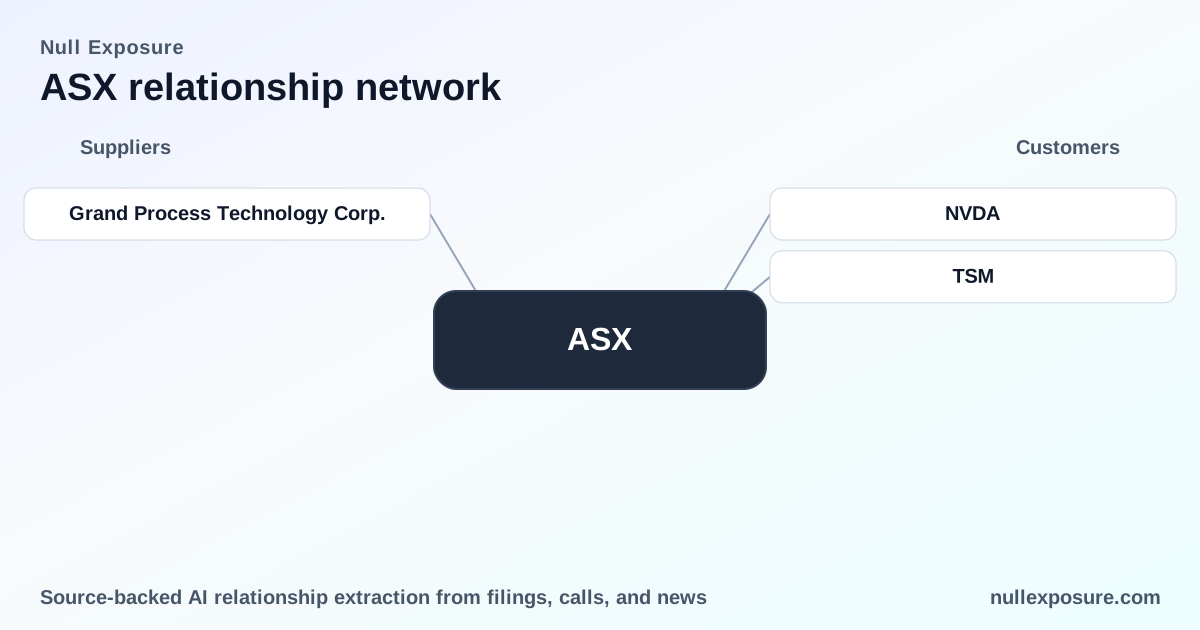
ASX (ASE Industrial) — customer map, strategic constraints, and investor implications
ASE Industrial (ticker ASX) operates as a high‑value semiconductor assembly and test contractor, monetizing through advanced packaging services, outsourcing agreements and capacity sales to leading foundries and AI chipmakers. The firm captures growth by scaling advanced packaging for AI GPUs and specialty silicon, converting engineering capability and factory capacity into premium margin revenue streams. For deeper company-level coverage visit https://nullexposure.com/.
Why customers determine the valuation case
ASE's business model is classic contract manufacturing with a technology premium: long‑cycle capital investment in fabs and R&D supports differentiated packaging capabilities (CoWoS, on‑substrate) that large OEMs and foundries require. This creates a contracting posture driven by capacity allocation and technical tightness, not simple price competition. Customer concentration is elevated — several relationships in the market commentary link ASE directly to Taiwan Semiconductor (TSMC) and Nvidia — which makes revenue growth highly correlated to a handful of large customers and the AI capital cycle. No explicit third‑party constraints were captured in the feed provided, so this is a company‑level signal: the operating model combines high criticality to marquee customers, capital intensity and rapid maturity in advanced packaging.
Relationship snapshots: what the market is reporting now
Below are the individual relationship mentions pulled from public coverage. Each entry is a plain‑English summary followed by the article source.
1) TSM — Taipei Times (Feb 6, 2026)
Taipei Times reported ASE is widely expected to receive outsourcing wafer‑on‑substrate orders from Taiwan Semiconductor Manufacturing Co to help ease CoWoS technology constraints for AI chip packaging, positioning ASE as an overflow partner for high‑end packaging capacity. (Taipei Times, Feb 6, 2026)
2) BULL (Webull) — Yahoo Finance press release (Mar 2026)
A Yahoo Finance press release noted Webull is a trading participant of both the Australian Securities Exchange (ASX) and Cboe Australia and emphasized its membership in the Stockbrokers and Investment Advisers Association to underline service and security standards relevant to ASX market participants. (Yahoo Finance, Mar 2026)
3) Nvidia — WMBdRadio coverage (Feb 5, 2026)
WMBdRadio summarized ASE’s corporate structure and noted that the holding company’s subsidiary Siliconware Precision Industries (SPIL) is a major packaging supplier for Nvidia’s AI chips, linking ASE’s advanced packaging pipeline directly to Nvidia demand. (WMBdRadio, Feb 5, 2026)
4) AVR (Anteris) — BioSpace press release (FY2024 / announcement)
BioSpace reported that Anteris Technologies Global Corp intends to list CHESS Depositary Interests representing shares on the Australian Securities Exchange under the symbol “AVR,” an item that touches ASX’s role as issuer venue rather than ASE’s manufacturing relationships. (BioSpace / press release)
5) TSM — duplicate Taipei Times mention (Feb 6, 2026)
The Taipei Times mention is repeated in the feed, reiterating that ASE is expected to take on wafer‑on‑substrate orders from TSMC to relieve CoWoS bottlenecks in AI packaging production. (Taipei Times, Feb 6, 2026)
6) BULL (Webull) — PR News Asia (Mar 2026)
PR News Asia coverage reiterated Webull’s status as an ASX trading participant and emphasized the platform’s commitment to service and security for Australian investors and advisers. (PR News Asia, Mar 2026)
7) Nvidia — WMBdRadio duplicate (Feb 5, 2026)
A duplicate WMBdRadio item in the feed again highlights SPIL’s supplier role to Nvidia, reinforcing the link between ASE’s packaging business and Nvidia’s GPU roadmap. (WMBdRadio, Feb 5, 2026)
8) NVDA — Intellectia.ai revenue note (Jan 2026)
Intellectia reported ASE expects advanced packaging sales to grow from roughly $450M in 2024 to $1.1B in 2025 and to reach about $2.1B in 2026 as the firm captures on‑substrate business tied to Nvidia’s Blackwell GPU. (Intellectia.ai, Jan 2026)
9) Nvidia — Intellectia.ai duplicate (Jan 2026)
A duplicate Intellectia entry reiterates the forecasted trajectory for advanced packaging revenues and ASE’s share gains in Nvidia‑related on‑substrate packaging for high‑end GPUs. (Intellectia.ai, Jan 2026)
10) BULL (Webull) — AAP/Cision release (Nov 11, 2024)
An AAP/Cision release in the feed likewise documented Webull’s role as a participant on ASX and Cboe Australia, underlining the exchange‑participant relationships that affect market access and liquidity for ASX‑listed issuers. (AAP/Cision, Nov 11, 2024)
11) BULL (Webull) — PR Newswire (Mar 2026)
PR Newswire coverage duplicated the Webull announcement, restating that Webull is a trading participant on ASX and reinforcing the exchange’s ecosystem of broker‑participants and technology vendors. (PR Newswire / PR Newswire APAC, Mar 2026)
What this relationship map implies for investors
- Revenue concentration and demand linkage: Multiple items link ASE’s advanced packaging upside to Nvidia and TSMC demand. That creates asymmetric upside if AI GPU volumes sustain, but also concentration risk if either partner alters sourcing strategy.
- Capacity and contract posture are the key operational levers: Reporting that ASE will accept wafer‑on‑substrate overflow from TSMC signals strategic outsourcing and capacity allocation rather than commodity price competition; ASE’s pricing power depends on scarce packaging capacity.
- Rapid product maturation and revenue re‑rating: Public commentary and firm sales expectations (from ~$450M in 2024 to >$2B in 2026 in cited coverage) indicate a stage‑shift in ASE’s product mix toward higher‑margin advanced packaging. Investors should treat growth assumptions as execution dependent on capital and yield scaling.
- Market microstructure relevance: Multiple press releases about Webull and ASX participation highlight the exchange ecosystem that affects liquidity for ASX‑listed securities and new issuer listings (as with AVR); exchange participants and listing flows are secondary but material to investor access and sentiment.
Risk checklist and monitoring items
- Track formal contract announcements with TSMC and Nvidia to convert press reports into confirmed revenue backlog.
- Monitor capacity expansion timelines and yield improvements at SPIL and ASE facilities; execution risk is the dominant downside.
- Watch ASX market‑structure developments and broker participation that influence liquidity for ASE’s ADRs and the visibility of new listings.
- Confirm the reconciliation between public sales guidance cited in media pieces and ASE’s formal financial disclosures.
Next steps for due diligence
- For a consolidated view of customer signals, investor presentations, and filing analyses, see our coverage hub at https://nullexposure.com/.
- Subscribe to targeted alerts on customer contract announcements and ASX market‑structure filings to capture the next inflection point in ASE’s advanced‑packaging monetization.
Bold takeaways: ASE’s valuation is now a function of advanced‑packaging share gains with a handful of strategic customers; capacity and execution are the primary catalysts and risks.