ATAI Life Sciences: Capital-heavy R&D backed by institutional investors, licensing exposure, and limited near-term revenue
ATAI Life Sciences develops psychedelic and related neuropsychiatric drug candidates and monetizes primarily through equity financings, selective licensing of program rights, and the long-term promise of milestone and commercialization receipts tied to successful clinical development. The company is capital-intensive, reports minimal operating revenue (Revenue TTM $4.09m) and sustained operating losses (Operating margin TTM -35.88; Diluted EPS -2.95), and leans on institutional placements to fund trials and platform investments (company filings, latest quarter 2025-12-31). For investors and operators assessing ATAI’s commercial counterparties, the October 2025 financing and historical licensing activity together define the most actionable counterparty signals. Learn more at https://nullexposure.com/.
Why the October 2025 financing matters: institutional support and funding runway
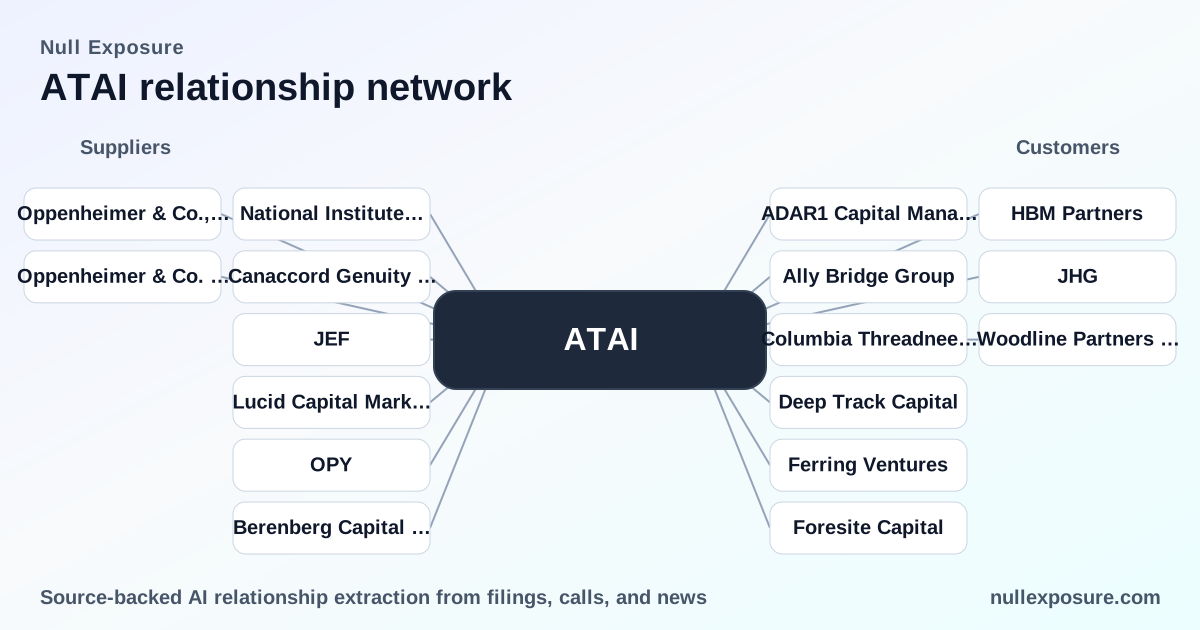
ATAI closed a public offering with the full exercise of the option to purchase additional shares in October 2025, and the transaction drew a mix of new and existing large investment managers. This capital raise is the company’s primary short-term monetization mechanism, given drug development timelines and current negligible product revenue. The transaction roster signals continued institutional appetite for the story but also underscores reliance on periodic equity markets rather than recurring commercial cash flows (public press release, Oct 20, 2025).
The investor roster — who participated and what it signals
Below I cover every institutional relationship reported in the offering disclosures. Each entry is a concise, one- to two-sentence investor summary with a source.
Janus Henderson Investors (JHG)
Janus Henderson participated as a new investor in the October 2025 public offering, representing a strategic institutional vote of confidence from a large asset manager; the filing identifies Janus Henderson and references its ticker, JHG. (GlobeNewswire / offering press release, Oct 20, 2025).
Foresite Capital
Foresite Capital joined the financing as a new institutional participant, bringing specialized healthcare investment capacity to the cap table and reinforcing ATAI’s access to sector-focused capital. (InvestingNews and GlobeNewswire coverage of the offering, Oct 2025).
Deep Track Capital
Deep Track Capital is listed among new investors in the offering, adding to the syndicate of funds underwriting ATAI’s near-term cash needs and clinical investment plan. (InvestingNews, Oct 2025).
HBM Partners
HBM Partners took part in the offering as a new institutional investor, providing additional healthcare-focused capital and validation for ATAI’s development pipeline. (InvestingNews and GlobeNewswire, Oct 2025).
Ferring Ventures
Ferring Ventures is named as an existing investor that participated in the financing; its continued exposure signals strategic alignment with biopharma/venture investors who have prior relationships to ATAI assets. (InvestingNews, Oct 2025).
Columbia Threadneedle Investments
Columbia Threadneedle is listed among existing institutional participants, maintaining or expanding its exposure through the offering and indicating repeat institutional support. (InvestingNews and StockTitan coverage, Oct 2025).
Ally Bridge Group
Ally Bridge Group appears as an existing investor that participated in the offering, consistent with participation by Asia- and life-science-focused investment groups in ATAI’s capital raises. (InvestingNews, Oct 2025).
Woodline Partners LP
Woodline Partners LP is noted among existing participating investors, signaling follow-on commitment from hedge/long-short investors alongside traditional mutual funds. (InvestingNews and StockTitan, Oct 2025).
ADAR1 Capital Management
ADAR1 Capital Management is included in the list of participating investors, representing additional allocators that supported the equity raise. (InvestingNews and StockTitan, Oct 2025).
(Primary coverage: GlobeNewswire press release and InvestingNews recap of the offering, Oct 20, 2025; supplementary reposts on StockTitan.)
What ATAI’s disclosed constraints reveal about its operating model
Company disclosures and contract excerpts provide explicit signals about how ATAI and related portfolio entities contract and where revenue risk concentrates:
- Licensing is part of the monetization playbook. A filing excerpt documents that Perception entered into a license and collaboration agreement with Otsuka in March 2021 granting Otsuka exclusive rights in Japan to develop and commercialize arketamine (PCN-101) for depression. (Company disclosure language cited in constraint evidence).
- ATAI (through portfolio entities) has acted as licensor. The same excerpt shows Perception retained non-Japan rights while granting exclusivity to Otsuka in Japan — a classic out-license structure that trades near-term non-dilutive funding for long-term royalty potential.
- Contract termination risk is real and material. Otsuka provided notice of termination effective April 24, 2025; following termination the company explicitly lost eligibility for milestone payments or royalties under that agreement. That termination is a concrete example of counterparty risk eliminating expected future cash flows (disclosed termination notice, Jan 2025 / effective Apr 24, 2025).
From those facts, derive operational characteristics: contracting posture is pro-licensing and asset-level monetization; revenue concentration and timing risk are elevated because milestone/royalty streams depend on counterparty performance; agreement maturity is early-stage and fragile — counterparties can terminate and eliminate expected receipts; and the broader business is financing-dependent, evidenced by frequent equity raises.
Risk and opportunity — the investor implications
- Capital dependency: With Revenue TTM $4.09m, negative operating margins and persistent losses, ATAI relies on syndicated equity placements to fund R&D and platform expansion; institutional investor participation reduces immediate dilution risk but does not substitute for commercial revenue.
- Licensing upside and downside: Historical licensing to Otsuka illustrated the upside of monetizing an asset outside core territories and the downside when counterparties exit; future licensing deals will be valuable if counterparties remain committed.
- Institutional endorsement vs. execution risk: The October 2025 syndicate demonstrates institutional conviction in the pipeline thesis, but value realization depends entirely on clinical success, regulatory progress, and counterparty durability in out-licensed territories.
Bottom line and practical next steps for diligence
- ATAI is a development-stage biotech with institutional financing as its primary near-term monetization channel and licensing as a secondary, conditional source of future revenue.
- Investors should prioritize diligence on (1) clinical milestones and timelines, (2) the scope and survivability of existing license agreements, and (3) the company’s planned cash runway given current burn and recent equity inflows (company filings, FY2025 and offering disclosures Oct 2025).
For an ongoing feed of counterparty intelligence, including updated ownership and contractual signals, visit https://nullexposure.com/.
This profile synthesizes the October 2025 offering disclosures and explicit contract excerpts from ATAI-related filings to present a compact commercial view: strong institutional investor support that underwrites near-term R&D but significant execution and counterparty risk that will dictate value capture.