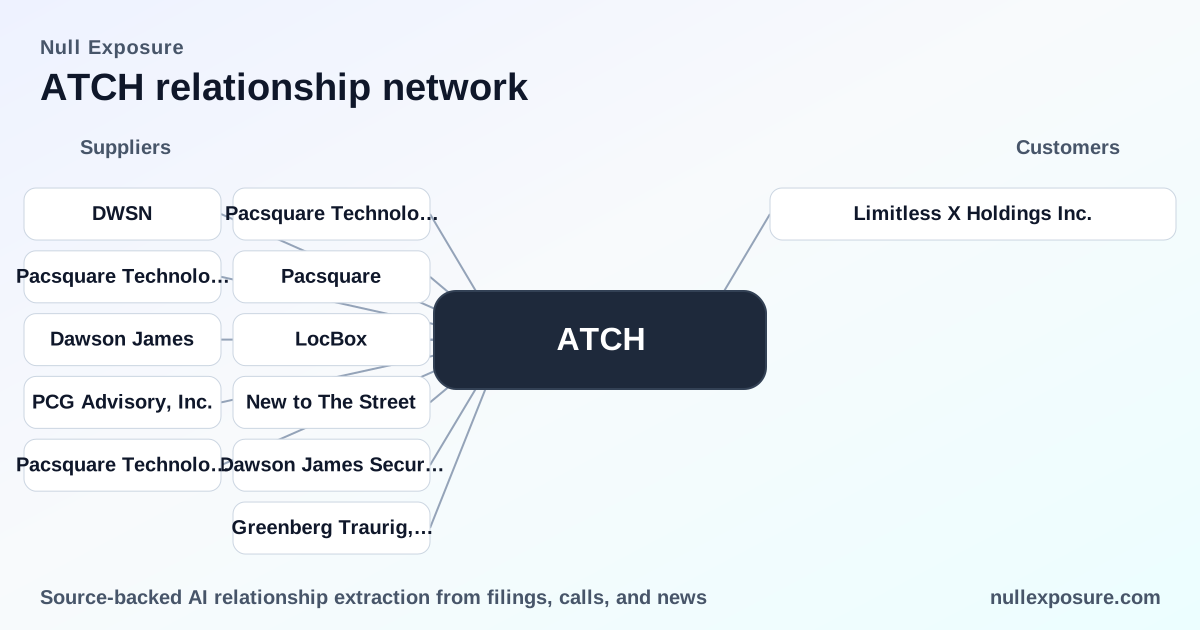
AtlasClear (ATCH) — customer relationships that drive a clearing-first growth story
AtlasClear Holdings builds and monetizes a modern clearing, custody and trading infrastructure through its self‑clearing broker‑dealer subsidiary, Wilson‑Davis & Co. The company collects clearing and vetting fees, commissions on liquidation of restricted and microcap securities, underwriting and advisory fees, and subscription/technical services tied to its front‑ and back‑office offerings; revenue TTM is reported at $14.6 million with gross profit of $12.2 million, indicating a high‑margin service mix centered on transaction and securities servicing. For investors, the critical question is whether institutional onboarding and capital markets activity scale fast enough to absorb operating leverage while reducing concentration risk.
Explore a concise investor briefing and data-driven coverage at https://nullexposure.com/ for further due diligence.
Why these customer wins matter now
AtlasClear’s recent customer activity is not incidental marketing — it maps directly to the company’s go‑to‑market thesis. Onboarding correspondent broker‑dealers validates Wilson‑Davis’s clearing rails, while underwriting engagements demonstrate the firm’s ability to monetize capital markets services beyond pure clearing. These two lines — clearing counterparty growth and middle‑office capital markets execution — drive recurring fees and episodic underwriting revenue, respectively. That combination is essential to move AtlasClear from a niche microcap operator toward a mid‑market correspondent clearing franchise.
The customer roster, in one clear list
Below I cover every customer relationship identified in the available reporting. Each relationship is summarized in plain English with a source callout.
-
Dawson James Securities, Inc.
AtlasClear announced that Dawson James has commenced clearing operations through Wilson‑Davis, making Dawson James the first major introducing/correspondent broker onboarded to the enhanced clearing platform — a direct validation of Wilson‑Davis’s self‑clearing capabilities. This was disclosed in a corporate release on March 23, 2026 and reiterated in subsequent press commentary in April and May 2026. (See GlobeNewswire, March 23, 2026; GlobeNewswire, April 6, 2026.) -
Limitless X Holdings Inc.
AtlasClear’s wholly owned subsidiary, Wilson‑Davis & Co., executed an underwriting agreement to raise up to $75 million for Limitless X — evidence that AtlasClear is leveraging its broker‑dealer and capital markets capabilities to generate underwriting fees and placement activity. The underwriting engagement was announced via a March 9, 2026 client press release distributed across regional outlets. (See March 9, 2026 press release coverage.)
What the reported constraints tell investors about the operating model
The company disclosures and constraint excerpts reveal consistent, actionable signals about AtlasClear’s business characteristics and contractual posture.
-
Contracting posture — longer time horizons and multi‑year financing: multiple amendments and notes in AtlasClear’s filings show maturity dates extended into 2028 and multi‑year equity line capacity, indicating a contracting posture that locks in capital commitments over multi‑year windows and allows for staged capital access. This supports a patient, infrastructure‑build strategy rather than quarter‑by‑quarter revenue flips.
-
Customer mix and concentration — mixed individual and mid‑market clients: filings describe Wilson‑Davis customers as largely individual investors and small private entities, while the prime banking/prime brokerage targets include mid‑market financial firms (revenues up to $1 billion). That dual client base produces diversified revenue sources but also concentration risk if correspondent relationships do not scale. The company reports approximately 4,652 active Wilson‑Davis customer accounts as of June 30, 2025, an operational base that is significant for a niche clearing firm.
-
Geography and expansion posture — U.S. focus with global aspirations: operations and principal transactions are currently U.S.‑centric (Utah, Arizona, California, Colorado, Florida, New York, Oklahoma and Texas), while strategic commentary explicitly cites opportunities to expand internationally, implying future revenue levers tied to cross‑border clearing and custody.
-
Role and service mix — service provider with both software and services components: AtlasClear offers technical services and an order management/trading front‑end (AtlasFX), alongside traditional clearing services; revenue sources include commissions on restricted security liquidations, vetting and clearing fees paid by introducing brokers, and underwriting activity. This hybrid model supports higher margins but requires investment in compliance, technology and liquidity management.
-
Spend and capitalization signals — mid‑to‑large financing capacity: the company’s financing arrangements include equity line capacity in the low tens of millions and convertible/term financings with principal amounts referenced up to $40 million, which indicates a capital footprint in the $1m–$100m band across different instruments. That scale is consistent with a firm building regulated clearing infrastructure while relying on external capital to underwrite growth.
Operational implications: concentration, criticality and maturity
AtlasClear’s operating model is capital‑intensive and operationally critical for counterparties that offload clearing and custody. On the one hand, clearing revenue is sticky — introducing brokers need reliable settlement and custody — so each correspondent that migrates to Wilson‑Davis represents recurring, mission‑critical revenue. On the other hand, early reliance on a small set of significant counterparties and underwriting deals creates customer concentration risk; the business must demonstrate a growing roster to de‑risk revenue volatility.
Maturity is mid‑stage: AtlasClear has live operations, productized services (AtlasFX, clearing rails) and measurable active accounts, but the path to scale requires continued onboarding of correspondent brokers and sustained underwriting/investment banking activity.
Key risks investors should track
- Concentration on early correspondents — losing a small number of newly onboarded broker‑dealers could disproportionately affect fee income.
- Regulatory and liquidity demands — self‑clearing imposes capital and compliance burdens that can compress margins if capital is expensive.
- Execution on underwriting pipeline — underwriting fees are episodic; reliance on them without steady clearing growth increases earnings variability.
Bottom line: validation, not victory
The Dawson James onboarding is a tangible validation of Wilson‑Davis’s clearing product; the Limitless X underwriting shows AtlasClear can cross‑sell capital markets capabilities. Both relationships are strategically meaningful: one underpins recurring fee economics, the other demonstrates episodic revenue upside. The firm’s financing instruments and stated multi‑year maturities provide runway, but investors should require a growing, diversified correspondent base before repricing the company for sustained scale.
For a deeper dossier and updates on customer momentum, visit https://nullexposure.com/.
Bold takeaway: AtlasClear is moving from proof‑of‑concept to commercialization — the next 12–24 months of correspondent onboarding will determine whether recurring clearing fees or one‑off capital markets events drive durable profitability.