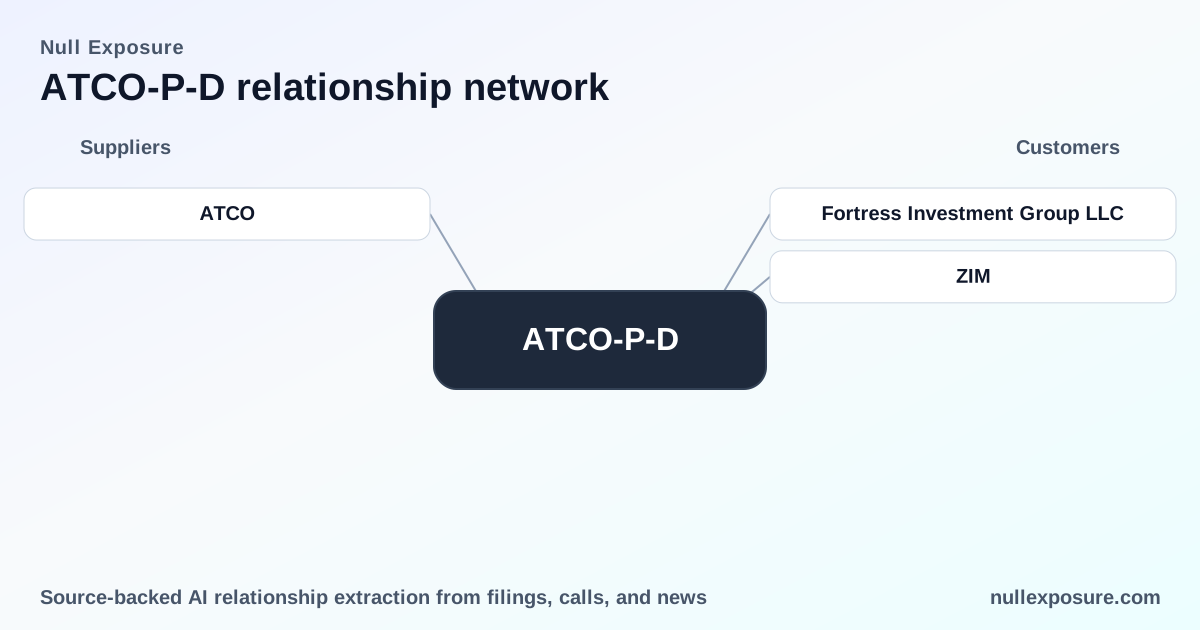
ATCO-P-D (Atlas / Seaspan): Customer Map, Contracting Profile, and Investment Implications
Atlas Corp.’s shipping franchise, led by Seaspan as a containership owner-operator, monetizes by owning vessels and leasing them on long-term charters to the world’s largest carriers, converting capital-intensive shipbuilding into contracted cash flow and residual asset exposure. For investors and operators evaluating ATCO-P-D customer relationships, the clearest facts are: revenue is highly contractual, counterparty concentration is material, and commercial performance tracks major carrier demand cycles. Explore the customer relationships below and the practical implications for underwriting earnings stability and counterparty credit.
If you want a consolidated view of fleet-level counterparty exposure and ongoing relationship monitoring, visit https://nullexposure.com/ for full coverage.
How the customer roster shapes Atlas’s economics
Seaspan’s commercial model is straightforward: buy or order vessels, then lock in multi-year charters with large liner operators. That structure produces predictable contract cash flows while leaving Atlas exposed to:
- Concentration risk because a handful of global carriers take up a meaningful share of fleet employment.
- Counterparty credit risk tied to liner profitability and the macro trade cycle.
- Asset and financing cyclicality from newbuild orders, fuel technology transitions (e.g., dual-fuel LNG), and residual values.
Below are every customer and partner cited in the available results, with a concise, plain-English note on each relationship and a direct source reference.
Customer and partner relationships (one-line summaries with sources)
Fortress Investment Group LLC
Fortress agreed to acquire an 850-megawatt energy generation portfolio from Atlas/Apr Energy, reflecting Atlas’s transactional interactions with institutional buyers beyond pure charter markets. This was reported by MarketScreener on March 9, 2026. (MarketScreener, 09-Mar-2026)
MSC
MSC ranks among Seaspan’s largest charterers and is listed as a major long-term counterparty that occupies a significant share of Seaspan’s fleet. This is detailed in Maritime Executive coverage tied to the Atlas/Seaspan acquisition storyline (May 2026). (Maritime Executive, May 2026)
MSC (additional mention)
Seaspan’s fleet is predominantly on long-term charters to major carriers including MSC, reinforcing the scale and duration of the MSC-Seaspan relationship. (Maritime Executive, May 2026)
Zim
Zim is one of the large carriers with multiple vessels on charter from Seaspan and was specifically cited as a primary counterparty in the Atlas/Seaspan shareholder announcements. (Maritime Executive, May 2026)
Ocean Network Express (ONE)
ONE is described as Seaspan’s single largest customer by contracted fleet share—roughly a quarter of group capacity—illustrating a concentrated and strategic charter relationship. (Maritime Executive, May 2026)
CMA CGM
CMA CGM is listed among the major carriers on long-term charters with Seaspan, underscoring that the carrier set spans all of the top global liner groups. (Maritime Executive, May 2026)
ZIM Integrated Shipping Services (specific charter agreement)
Seaspan executed a strategic long-term charter agreement with ZIM for ten 7,000 TEU dual-fuel LNG containerships, signaling a technology-upgrade trend tied to customer commitments. (Offshore-Energy.biz, 06-Jul-2021 / reported 09-Mar-2026)
Maersk
Maersk is named among Seaspan’s long-term charter customers, confirming that Seaspan’s counterparty base includes the largest integrated ocean carriers. (Maritime Executive, May 2026)
ZIM (incident-related operational interaction)
A general average declaration for a Seaspan-owned vessel chartered to ZIM shows operational and insurance interactions between owner and charterer in loss events, with ZIM identified as the charterer. (gCaptain, May 2026)
ONE (additional mention)
Reiterating the relationship, ONE is cited multiple times among the major long-term charterers, reflecting both ownership stakes and customer demand alignment. (Maritime Executive, May 2026)
COSCO
COSCO is listed among the major carriers that charter Seaspan vessels long-term, adding state-owned and private Chinese carrier exposure to the counterparty mix. (Maritime Executive, May 2026)
What these relationships say about Atlas’s operating constraints and business model
- Contracting posture: long-term, capital-backed leases. Seaspan converts asset risk into contractual revenue by placing ships on multi-year charters with investment-grade and top-tier liner customers; this is central to the business’s revenue predictability.
- Concentration is material. A small set of global carriers (ONE, MSC, ZIM, Maersk, CMA CGM, COSCO) account for the bulk of employment, producing counterparty concentration risk that investors must underwrite directly.
- Commercial criticality: high to carriers, moderate to the owner. For carriers, stable tonnage supply with modern fuel standards is operationally critical; for Atlas, charters secure cash flow but leave residual value risk in a cyclical asset class.
- Maturity and capital intensity: advanced but cyclical. The business is mature—established charter markets and repeat counterparties—yet exposed to shipping cycles, technology transitions (dual-fuel/LNG), and newbuild delivery timing that affect earnings and refinance needs.
If you want a deeper, portfolio-level breakdown of charter maturities and counterparty share, see the Atlas/Seaspan coverage at https://nullexposure.com/.
Investment implications: risks and catalysts for ATCO-P-D investors
- Earnings stability is strong while charters are in place, but downside from counterparty stress or re-contracting at lower rates is immediate. Monitor charter maturities and the mix of fixed vs. index-linked rates.
- Concentration to a few large carriers is both a strength and a risk. It provides scale and lower commercial friction but increases exposure to decisions by a handful of counterparties.
- Technology and environmental retrofits create optionality and execution risk. The ZIM dual-fuel charters signal demand for greener tonnage; success depends on delivery schedules and financing.
- Operational incidents (e.g., a vessel fire and a general average) produce insurance and cash-flow events that are immediate, contractual, and public. Owners and charterers will navigate claims and declarations that affect net cash flows and customer relations.
Bottom line: underwriting Atlas’s customer exposure
Atlas/Seaspan’s customer list reads like a who’s who of global liners—concentrated, contractual, and strategically critical. For investors and operators, the thesis is clear: value is driven by charter coverage, counterparty credit, and asset timing, not by merchant spot exposure. Active monitoring of charter maturities, carrier credit, and newbuild deliveries is essential to risk management and valuation.
For continuous tracking of these customer relationships and charter maturity risk, visit https://nullexposure.com/ for our analytics and monitoring tools.
Bold final takeaway: Atlas’s cash flows are contract-driven and durable while charters stand; downside is concentrated to carrier health and asset cycle timing.