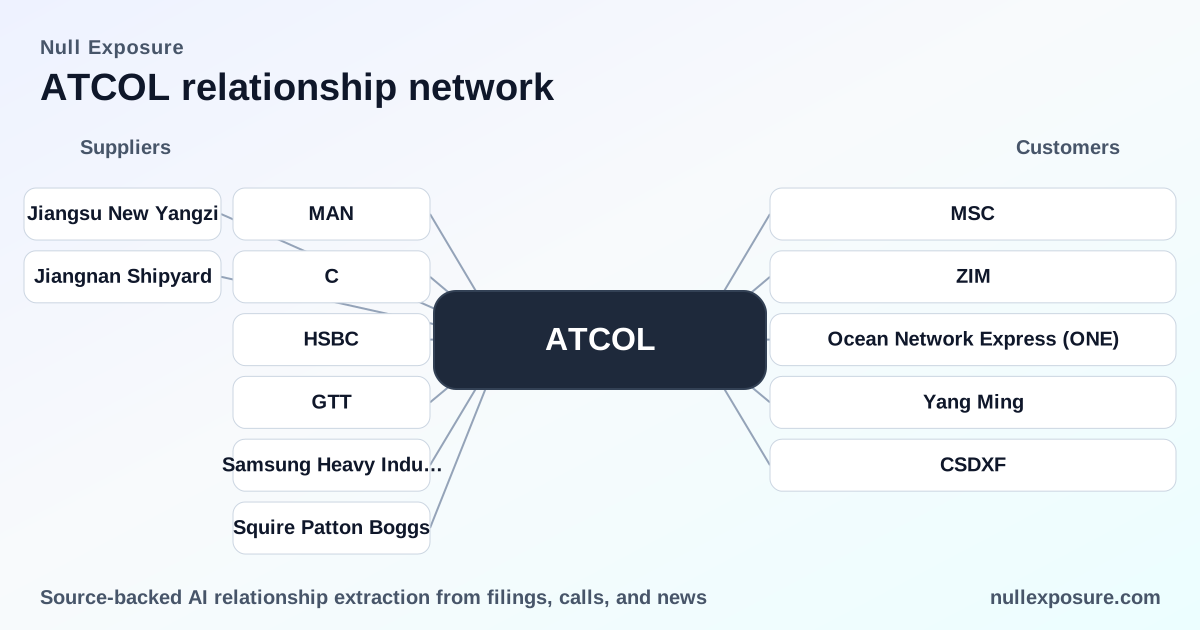
Atlas Corp (ATCOL) — customer map and commercial implications for investors
Atlas Corp operates as a shipping asset owner and lessor through its Seaspan unit, monetizing primarily by entering long-term time-charters and leases with the world’s largest container lines and selectively financing newbuilds and fuel-conversion assets. Revenue is driven by secured charter cashflows and fleet modernization that supports premium, long-duration contracts, making customer composition and contract tenor the principal lens for valuation and risk. For primary-source context and deeper document access visit https://nullexposure.com/.
Why customers matter: charter cashflow is the product
Atlas’s business model is straightforward: buy or finance container vessels, then place them on long-term charters with major carriers. That structure creates high visibility on EBITDA when charters are long and counterparties are investment-grade carriers, but it concentrates counterparty risk where a few large lines account for meaningful shares of utilization and revenue. The public discussion around Atlas’s Seaspan unit in 2026 reinforces both the depth of those customer ties and the strategic importance of a small set of global carriers.
The roster — every customer relationship cited in the record
Below are plain-English summaries of each customer relationship identified in the available reporting, with source references.
- MSC: MSC is listed among Seaspan’s top charterers and, together with other major lines, captures a meaningful share of the fleet’s employment; reporting notes the six largest container lines including MSC are named on Seaspan’s charterer list. According to Seatrade Maritime (May 2026), Seaspan publicly lists MSC among 17 charterers including the six largest global container lines (https://www.seatrade-maritime.com/shipping-finance/-10-9bn-deal-agreed-to-take-seaspan-owner-atlas-private).
- ZIM: Atlas/Seaspan has a long-term commercial relationship with ZIM, including a deal for ten 15,000-TEU LNG-capable vessels that were built for long-term charter to ZIM to serve Asia–US East Coast trades. The launch of the vessel ZIM Sammy Ofer and the decade-scale chartering arrangement were documented in shipbuilding and industry coverage (LNG Industry, Feb 2021; Samsung Heavy reporting noted in 2026 coverage — https://www.lngindustry.com/liquid-natural-gas/16022021/zim-and-seaspan-sign-chartering-agreement-for-lng-fuelled-vessels/, https://lngprime.com/asia/samsung-heavy-launches-seaspans-lng-powered-containership/64105/).
- Ocean Network Express (ONE): ONE is identified as one of Seaspan’s largest customers and was explicitly named among the parties involved in the investor group that agreed to acquire Atlas in a 2026 transaction discussion, underscoring a strategic and commercially significant customer relationship. Maritime Executive (Mar 2026) cited ONE as a largest customer and a participant in the investor-led acquisition (https://maritime-executive.com/article/investors-with-one-complete-acquisition-of-seaspan-s-parent-atlas-corp).
- CMA CGM: CMA CGM is included on Seaspan’s published list of 17 charterers and is counted among the six largest container lines named by Seaspan as customers; this positions CMA CGM as a core counterparty for Atlas’s leased fleet (Seatrade Maritime, May 2026 — https://www.seatrade-maritime.com/shipping-finance/-10-9bn-deal-agreed-to-take-seaspan-owner-atlas-private).
- Maersk: Maersk appears on the same charterer list and is one of the six largest global carriers that anchor Seaspan’s employment book, providing scale and credit quality to Atlas’s revenue base (Seatrade Maritime, May 2026 — https://www.seatrade-maritime.com/shipping-finance/-10-9bn-deal-agreed-to-take-seaspan-owner-atlas-private).
- Yang Ming: Historical composition metrics cited in reporting show Yang Ming once represented a substantial portion of Seaspan’s revenue mix (reported at 19% in earlier periods), indicating that single-carrier concentration has been material in prior cycles (Maritime Executive, Mar 2026 — https://maritime-executive.com/article/investors-with-one-complete-acquisition-of-seaspan-s-parent-atlas-corp).
- Hapag-Lloyd: Hapag-Lloyd is listed among the named top carriers on Seaspan’s charterer roster and contributes to the diversified set of large counterparties that underpin Atlas’s charter revenues (Seatrade Maritime, May 2026 — https://www.seatrade-maritime.com/shipping-finance/-10-9bn-deal-agreed-to-take-seaspan-owner-atlas-private).
- ONE (ticker ONEG referenced in filings): In company lists and coverage the carrier is also referenced by its market ticker in some contexts, reinforcing that ONE’s role is both large and well-publicized in the investor dialogue around Atlas (Seatrade Maritime, May 2026 — https://www.seatrade-maritime.com/shipping-finance/-10-9bn-deal-agreed-to-take-seaspan-owner-atlas-private).
- Cosco / CSDXF: COSCO historically represented a very large share of Seaspan’s book (reported as 40% in earlier composition metrics), and reporting alternately references COSCO under related ticker-like identifiers such as CSDXF; both labels point to the same commercial concentration signal (Maritime Executive, Mar 2026 — https://maritime-executive.com/article/investors-with-one-complete-acquisition-of-seaspan-s-parent-atlas-corp).
Contracting posture, concentration and criticality — what the relationships imply
The relationship data and contemporary reporting together describe a business with long-duration charters to large, global carriers, which produces stable contracted cashflows but also creates counterparty concentration risk:
- Contracting posture: Reporting repeatedly references long-term charters (including specific newbuild charters and LNG dual-fuel contracts), indicating Atlas competes on asset-backed, multi-year leases rather than spot exposure. The ZIM ten-vessel LNG deal is a concrete example of that posture (LNG Industry, Feb 2021; LNG Prime reporting cited in 2026 — https://www.lngindustry.com/liquid-natural-gas/16022021/zim-and-seaspan-sign-chartering-agreement-for-lng-fuelled-vessels/).
- Concentration: Historical composition notes that COSCO once represented 40% and Yang Ming 19% of the customer mix, and reporting names six carriers that dominate the roster. That concentration is a structural risk to address in valuation — a small set of counterparties account for large shares of employment. Source: Maritime Executive (Mar 2026) and Seatrade Maritime (May 2026) (https://maritime-executive.com/article/investors-with-one-complete-acquisition-of-seaspan-s-parent-atlas-corp, https://www.seatrade-maritime.com/shipping-finance/-10-9bn-deal-agreed-to-take-seaspan-owner-atlas-private).
- Criticality and maturity: The fleet’s modernization (LNG dual-fuel newbuilds) signals a mature lessor strategy that monetizes regulatory and fuel-efficiency upgrades by securing charters with carriers targeting lower emissions and long-haul trades; that supports both pricing power and demand from creditworthy counterparties (LNG and shipbuilder coverage, 2021–2026).
Strategic signal from the 2026 ownership dialogue
Investor reporting in 2026 highlighted a take-private transaction led by major investors and named Ocean Network Express (ONE) among the largest customers and participant stakeholders, which shifts the governance and disclosure dynamics for Atlas. When customers also appear as strategic investors or sponsors, negotiating leverage and renewal dynamics change materially; that is a valuation-relevant structural shift. (Maritime Executive, Mar 2026 — https://maritime-executive.com/article/investors-with-one-complete-acquisition-of-seaspan-s-parent-atlas-corp).
For further background on how ownership and customer alignment affect leasing economics, see the Atlas research page at https://nullexposure.com/.
Investment takeaways — what to watch
- Positive: contract-protected cashflow. Long-term charters to the largest global carriers underpin predictable EBITDA and reduce near-term earnings volatility.
- Risk: customer concentration is elevated. Historical data show single carriers can represent large shares of employment; under adverse renegotiation or counterparty distress this amplifies downside. (Maritime Executive, Mar 2026).
- Structural offset: fleet modernization supports premium contract terms. LNG-capable newbuilds and long-term charters align with carriers’ decarbonization and capacity strategies, improving recharterability. (LNG Industry, Feb 2021).
- Governance shift: ownership and customer overlap. The 2026 investor group that included major customers changes the negotiation landscape and may reduce transparency as Atlas moved toward privatization discussions. (Seatrade Maritime, May 2026).
Final perspective
Atlas’s business is a classic asset-backed leasing model: stable, capital-intensive, and concentrated around a small number of global carriers whose credit and strategic choices determine cashflow durability. For investors, the trade-off is clear: long-duration charters and modern fuel-efficient tonnage provide predictability and potential premium pricing, while concentration and evolving ownership structures require active monitoring of counterparty exposure and contract renewal terms.
If you want updated archival links and primary filings related to Atlas’s charterer disclosure and transaction coverage, consult the research portal at https://nullexposure.com/.