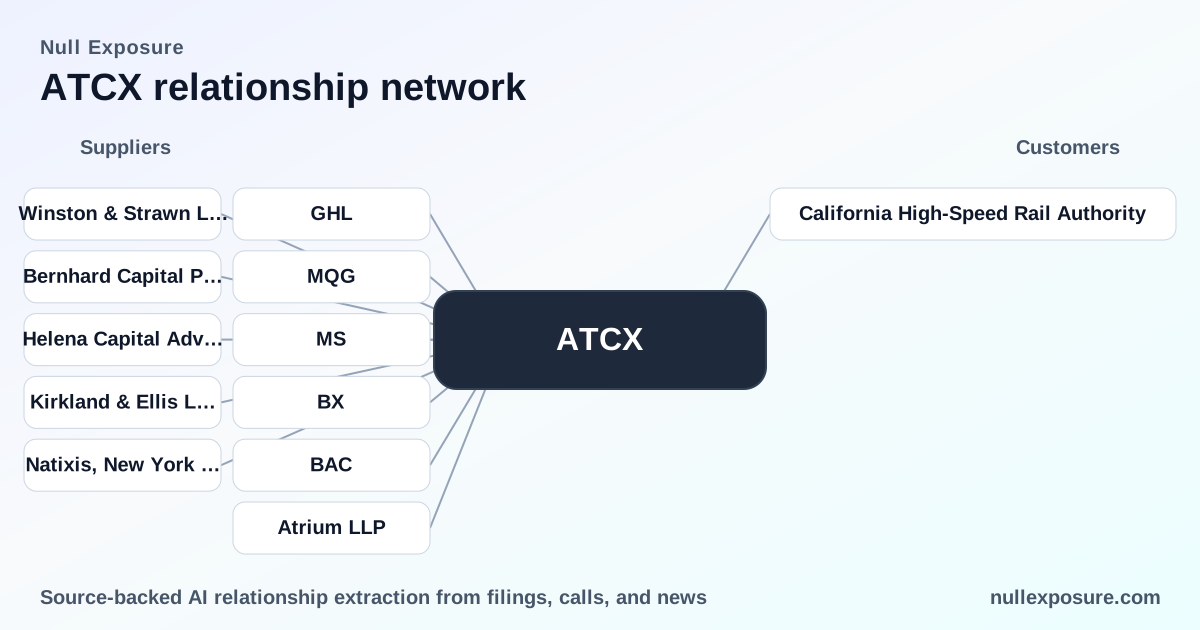
ATCX: How Atlas Technical Consultants monetizes public infrastructure work and what its client list signals to investors
Atlas Technical Consultants (ticker: ATCX) operates as a professional services firm focused on testing, inspection, engineering, program and environmental management for public infrastructure owners. The company monetizes through fee-based project work and multi-year program delivery contracts with government agencies and transit authorities, generating predictable revenue when it secures long-running program management roles and episodic lift when it wins discrete engineering or environmental assignments. For a consolidated view of client intelligence and commercial relationships, visit https://nullexposure.com/.
Why client relationships are the operational spine of ATCX
ATCX’s commercial model is project-driven but program-friendly: a large share of value accrues when the firm converts single projects into enduring program delivery engagements. That commercial posture means three investor-relevant characteristics stand out:
- Contracting posture — bid-to-award, then program scale-up. Public-sector work starts with competitive procurements for discrete assignments; winning authorities often leads to follow-on program management opportunities that scale margins and reduce future bid frequency.
- Concentration and diversification. The client list is concentrated in state-level Departments of Transportation and county agencies, which reduces exposure to pure private cyclical markets but introduces dependence on public budgets and capital programs.
- Criticality and maturity. Services such as grade-crossing engineering, environmental clearances and program delivery are critical to project timelines, positioning ATCX as a retained partner rather than a low-priority vendor. Recognition through engineering awards and joint-venture selections signals operational maturity and credibility in complex delivery environments.
These structural traits drive the investment thesis: value is created when ATCX converts awards into multi-year program roles; downside is tied to public capital cycles and competitive public procurements.
Client roll call: the public agencies and projects that define ATCX’s commercial footprint
Below are the customers surfaced in the available records and the direct citations that support each relationship.
Caltrans
Atlas reported project work that delivered honors at California engineering awards in partnership with Caltrans, highlighting its role on state transportation projects. According to GlobeNewswire releases in February and March 2021, Atlas earned multiple ACEC California Engineering Excellence Awards for projects delivered with Caltrans. (GlobeNewswire, Feb 2, 2021; GlobeNewswire, Mar 16, 2021 — https://www.globenewswire.com/news-release/2021/02/02/2167999/0/en/Atlas-Technical-Consultants-Strengthens-Management-Team.html; https://www.globenewswire.com/news-release/2021/03/16/2193447/0/en/atlas-technical-consultants-appoints-new-chief-diversity-officer.html)
Placer County
Atlas’s client work with Placer County was also highlighted as award-winning, indicating the firm’s footprint in county-level infrastructure and public works. GlobeNewswire documentation from the same 2021 releases notes ACEC awards tied to projects delivered with Placer County alongside Caltrans. (GlobeNewswire, Feb 2, 2021; GlobeNewswire, Mar 16, 2021 — https://www.globenewswire.com/news-release/2021/02/02/2167999/0/en/Atlas-Technical-Consultants-Strengthens-Management-Team.html; https://www.globenewswire.com/news-release/2021/03/16/2193447/0/en/atlas-technical-consultants-appoints-new-chief-diversity-officer.html)
Georgia Department of Transportation (GDOT)
Georgia DOT awarded Atlas a contract for engineering, design and environmental services related to work at grade crossings owned by a Class I railroad, confirming ATCX’s role in rail-adjacent transportation infrastructure and safety-related capital projects. This engagement was reported in Progressive Railroading supplier news covering FY2023. (Progressive Railroading supplier news, FY2023 — https://www.progressiverailroading.com/supplier_spotlight/news/Rail-supplier-news-from-Loram-Atlas-Greenbrier-and-Rail-Vision-Jan-9--68315)
California High-Speed Rail Authority (CAHSR)
Atlas’s joint-venture team was selected to provide program delivery support to the California High‑Speed Rail Authority, signaling capability to participate in multi-billion-dollar, long-duration program delivery structures. The selection was reported in Progressive Railroading supplier news covering FY2023. (Progressive Railroading supplier news, FY2023 — https://www.progressiverailroading.com/supplier_spotlight/news/Rail-supplier-news-from-Trinity-Burns-Atlas-Michael-Baker-RELAM-and-ZEDAS-Jan-6--68302)
What these client ties imply for revenue durability and downside
- Public-sector client mix implies revenue durability but budget sensitivity. State DOTs and county governments provide steady pipelines when capital plans are funded; however, reliance on public capital programs creates exposure to political and budgetary cycles.
- Awards and JV selections drive credibility. ACEC awards and JV wins for program delivery are positive signals of technical competence, improving win rates on large procurements and enabling higher-margin program management roles.
- Concentration risk exists but is asymmetrically favorable. The firm’s client base is focused on a small set of high-value public clients — this increases sensitivity to individual agency funding decisions but concentrates relationship maintenance efforts and reduces overhead of broad commercial sales.
No explicit client-imposed constraints are present in the available records; this absence is a company-level signal that the sourced data did not surface contractual limitations, exclusivity clauses, or similar constraints in the public documents reviewed.
Key investment takeaways and risk checklist
- Positive: Atlas converts technical wins into reputation; joint-venture selection for CAHSR and state DOT work position the firm for multi-year program revenues. Awards boost competitive differentiation.
- Negative: Dependence on public-sector budgets and competitive procurement processes creates episodic revenue risk; winning individual procurements is essential to sustain growth.
- Operational focus: Expect the company to pursue repeatable program-delivery roles that convert one-off project wins into multi-year fee streams and to partner via JVs on very large projects to manage risk and scale.
For investors and operators tracking ATCX’s commercial trajectory, the client list here underscores the firm’s strategic emphasis on state and county transportation work and program delivery roles. To explore deeper client intelligence and comparable relationship mappings, see https://nullexposure.com/.
In sum: ATCX’s client relationships demonstrate a clear public‑sector leaning, operational credibility through awards and JV selections, and a business model that monetizes technical delivery into recurring program work — a profile that favors patience through procurement cycles and attention to agency capital plans as the primary drivers of near-term performance.