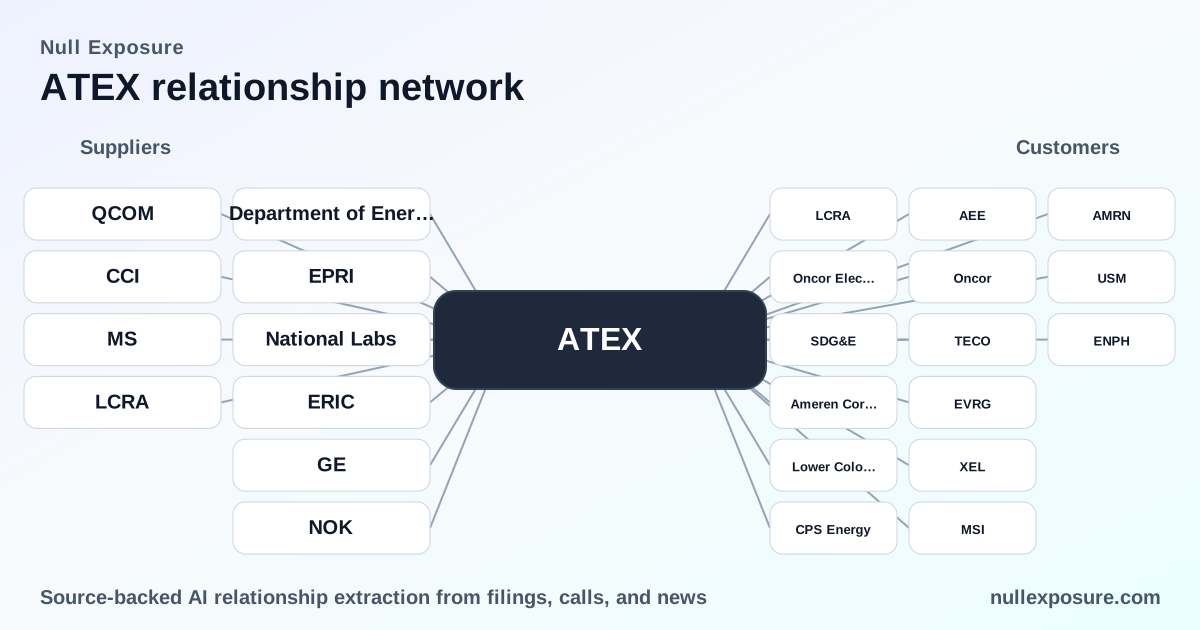
Anterix (ATEX): Customer relationships that underpin the private‑wireless roll‑out
Anterix monetizes by selling and leasing mission‑critical 900 MHz spectrum to utilities and critical infrastructure operators, converting spectrum holdings into long‑dated contracts and milestone payments. Revenue is driven by multi‑year spectrum sales/leases and upfront milestone payments from large utility customers, while the company retains leverage through national spectrum footprint and delivered network rights. For investors evaluating counterparty risk and growth runway, the customer roster is a direct map of where cash lands and where scale in private‑wireless deployments will come from. (See more at https://nullexposure.com/.)
What the customer roster looks like today
Anterix’s disclosed relationships are concentrated among U.S. utilities and a few legacy narrowband partners. Below I catalog each customer relationship disclosed in public filings, earnings calls, and press releases — one short, plain‑English summary per relationship with source attribution.
Lower Colorado River Authority (LCRA)
Anterix transferred broadband licenses covering 60 counties to LCRA for total consideration of $29.3 million and later announced a $13.5 million expansion agreement as an existing customer. (AlphaStreet / Q3 FY2026 reporting; Anterix earnings call Q3 2025.)
Oncor Electric Delivery Company LLC (Oncor)
Oncor is a marquee customer: Anterix executed a large Oncor Agreement covering 95 counties with total estimated consideration of ~$102.5 million and the FY2025 10‑K records a $6.0 million contingent liability change tied to that agreement and transferred broadband licenses. (Anterix FY2025 10‑K; corporate disclosures referencing the Oncor Agreement.)
San Diego Gas & Electric (SDG&E)
Anterix reported a $25.4 million cash inflow from sale of spectrum related to the transfer of San Diego and Imperial County broadband licenses to SDG&E in FY2024. (Anterix FY2025 10‑K.)
Ameren Corporation
Ameren provided $8.5 million in cash proceeds tied to 900 MHz broadband spectrum customer prepayments, with $6.0 million recognized as revenue upon delivery; the 10‑K shows related deferred revenue movements and minor recurring spectrum revenue. (Anterix FY2025 10‑K; Q3 FY2026 commentary.)
CPS Energy
Anterix entered a spectrum sale agreement with CPS Energy for a $13 million contract (50% payable upfront, remainder due at the end of fiscal 2027), enabling a 900 MHz private wireless deployment in Bexar County, Texas. (Anterix press release / GlobeNewswire, Feb 11, 2026.)
Public Utility District No. 1 of Benton County (Benton PUD)
Anterix sold a 10 MHz 900 MHz license to Benton PUD — described as the first private‑wireless deployment among publicly owned utilities in the Pacific Northwest. (Anterix press release / GlobeNewswire, Apr 21, 2026.)
Texas‑New Mexico Power (TNMP)
Anterix announced a spectrum sale agreement with TNMP to bolster grid resiliency with a 900 MHz private wireless platform; reporting and company PR place this transaction in early April 2026. (Anterix press release / GlobeNewswire, Apr 1, 2026.)
NorthWestern Energy
Anterix announced a milestone sale agreement that marks the first planned deployment of Anterix’s 10 MHz broadband configuration in the 900 MHz band with NorthWestern Energy. (Anterix press release Apr 6, 2026; Marketscreener coverage.)
Xcel Energy
Anterix entered a long‑term agreement granting Xcel dedicated usage of 900 MHz broadband spectrum for 20 years across eight states, and Xcel is a visible source of recurring spectrum revenue. (Anterix FY2025 10‑K; Q3 FY2026 revenue commentary.)
Evergy
Evergy is listed among the utility customers contributing spectrum revenue (reported shares in FY2026 reporting), with recurring, modest quarterly revenue noted. (Q3 FY2026 earnings summary / AlphaStreet and TradingView coverage.)
Tampa Electric Company (TECO)
Tampa Electric is recorded as a spectrum customer with small recurring revenue (reported as $78,000 in Q3 FY2026 disclosures). (Q3 FY2026 reporting / AlphaStreet.)
Motorola (MSI) — narrowband legacy customer
Narrowband revenue historically included a small contribution from Motorola; Anterix reports that all revenue under the legacy 2014 Motorola narrowband agreement was fully recognized by Dec. 31, 2024, with limited residual narrowband receipts in FY2026. (TradingView / Bitget summaries of Anterix filings, FY2026.)
Encore
Encore was named in earnings commentary as a counterparty tied to milestone payments and executed spectrum sales during fiscal '25. (Anterix earnings call Q4 2025.)
Amarin (AMRN)
Anterix disclosed milestone proceeds of $8.5 million from Amarin tied to spectrum delivery milestones in fiscal '25 earnings commentary. (Anterix earnings call Q4 2025.)
US Cellular (USM)
Management compared Anterix’s total coverage across contracted utility service areas to be larger than US Cellular, using that scale comparison to illustrate national footprint. (Anterix earnings call Q3 2025.)
Green Grid Inc (active ecosystem partner mention)
Anterix named Green Grid Inc as an Active Ecosystem Partner and listed multiple utilities (Ameren, Evergy, Xcel, TECO, SDG&E, LCRA, Oncor) as current deployers of its spectrum at events and PR. (Columbia Tribune / press coverage of partner program, FY2026.)
What the constraint signals mean for investors
Anterix’s public disclosures and filings produce several structural signals about the operating model that go beyond individual deals.
-
Long‑dated contract posture. Anterix recognizes advanced payments as deferred revenue and states lease terms are “typically 20 to 30 years.” This makes revenue front‑loaded into cash receipts but back‑loaded into recognized revenue and creates long tail visibility for lifetime value. (Company filings, FY2025 10‑K.)
-
Customer concentration, but enterprise quality. Counterparties are predominantly regulated utilities and critical infrastructure operators; this is large‑enterprise counterparty risk, which reduces churn risk but increases procurement complexity. (Company filings and FY2026 PRs.)
-
Geographic concentration: North America only. All assets and revenue derive from the United States (including territories), which simplifies regulatory footprint but exposes the business to U.S. policy and FCC timing. (Company filings, FY2025.)
-
Spectrum is the company’s most valuable asset. Management reiterates spectrum as the primary owned intangible and monetization vehicle — a critical, durable asset class for the company’s business model. (FY2025 10‑K.)
-
Licensor role with Xcel Energy explicitly documented. The 20‑year dedicated usage agreement with Xcel shows Anterix is an actual licensor of long‑term spectrum rights, not a short‑term operator. (Xcel Energy Agreement disclosed in FY2025 10‑K.)
-
Large, single‑deal economics in evidence (Oncor). The Oncor Agreement counts as a >$100 million commercial transaction and is explicitly cited in filings, which signals that single deals can move material cash and contingent liability lines on the balance sheet. (Oncor Agreement disclosure; FY2025 10‑K.)
-
Active delivery and transition stage. Management describes ongoing delivery of cleared 900 MHz spectrum through 2029, with recent transfers and milestone receipts indicating the relationship stage for many customers is operational/active. (FY2025 filings; Q3 FY2026 commentary.)
Investment implications — risks and upside
-
Upside: Large utility deals produce sizable upfront cash and create a network effect as multiple utilities in a region interoperate; recent headlines around CPS Energy, Xcel and Oncor suggest an upsell pathway to larger 5x5 MHz “super pipes.” (FinancialContent / MarketMinute commentary, FY2026.)
-
Risk: Revenue recognition lags cash collection; dependence on a small set of large buyers creates concentration and delivery risk (contract remedies and refund provisions are referenced in customer agreements such as NorthWestern Energy’s). (NorthWestern Energy press reporting, May 2026; Anterix filings.)
-
Balance sheet sensitivity: Large milestone receipts (Encore, Amarin, Oncor) materially move cash and contingent liabilities; monitoring milestone schedules and deferred revenue roll‑forward is essential for near‑term cash visibility. (Anterix earnings calls Q4 2025 / Q3 2025; FY2025 10‑K.)
Bottom line and next steps
Anterix has converted spectrum ownership into repeatable commercial relationships with large U.S. utilities, using long‑term leases and milestone payments to fund deployment and growth. The business is capital efficient at the contract level — large upfront cash, long‑dated revenue recognition — but concentrated in counterparty and geography, which raises execution and delivery risk.
For further, deal‑level intelligence and to track emerging customer announcements, visit Null Exposure for structured monitoring and investor‑grade summaries: https://nullexposure.com/
If you want this customer roster delivered as a one‑page investor brief or integrated into a portfolio monitoring workflow, review our services at https://nullexposure.com/ and request a tailored extract.