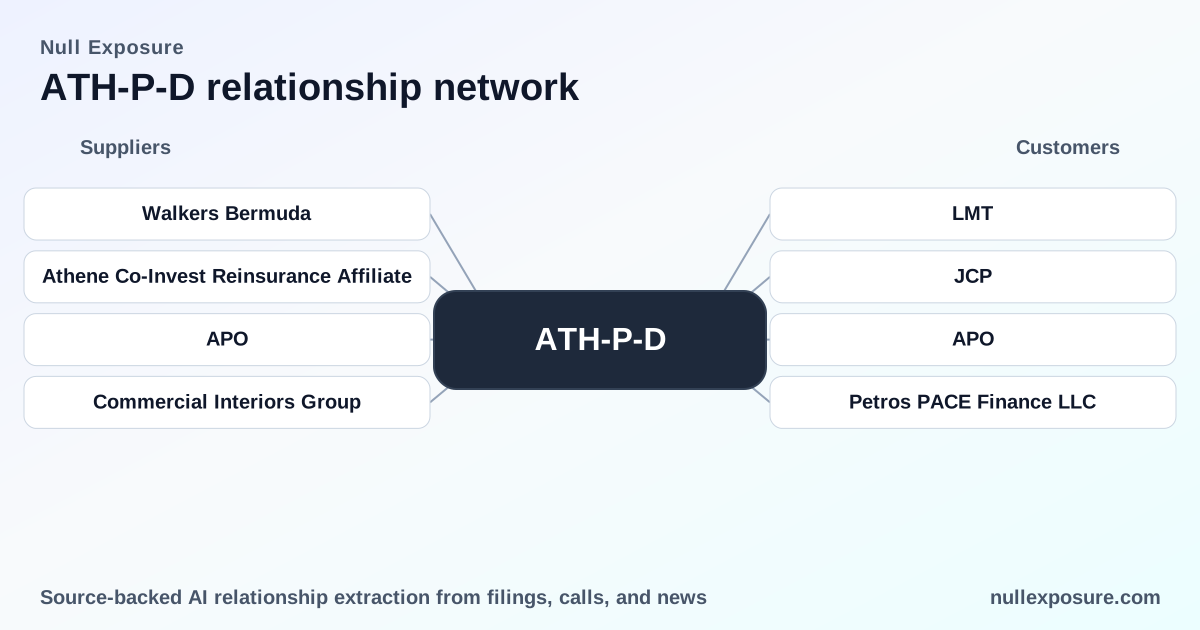
ATH-P-D: Customer signals that reveal capital allocation and counterparty concentration
ATH-P-D is listed as a preferred stock issuance associated with Athenahealth, a cloud-based healthcare software and services provider that monetizes through subscription and transaction-based fees for electronic health records, practice management and network-enabled services. Investors in ATH-P-D should treat the customer feed assembled here as a set of media signals tied to Athene-related capital transactions and annuity counterparties — information that illuminates counterpart concentration, capital deployment strategy, and reputational exposures that affect preferred-income stability and issuer credit perception. For an ongoing view of counterparty and capital relationships, see https://nullexposure.com/.
Why these customer headlines matter to income investors
The itemized relationships in this report are dominated by large pension and annuity transactions and strategic capital partnerships. Those deal types drive long-dated liabilities and recurring cash flows for insurers and capital providers, and they reveal counterparty concentration with large corporate sponsors. For holders of preferred instruments, the practical implications are clear: counterparty credit quality, capital deployment choices, and the maturity profile of liabilities directly influence yield sustainability and downside protection.
- Contracting posture: Athene-style transactions imply a focus on long-duration, contractually predictable payouts (annuity administration and group annuities), signaling a conservative liability match and predictable cash generation.
- Concentration: Several large, named counterparties (Lockheed Martin, JCPenney, LeasePlan/Wheels Donlen) show practice of transacting material pension blocks, implying concentration risk if a small number of sponsors dominate premiums or liability transfers.
- Criticality: These contracts are critical to the issuer’s liability management strategy; loss or renegotiation would materially affect reserve and capital planning.
- Maturity: The relationships reflect established, mature lines of business—pension buy-outs and annuitizations—rather than early-stage commercial relationships.
Relationship-by-relationship readout
Below are the media-sourced customer items from the feed, each summarized in plain English with the original reporting cited.
-
Lockheed Martin Corporation (LMT) — FY2022: Lockheed Martin purchased group annuity contracts that transferred roughly $4.3 billion in gross pension obligations, shifting payment responsibility for a block of retirees to the insurer. Source: Cobb County Courier coverage of Lockheed’s press release (FY2022) — https://cobbcountycourier.com/2022/06/athene-holding-will-pay-and-administer-pensions-for-13600-more-lockheed-martin-retirees-after-sale-of-group-annuity-contracts-to-lm/
-
Lockheed Martin — FY2022 (Reinsurance News): Athene’s subsidiaries Athene Annuity and Life Company (AAIA) and Athene Annuity & Life Assurance Company of New York (AANY) agreed to provide annuity benefits for approximately 13,600 Lockheed Martin pension participants receiving benefits. Source: Reinsurance News (FY2022) — https://www.reinsurancene.ws/athene-secures-4-3bn-pension-deal-with-lockheed-martin/
-
Lockheed Martin (duplicate reporting) — FY2022: The same Lockheed transaction is reflected in a second item in the feed, confirming broad press coverage of the $4.3 billion pension transfer. Source: Cobb County Courier (FY2022) — https://cobbcountycourier.com/2022/06/athene-holding-will-pay-and-administer-pensions-for-13600-more-lockheed-martin-retirees-after-sale-of-group-annuity-contracts-to-lm/
-
Lockheed Martin (duplicate Reinsurance News) — FY2022: The feed repeats the Reinsurance News note that Athene’s subsidiaries will service and pay the annuities for the transferred pension participants. Source: Reinsurance News (FY2022) — https://www.reinsurancene.ws/athene-secures-4-3bn-pension-deal-with-lockheed-martin/
-
JCPenney (JCP) — FY2021: JCPenney transferred approximately $2.8 billion in pension obligations to Athene under a buy-out transaction, removing a material legacy corporate pension liability from its balance sheet. Source: The Royal Gazette report (FY2021) — https://www.royalgazette.com/international-business/business/article/20210413/pension-obligations-of-2-8bn-transferred-to-athene/
-
JCPenney (duplicate entry) — FY2021: A second feed item reiterates that JCPenney moved $2.8 billion of pension obligations to Athene, confirming the size and timing of the buy-out. Source: The Royal Gazette (FY2021) — https://www.royalgazette.com/international-business/business/article/20210413/pension-obligations-of-2-8bn-transferred-to-athene/
-
Wheels Donlen / Athene capital support — FY2022: Reporting noted that Wheels Donlen’s parent will combine with LeasePlan USA, and that Athene’s large asset base positions it to provide deep capital support to the combined fleet-management business. Source: The Royal Gazette coverage of the fleet-unification story (FY2022) — https://www.royalgazette.com/international-business/business/article/20220613/athene-company-in-fleet-unification/
-
Apollo Global Management Inc. (APO) — FY2019: Industry reporting described Athene as an important element in Apollo’s financial ecosystem, allowing Apollo to access “permanent capital” from annuity cashflows for deployment into higher-return credit and private equity strategies. Source: Insurance Journal analysis (FY2019) — https://www.insurancejournal.com/news/international/2019/09/25/541161.htm
-
Apollo Global Management (duplicate) — FY2019: A second item reiterates the strategic financing relationship between Athene and Apollo, highlighting the capital-arbitrage role of annuity assets. Source: Insurance Journal (FY2019) — https://www.insurancejournal.com/news/international/2019/09/25/541161.htm
-
Bermuda College / Athene Life Re donation — FY2025: Athene Life Re, among other Bermuda-based reinsurers, contributed to a $3.8 million donation enabling the construction of a career development centre at Bermuda College, indicating community and jurisdictional engagement by Athene subsidiaries. Source: Bernews coverage of the grand opening (FY2025) — https://bernews.com/2022/04/grand-opening-athene-career-development-centre/
-
Petros PACE Finance LLC — FY2022: A local report quoted Petros saying that with Athene as a capital partner, the company gains access to significant capital to support growth after completing an acquisition. Source: The Royal Gazette (FY2022) — https://www.royalgazette.com/international-business/business/article/20220119/athene-completes-petros-acquisition/
What investors should take from these ties
- Counterparty concentration is material. Large blocks of pension obligations from corporate sponsors like Lockheed and JCPenney demonstrate that Athene-style issuers transact sizeable, long-duration liabilities with a small set of counterparties; that concentration is a double-edged sword for preferred holders—supportive of stable cashflows but a source of exposure if one relationship weakens.
- Business model clarity: annuity economics and capital recycling. The feed reinforces a model where insurers acquire long-duration liabilities and monetize stable cashflows, which can then support strategic investments (as with Apollo affiliations) or direct capital support for portfolio companies.
- Reputational and jurisdictional exposure exists but is manageable. Charitable donations and local investments (Bermuda College, fleet financing) signal community engagement and regulatory footprint; these items are credit-neutral but relevant to long-term franchise valuation.
- Liquidity and maturity profile favor predictability. Pension buy-outs and group annuities create contractual payment obligations with known timing, which is beneficial for preferred security holders who prioritize stable distributions.
For a consolidated portal of counterparty signals and to monitor how these relationships evolve relative to capital and liability metrics, visit https://nullexposure.com/.
Bottom line
The customer signal set here centers on large-scale pension transfers and capital partnerships that define long-duration liability management and capital deployment strategy. For investors in ATH-P-D, the implications are straightforward: prioritize counterparty credit assessment, concentration monitoring, and an understanding of how annuity-derived cashflows are being redeployed by the issuer and its affiliates. These are the primary drivers of preferred-security resilience and downside protection in the issuer’s capital stack.