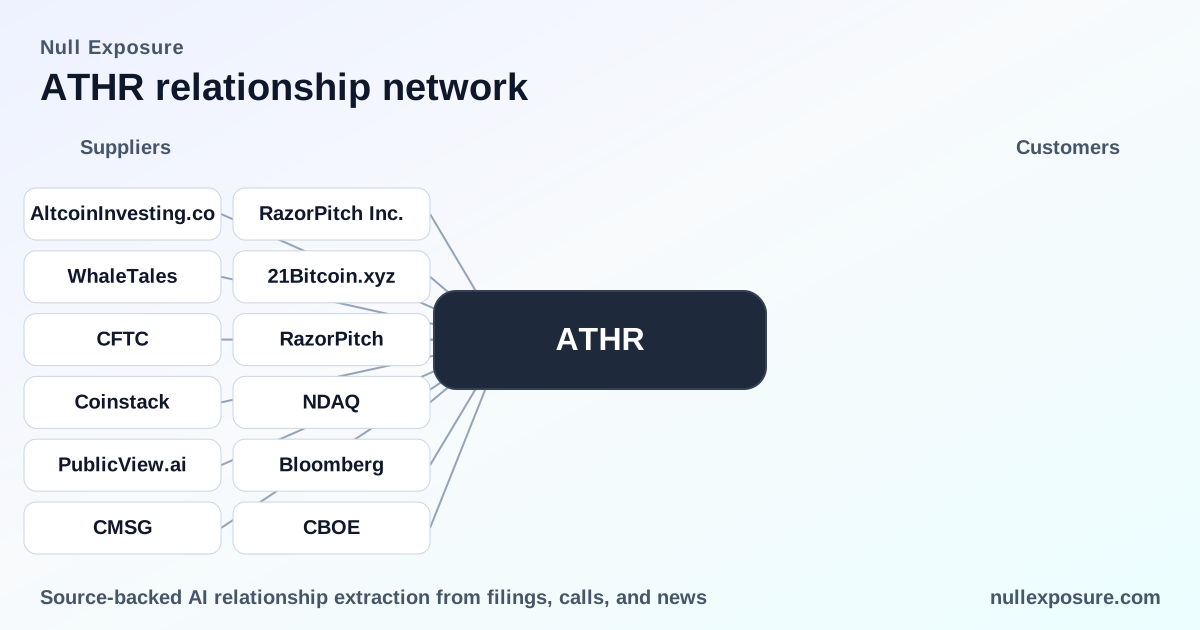
Aether Holdings (ATHR): Customer Relationships and Commercial Signals — What Investors Need to Know
Aether Holdings operates a subscription-driven cloud analytics and research platform that monetizes through recurring paid packages and content distribution services to retail and institutional users. Revenue is generated primarily from short-term subscription contracts (one month to one year) for cloud-based software and newsletter products, while the company also supplies analytics and distribution infrastructure to third‑party publishers. For a structured view of Aether’s customer relationships and operating constraints, continue reading or see broader coverage at https://nullexposure.com/.
Quick commercial snapshot investors will use in modeling
Aether is a small, early‑stage commercial operator. Latest reported figures (quarter ending 2025-12-31) show trailing revenue of $1.365M and gross profit of $1.0028M, against an operating margin that is negative (OperatingMarginTTM: -3.924). Market capitalization is roughly $49.67M, with insider ownership high at 66.1% and institutional ownership at ~1.0%. These are the baseline metrics that anchor customer-level value and downside risk.
How the company sells and where value is created
Aether’s go-to-market is subscription-first, offering both free and paid tiers of its research platforms and newsletters. Revenue recognition is ratable over the term of each subscription, reflecting a services/software hybrid model where recurring payments fund content, analytics, and platform hosting. The business combines:
- Software-as-a-Service distribution (cloud access to analytics);
- Content and newsletter monetization (paid subscriptions and third‑party publishing partnerships);
- Technology and analytics licensing to publishing partners (white‑label or infrastructure support).
This operating model implies predictable short-term cash flows, but also sensitivity to churn because most contracts are short-term. Geographically the business is concentrated in the United States, which centralizes market risk but simplifies go-to-market execution.
Customer relationships in the record — what each link means
The dataset lists two media reports tying Aether’s technology into a third‑party publisher relationship with Coinstack; both items reference FY2026 developments.
Coinstack — Intellectia news item (FY2026)
According to an Intellectia news item published May 2, 2026, Coinstack will continue to operate under its existing brand while leveraging Aether’s technology and analytics infrastructure to improve content integration and audience insights, which is positioned to boost investor engagement. This is framed as a technology-and-distribution arrangement rather than an acquisition of the underlying Coinstack brand.
Coinstack — CityBiz report on Alpha Edge Media transaction (FY2026)
CityBiz reported on May 2, 2026 that following Alpha Edge Media’s acquisition of Coinstack, Coinstack will remain branded separately but will benefit from Aether’s analytics, technology stack, and distribution capabilities, implying a commercial services relationship where Aether supplies backend capabilities to content owners. Both reports underline the same operational theme: Aether as an analytics and distribution enabler for financial publishers.
Takeaway: Both items describe the same customer relationship in FY2026: Aether is being used as the technology and analytics backbone for an acquired crypto-news publisher, increasing Aether’s distribution footprint without absorbing editorial assets.
Operating constraints and what they imply for customers and cash flows
Use these company-level signals to assess concentration, contract risk, and service criticality.
- Contracting posture — short-term, subscription-based: Subscription agreements typically run from one month to one year, implying lower customer lock-in and revenue that is recognized ratably. This structure supports flexible pricing and quick scaling but increases churn risk and requires ongoing content/feature investment to retain users.
- Counterparty mix — retail-first with some enterprise demand: Evidence shows products target individual retail traders and investors, while select offerings (e.g., DataEdge API references) are positioned for hedge funds and advisory firms. That dual approach diversifies demand but requires separate feature sets and support models.
- Geographic concentration — North America only: The company reports 100% of revenue and non-current assets in the United States, concentrating regulatory and market risk domestically but simplifying go-to-market execution.
- Materiality and concentration — customer base is not dependent on a single key user: Filings state Aether is not dependent on any single large customer or government agency, which reduces single-counterparty concentration risk.
- Role and stage — seller and service provider; relationships active: The company functions as both vendor of subscription products and technology provider to publishers, with active engagement channels such as daily/weekly emails to subscribers — an operational posture that supports recurring engagement but requires steady content cadence.
- Business segments — software + services: Revenue lines combine cloud software subscriptions and subscription-based services (newsletters, research), producing a hybrid margin profile.
What Coinstack means strategically and for valuation
The Coinstack engagements are distribution and capability multipliers rather than material revenue book transfers. For investors:
- Strategic upside: Partnerships with niche publishers expand Aether’s reach into vertical audiences and create cross-sell opportunities for premium subscriptions. That supports revenue growth without commensurate CAPEX.
- Earnings impact: Given Aether’s small absolute revenue base ($1.365M TTM), these publisher relationships are unlikely to be materially dilutive or immediately transformative to reported revenue but are strategically important for audience acquisition and product validation.
- Risk profile: The short-term subscription model keeps revenue flexible but increases sensitivity to content quality and distribution effectiveness; publisher partnerships mitigate customer acquisition cost if the publisher retains its audience.
For detailed customer analytics and comparative relationship intelligence, visit https://nullexposure.com/.
Bottom line — investor-oriented takeaways
- Aether is a subscription-led, US-centric fintech/content platform that also operates as a technology provider to publishers.
- Contract terms are short, which supports fast ramp but elevates churn risk; management must demonstrate retention and up-sell capability to convert distribution partnerships into durable revenue.
- Coinstack engagements (FY2026) are distribution/technology arrangements that expand reach without absorbing editorial assets; these are strategically positive but not yet material to top-line figures.
- High insider ownership and low institutional ownership indicate founder control and limited external institutional validation; investors should track future institutional uptake as a governance and liquidity signal.
For a deeper read on Aether’s customer map and comparable commercial relationships, see https://nullexposure.com/.